

Skip to main content Skip to search
info@irs-audit-group.com   
468 N Camden Dr, Beverly Hills, CA 90210 | 2901 West Coast Hwy, Suite 200, Newport Beach, CA 92663

Request a free Consultation

    Mon - Sat: 8:00 -21:00
    + 888 300 6670
    info@IRS-Audit-Group.com

    IRA tax

    Changes on tax filings and credits_Blog

    Find Changes to Tax Filings and Credits for Tax Season 2024 – Top Five Changes for The Tax Year 2023

    IRS and Regulatory bodies update tax laws and regulations yearly. It is crucial to stay updated about the modifications that could affect your tax return and eligibility for tax credits as you gear up for the upcoming tax season 2024. Below are a few significant updates all taxpayers need to know.


    Change in Standard Deductions

    The standard deduction has been increased for the tax season 2024, which benefits all taxpayers. The revised deduction levels are as follows:

    • $13,850 for single filers or married individuals filing separately,
    • $20,800 for heads of households, and
    • $27,700 for married couples filing jointly or qualified surviving spouses.

    These changes are intended to give taxpayers improved tax savings and lower taxable income, thereby alleviating their financial burden.


    Increased Additional Childcare Credit

    The amount of the Additional Child Tax Credit (ACTC) has been raised. Now, the maximum additional child tax credit amount has been increased to $1,600 for every qualifying child.

    The modifications made to the Child Tax Credit (CTC) under the American Rescue Plan Act of 2021 have now lapsed, signaling the end of those changes. Despite this, the IRS is actively keeping an eye on any new legislation related to the CTC that may be passed by Congress. The IRS is advising taxpayers who qualify for the Child Tax Credit not to delay filing their 2023 tax returns during this tax season 2024. If Congress alters the guidelines for the CTC, the IRS will automatically adjust the credits for individuals who have already submitted their tax returns, eliminating the need for any further action on the part of eligible taxpayers. Under the current law, the following conditions are applicable for the tax year 2023:

    • The expanded tax credit for qualifying children under the age of 6 and the age of 18 is no longer in effect. For tax season 2024, the base amount of the CTC is set at $2,000 per qualifying child.
    • The CTC begins to phase out for taxpayers with an Adjusted Gross Income (AGI) above $200,000 ($400,000 for joint filers).
    • The refundable portion of the CTC remains limited, similar to the rules in 2020, with the ACTC maximum amount per qualifying child now increased to $1,500.


    Changes to the Earned Income Tax Credit (EITC)

    The provisions for taxpayers who do not have a qualifying child, as established by the American Rescue Plan Act of 2021, will not be in effect for the tax year 2023. To be eligible for the EITC without a qualifying child in 2023, taxpayers need to meet the age requirement of being at least 25 years old but under 65 years old by the end of 2023. For married taxpayers who are filing a joint return, at least one spouse must meet the age criteria of being at least 25 years old but under 65 years old by the end of 2023 to claim the EITC without a qualifying child. These age restrictions are put in place to ensure that taxpayers who are seeking this credit without a qualifying child meet certain age qualifications as outlined in the legislation. Taxpayers can find out if they are eligible to claim EITC through this official IRS link.


    New Clean Vehicle Credit

    The Clean Vehicle Credit, formerly known as the credit for new qualified plug-in electric drive motor vehicles, has changed in the tax season 2024. These changes include modifications to the maximum credit amount and the requirements for claiming the credit. Taxpayers may qualify for a credit of up to $7,500 for vehicles bought in the tax year 2023. For vehicles purchased before 2023, tax credits are calculated differently. Taxpayers can check for eligibility and corresponding tax credits here. To report the credit, taxpayers should use Form 8936, Qualified Plug-In Electric Drive Motor Vehicle Credit, and Form 1040, Schedule 3.


    Health Savings Account (HSA) Limits

    The contribution limits for HSAs have been raised for tax season 2024, benefiting those with high-deductible health plans. Individuals can contribute up to $4,150 in 2024, up $300 from 2023. The family contribution amount for 2024 rose to $8,300, a $550 increase compared with 2023. This increase allows individuals to save for medical expenses with tax advantages.


    IRS Audit Group

    IRS Audit Group consists of tax professionals, CPAs, enrolled agents, and tax attorneys.  We are located in Los Angeles; California and our primary area of expertise is IRS Tax Audit Representation.  However, our certified professionals cooperate and work with all IRS offices across the country.  Please contact us for more information.  https://irsauditgroup.com/contact/

    Telephone Number: (310) 498-7508

    info@irs-audit-group.com

    Read more
    IRS blog on tax relief and Filing Extension

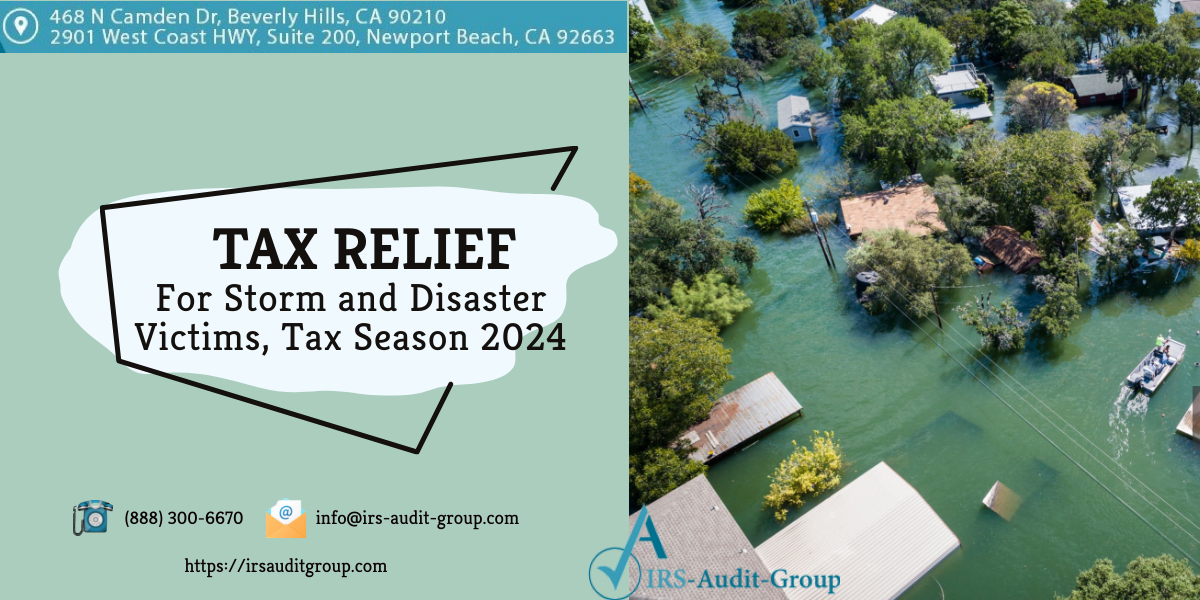
    How to Claim Tax Relief Measures in Tax Season 2024 for the Storm and Disaster Victims in Federally Declared Disaster Areas

    Every year, based on the Federal Emergency Management Agency’s (FEMA) federally declared disaster areas, the IRS will implement administrative disaster tax relief measures. For the Tax Season 2024, the IRS made special tax law provisions to provide affected individuals and businesses with additional time to file returns, pay taxes, and complete other time-sensitive tasks. This assistance is specifically tailored for taxpayers who are affected by a disaster declared at the federal level, guaranteeing that they receive essential assistance during difficult circumstances. It is important to note that certain conditions may need to be met in order to qualify for the tax relief and provisions offered by the IRS. By following the established procedures and guidelines, disaster victims can benefit from the assistance provided by the government to alleviate the financial burden caused by the disaster.


    The relief for the tax season 2024 extends the deadlines for filing and paying taxes that fell between Sept. 10, 2023, and June 17, 2024. This means that individuals and businesses affected in the disaster regions will now have until June 17, 2024, to submit their returns and settle any outstanding taxes from this period.


    Who Qualifies for the Extension in Tax Season 2024?

    In order to be eligible for an extension on filing your taxes, it is required that you are a resident or business situated in a region identified by the Federal Emergency Management Agency (FEMA) as a federally declared disaster area. This encompasses not only the main area impacted by the disaster but also the surrounding areas that have been affected.


    Furthermore, the IRS is prepared to collaborate with any taxpayer residing outside the disaster zone but whose essential records are required to comply with a deadline falling within the extension period are situated in the impacted region. Taxpayers eligible for assistance and residing beyond the disaster zone must reach out to the IRS at 866-562-5227 for further guidance and support. This provision also encompasses individuals who participated in relief efforts and are associated with a reputable governmental or charitable institution.


    What is included in the Extension?

    Extension generally encompasses a range of tax deadlines, which can include filing income tax returns, making quarterly estimated income tax payments, and submitting different business tax returns. Additionally, extension can be utilized for other tax-related tasks, like requesting an extension for an individual tax return or making contributions to an IRA. The June 17, 2024, deadline will now apply to the following activities.

    • Individual income tax returns and payments normally due on April 15, 2024.
    • 2023 contributions to IRAs and health savings accounts for eligible taxpayers.
    • 2023 quarterly estimated income tax payments normally due on Sept. 15, 2023, and Jan. 16, 2024.
    • Quarterly payroll and excise tax returns normally due on Oct. 31, 2023, and Jan. 31 and April 30, 2024.
    • Calendar-year partnership and S corporation returns normally due on March 15, 2024.
    • Calendar-year corporation and fiduciary returns and payments normally due on April 15, 2024.
    • Calendar-year tax-exempt organization returns normally due on May 15, 2024.


    How to Claim the Extension?

    Taxpayers residing in a federally declared disaster area who qualify for the extension do not have to take any action to receive it. The IRS will recognize individuals located in the designated disaster zone and grant them an extension on their tax deadlines without requiring any additional steps. In the event that you receive a penalty notification from the IRS due to late filing or payment of taxes, you have the option to contact the phone number provided on the notice to request a waiver of the penalty.


    The tax relief measures have been implemented as a component of a well-coordinated federal initiative aimed at addressing the extensive harm inflicted by these calamities. These measures have been devised after careful evaluation of the local damage assessments conducted by FEMA, ensuring that the relief efforts are targeted toward the areas most affected by the disasters.


    IRS Audit Group

    IRS Audit Group consists of tax professionals, CPAs, enrolled agents, and tax attorneys.  We are located in Los Angeles; California and our primary area of expertise is IRS Tax Audit Representation.  However, our certified professionals cooperate and work with all IRS offices across the country.  Please contact us for more information.  https://irsauditgroup.com/contact/

    Telephone Number: (310) 498-7508

    info@irs-audit-group.com
    Read more
    AFV Credit Blog

    Tax Season 2024 – Business Credit for Alternative Fuel Vehicle Refueling Property

    What is the Credit?

    Alternative Fuel Vehicle (AFV) Refueling Property credit is the credit given to taxpayers under section 30C credit. The taxpayers must have installed and utilized a certified vehicle refueling and recharging station at their residential or commercial properties in the tax year 2023 per the detailed eligibility criteria.


    Eligibility Criteria

    The criteria to qualify for the AFV Refueling Property credit is to have a property that must either store or dispense clean-burning fuel or recharge electric motor vehicles. Along with that:

    • The property must be placed in service during the tax year 2023.
    • The property should have an original use that began with the taxpayer.
    • The property must be used primarily in the U.S. and U.S. territories.
    • The installation must be either on business property or a main home.

    To be eligible, all qualified fueling equipment also must be installed in a population census tract that is a low-income community or not an urban area.


    How Much is the Credit for the Tax Season 2024?

    The credit for qualified refueling property as of January 1, 2023, is as follows:

    • 6% credit with a maximum credit of $100,000 for each single item of property, for properties that are subject to depreciation.
    • 30% credit with $100,000 limit, for businesses that meet the prevailing wage and apprenticeship requirements.
    • 30% of the cost with a maximum credit of $1,000 per item, for the qualifying properties that are not subject to depreciation.
    • 30% of the cost of qualified property with a maximum total credit allowed of $30,000 per location for depreciable property and $1,000 per location for all the qualifying properties (including personal property) that is being placed in service before January 1, 2023.


    What are the Key Changes in Tax Season 2024?

    According to Notice 2024-20, the property placed in service as of Jan 1, 2022, to Dec 31, 2032, must follow the below qualifications, credits, and transfer options:

    1. Modification of Section 30C Credit Limitation:
      • The IRS adjusted the limitation on the 30C credit, changing it from being based on the location of the property to being based on every single item of qualified AFV refueling property.
      • For depreciable property, the credit is limited to $100,000 per item. For non-depreciable property, the limit is $1,000 per item.
    2. Requirement for Eligible Census Tract:
      • The IRS introduced a requirement that qualified alternative fuel vehicle refueling property must be placed in service in an “eligible census tract”.
      • Eligible census tracts are defined as low-income communities or areas that are not urban.
      • To know if the property is eligible the taxpayers must determine the GEOID (an 11-digit ID) of the property and crosscheck with the GEOID in appendix A and B of the notice. If the property’s GEOID is listed in the notice, then the property is eligible for credit.
      • To help determine if an installation location is in a qualified census tract, please see Argonne National Laboratory’s 30C Tax Credit Eligibility Locator tool and list of frequently asked questions.
    3. Clarification on Property Eligibility:
      • The IRS clarified that the property will still be considered qualified AFV refueling property even if it can charge and discharge electricity from a vehicle battery to an external load.
    4. Modification of Qualified Property Definition:
      • The definition of qualified AFV refueling property was amended to include depreciable property designed specifically to charge two- and three-wheeled electric vehicles primarily used on public streets, roads, or highways.
    5. Adjustment of Credit Amount:
      • The IRS reduced the credit amount for depreciable qualified alternative fuel vehicle refueling property from 30% to 6%.
      • An enhanced credit amount is provided for such property that is part of a qualified alternative fuel vehicle refueling project meeting certain criteria.
    6. Option for Applicable Entity Election:
      • Applicable entities, defined in section 6417(d)(1)(A), can choose to make an election under section 6417 to treat the credit amount as a payment against the tax imposed by the Code.
      • The amount of the section 30C credit, if treated as a general business credit under section 38, is considered an applicable credit.
    7. Transfer Option for Eligible Taxpayers:
      • Eligible taxpayers can opt to transfer all or a portion of their section 30C credit determined for any taxable year to an unrelated taxpayer by making an election under section 6418.


    How to Claim the Credit?

    Partners and S corporations having AFV Refueling Property placed in service during the tax year 2023, can be reported and claimed by filling the Form 8911 (PDF), for more instructions visit https://www.irs.gov/pub/irs-pdf/i8911.pdf. Other taxpayers can report the credit directly online 1s of part III of Form 3800(PDF) which is general business credit, for more instructions visit https://www.irs.gov/instructions/i3800.


    IRS Audit Group

    IRS Audit Group consists of tax professionals, CPAs, enrolled agents, and tax attorneys.  We are located in Los Angeles; California and our primary area of expertise is IRS Tax Audit Representation.  However, our certified professionals cooperate and work with all IRS offices nationwide.  Please contact us for more information.  https://irsauditgroup.com/contact/

    Telephone Number: (310) 498-7508

    info@irs-audit-group.com

    Read more
    How to Handle a Dispute with the IRS

    Mistakes in Tax Refunds or Tax Due – How to Handle a Dispute with the IRS? Appeals and Litigation Options

    The deadline for Tax Season 2023 for individuals is over, and those who filed for refunds will be receiving the same within 21 days from the filing date.  But, If the taxpayers have received a notice from the IRS that their taxes are incorrect or that they owe money, they can either pay or dispute if IRS is wrong. There are options available to resolve such disputes. The IRS dispute process is an essential part of the tax system, but it can be complicated and intimidating. Managing a dispute with IRS can be a complex and compelling process for taxpayers. Following are the steps to manage a dispute with the IRS. The first step in managing an IRS dispute is understanding how the process works, and what options are available for appealing or litigating the issue at hand.

    Understanding the IRS Dispute Process

    The IRS dispute procedure consists of numerous steps. Taxpayers can file a dispute if they disagree with the amount of tax they are required to pay or believe the IRS made a mistake in their tax return. If there are any changes that would affect their refund or balance payable, the first step is to file Form 1040X. Taxpayers can submit Form 9465, Form 8857, or Form 843 with the required supporting paperwork if there are no changes. These forms include Instalments Agreement Request, Request for Innocent Spouse Relief, and Claim for Refund and Request for Abatement, respectively. Ensure that taxpayers submit all required forms and documents to initiate the dispute process.

    If there is no communication from the IRS regarding the dispute after 90 days from the filing, it is time to move forward with appealing their decision. To do so, follow these steps:

    Appealing IRS decision

    Taxpayers have the right to appeal an IRS decision, and taxpayers have the right to use the two-step appeals process which involves an administrative appeal. Taxpayers need to submit a written request for reconsideration to the office that made the initial decision within 60 days of receiving a letter of disallowance. This can be done by letter, fax, or online at www.irs.gov/appeals. Taxpayers can request Form 12356-A, which offers guidance on how to complete and submit the appeals with necessary supporting evidence. This phase of the investigation aims to identify why the IRS took certain actions, such as reducing refunds.

    Litigating IRS Dispute

    Taxpayers need to take legal action if they are unable to resolve their dispute with the IRS. The IRS offers several options for litigating disputes that include.

    • Filing a lawsuit against the IRS in court. If a taxpayer has a valid reason for disputing an assessment or collection activity, they can file suit against the IRS in federal court or state court if applicable. Throughout this process, they need a tax attorney who specializes in tax law to represent them.
    • Requesting a management hearing with the Appeals Office Reviewer (AOR) is another option when appealing an IRS decision. AOR evaluation from the relevant evidence before determining whether to grant relief or not. This step does not guarantee relief, but it’s usually the first taken in appeals.

    The IRS dispute process can be confusing, but it’s important to know taxpayers’ options. It is important to understand the steps included and the options available to taxpayers for resolving the issue. This may include communications with IRS and providing additional information to support their position, requesting an appeals conference with an independent appeals officer, or considering mediation. In some cases, litigation may be necessary. Therefore, seeking tax professional advice and guidance throughout the process can help ensure that taxpayer’s rights are protected and they’re able to achieve the best possible outcome. IRS Audit Group is a tax audit representation company that helps taxpayers navigate such time-consuming dispute processes. Contact us for a free consultation. https://irsauditgroup.com/contact/

    Telephone Number: (310) 498-7508

    info@irs-audit-group.com

    Read more
    Missed Your Tax Season filing

    Missed Your Tax Season 2023 Deadline? Find Out Your Options to Pay Taxes, if any.

    Tax season can be a stressful time for those who run behind the filing schedule. Taxpayers who aren’t able to file their returns for tax season 2023 by April 18, 2023, deadline, can request an extension. Filing an extension will give an additional six months to file taxes. However, it is important to note that an extension does not give taxpayers extra time to pay any taxes owed. Taxpayers need to pay their federal income tax due by April 18, 2023, to avoid interest and penalties.

    If you have missed paying the taxes and/or failure to file an extension before the deadline, the following options are the next actions available now.

    Option 1: Pay Taxes as Soon as Possible.

    If one owes taxes, it is important to pay them as soon as possible. If you are unable to pay the full amount, then can still make a partial payment to reduce the amount of interest and penalties. Taxpayers can make a payment online using the IRS Direct Pay system, which allows individuals to pay directly from their bank account. Taxpayers can also pay by credit or with a debit card, with certain additional fees associated with this method.

    Option 2: Set Up a Payment Plan

    The IRS gives an option for taxpayers who cannot pay the full amount owed all at once. They can set up a payment plan with the IRS. This will allow taxpayers to make monthly payments until the balance amount is paid in full. To set up a payment plan, an individual needs to fill out Form 9465.

    There are two types of payment plans available: short-term and long-term. A short-term payment plan allows payment of the balance in full within 120 days. No extra fee associated with this plan, but interest and penalties will continue to accrue until the balance is paid in full. A long-term payment plan allows payment of a balance over a period of several months or years. There is a fee associated with this plan, and interest and penalties will continue to accrue until the balance is paid in full.

    Option 3: Offer in Compromise

    If the taxpayer is unable to pay the full amount owed and can’t set up a payment plan, they are eligible for an Offer in Compromise. This is an agreement between the taxpayer and the IRS to settle the debt for less than the full amount owed. To be eligible for an Offer of Compromise, one needs to demonstrate that paying the full amount owed would cause financial hardship. And also need to provide detailed financial information, including their income, expenses, assets, and liabilities. To apply for an Offer in Compromise, the individual needs to fill out Form 656. It is important to note that an Offer in Compromise is not guaranteed, and the IRS will carefully review the individual’s financial information before making a decision.

    In case an individual has missed the tax season 2023 deadline and owes taxes; it is important to act as soon as possible. Filing an extension, paying taxes as soon as possible, setting up a payment plan, or exploring an Offer in Compromise are all options to consider. Be sure to consult with a tax professional to determine the best course of action for the specific situation.


    IRS Audit Group is Los Angeles-based company that offers tax audit representation services to individuals and businesses facing IRS audits or disputes. The company’s team consists of CPAs, tax attorneys, and enrolled agents who have experience working on both sides of tax disputes. If you receive any mail from IRS regarding a tax audit, don’t panic and don’t delay, contact a tax professional who is experienced in handling IRS audits by us. Contact us for a free consultation on understanding your tax situation.

    https://irsauditgroup.com/contact/

    Telephone Number: (310) 498-7508

    info@irs-audit-group.com

    Read more
    Tax Refunds Deadline

    Have You Claimed Your Refunds for the Tax Year 2019? IRS Set Tax Season 2023 as Deadline to Claim the Refunds

    The Internal Revenue Service (IRS) has recently announced that around 1.5 million people across the country have not yet claimed their refunds for the tax year 2019. However, the deadline to file the returns is July 17, 2023, which is three years after the usual deadline. Due to the COVID-19 pandemic crisis, the IRS deferred the deadline for 2019 unfiled returns. The average median refund for 2019 is $893, and the IRS has estimated that $1.5 billion in refunds are still unclaimed.

    Many taxpayers may have forgotten or ignored their tax refunds since 2019 due to the pandemic. To prevent losing out on the opportunity, taxpayers need to submit their refund requests prior to the deadline. Typically, individuals have three years to file their tax returns and request any refunds.

    While many people would have missed out on filing their tax returns due to the unusual situation caused by the pandemic, some stand to lose more than just their refund of taxes withheld or paid during 2019. Earned Income Tax benefit (EITC) is a tax benefit that many low – and moderate-income employees are eligible for. The credit’s maximum value for 2019 was $6,557. The EITC provides assistance when an individual or family’s income is below a specific threshold. Those who qualified for the EITC in 2019 had incomes below particular thresholds, based on the number of qualifying children.

    Taxpayers requesting a 2019 tax refund should also be aware that their checks will be held if they fail to file tax returns for 2020 and 2021. Additionally, the refund will be applied to any amounts still owed to the IRS or a state tax agency and may be used to offset unpaid child support or past-due federal debts, such as student loans.

    Where To Obtain Essential Documents for Filing 2019 Tax Return?

    Even though the tax year was three years ago, the IRS has offered taxpayers several ways to access the data they need to submit their 2019 tax forms. To ensure taxpayers have enough time to file before the deadline, IRS advises people to get started as soon as possible. One approach is to ask their employer, bank, or other payers for copies of important records like Forms W-2, 1098, 1099, or 5498. Another choice is to order a free wage and income transcript via Get Transcript Online at IRS.gov. For many taxpayers, this instrument is by far the quickest and easiest choice. As an alternative, individuals can submit Form 4506-T to the IRS to obtain a “wage and income transcript.” However, it is essential to plan since written requests can take several weeks.


    Depending on a household’s tax circumstances, the actual refund amount can change. Therefore, to avoid missing the deadline, taxpayers are urged to review their records and start gathering documentation.

    IRS Audit Group is a tax audit representation firm located in Los Angeles, California. If the IRS requires more information to validate your tax return filing, they may ask for it, and in rare cases, they may initiate a tax audit via mail notice. In such situations, it is crucial to have the assistance of a licensed tax professional like the ones at IRS Audit Group. IRS Audit Group is comprised of qualified CPAs and IRS Enrolled Agents. They can analyze your tax situation and help alleviate the burden of dealing with an IRS audit. Having proper representation in an IRS audit is essential, and the IRS Audit Group can provide the necessary support to navigate the process successfully. To learn more about our services, visit the website and contact us for further information.

    https://irsauditgroup.com/contact/

    Telephone Number: (310) 498-7508

    info@irs-audit-group.com
     

    Read more
    IRS Warns of a New Scams for This Tax Season

    IRS Warns of a New Scams for This Tax Season 2023 That Is Aimed At Falsely Inflating Tax Refunds

    The Internal Revenue Service (IRS) has issued warnings of new scams that urge taxpayers to use wage information on a tax return to claim false credits in hopes of getting a big refund. The new scheme circulating on social media encourages people to use tax software to fill out a Form W-2 to include false information. Scam artists encourage taxpayers to make up numbers showing large amounts of income and related withholding. Then, the scammers suggest simply e-file a bogus tax return to snag a large refund due to the amount of fake withholding. This deliberate misinformation about inflated income is used to take advantage of refundable tax credits.

    Scam Variations

    Two variations of this scheme are also being seen by the IRS; both involve misusing Form W-2 wage information in hopes of generating a larger refund.

    • One variation involves scammers suggesting taxpayers file Form 7202, Credits for Sick Leave and Family Leave for Certain Self-Employed Individuals, to apply for a credit based on earnings made as an employee rather than a self-employed individual. These credit dates to the pandemic period for 2020 and 2021 and can’t be accessible for 2022 tax returns.
    • Another variation of this scam involves taxpayers making up fictional employees that they claim are employed in their household and using Schedule H, Household Employment Taxes. Then, taxpayers file for a refund based on false sick and family wages they never paid in the first place.

    Many such scams, where taxpayers suggesting to claim huge refunds by filing the tax return electronically in hopes of getting a substantial refund.

    Vigilance

    The IRS reminds taxpayers that they are actively watching for this scheme and others along with the Security Summit partners in the tax industry and the states. In addition, the IRS works with payroll companies and large employers—as well as the Social Security Administration—to verify Form W-2 information.

    Penalties

    Falling for such scams unknowingly or deliberately for getting viral on social media will be subject to a wide range of penalties. This may include a frivolous return penalty of $5,000. Filers also run the risk of criminal prosecution for filing a false tax return.


    What To Do?

    Seek out tax advice from credible sources, including the IRS website, and consult trusted tax professionals. Ignore advice from viral reels and videos that sounds too good to be true. And please do not share such contents which misguides other taxpayers. For anyone who has participated in one of these schemes, there are several options that the IRS recommends. People can amend a previous tax return or consult with a trusted tax professional.


    IRS Audit Group is a tax audit representation firm from Los Angeles, California. The company employs a team of certified tax lawyers who possess expertise in both state and federal tax audits. Irrespective of the client’s location, these tax professionals can evaluate your audit situation and represent you before the IRS to secure a favorable outcome for the client. Please contact us for more information. https://irsauditgroup.com/contact/

    Telephone Number: (310) 498-7508

    info@irs-audit-group.com
    Read more
    Tax Deadlines for Disaster Affected Areas of California, Alabama, and Georgia

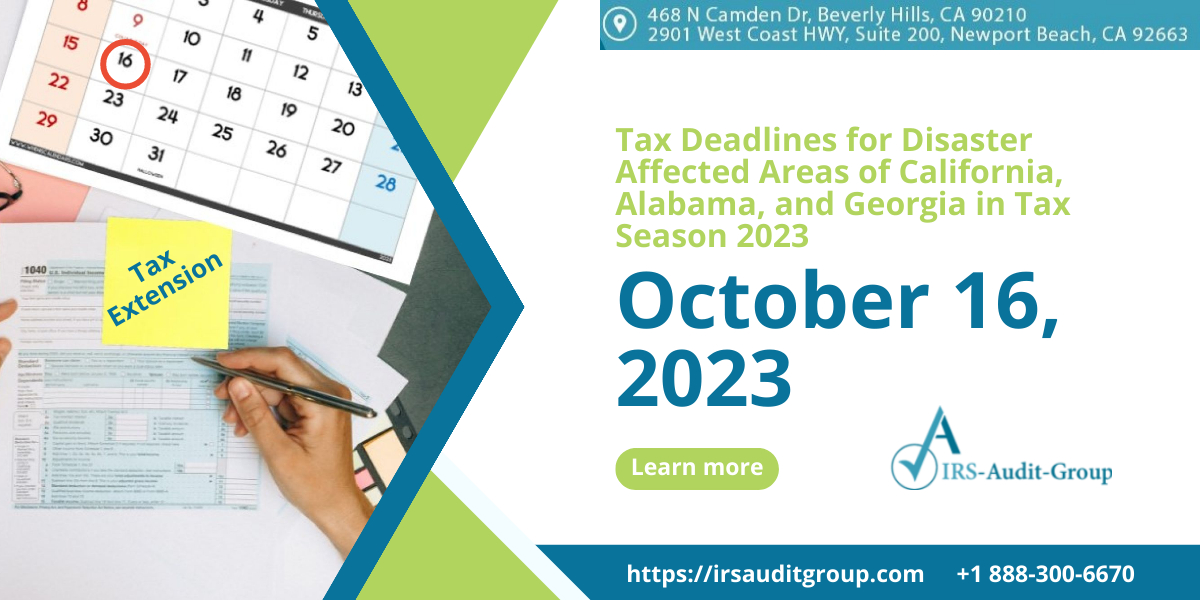
    IRS Extends Again the Tax Deadlines for Disaster Affected Areas of California, Alabama, and Georgia in Tax Season 2023

    Taxpayers from disaster areas in most of California and parts of Alabama and Georgia now have until Oct. 16, 2023, to file various federal individual and business tax returns and make tax payments. Previously, the tax deadline was May 15, 2023, for these areas. Currently, tax relief is available to any area designated by FEMA. The current list of eligible localities and other details for each disaster is available on the Tax Relief in Disaster Situations page on IRS.gov.

    Extended Tax and Payment Deadlines List

    Several tax filing and payment dates that were set to begin on January 8, 2023, have been postponed by the tax relief. Below are a few of the tax reliefs that are postponed for this tax season 2023.

    • Individual and business tax returns for 2022 are now due on October 16, 2023, for disaster-affected areas.
    • Applicable taxpayers will have until October 16 to make 2022 contributions to their IRAs and health savings accounts.
    • The expected tax payments for the fourth quarter of the tax year 2022, which have a deadline of January 17, 2023, are also postponed to October 16, 2023
    • The estimated tax payments for tax season 2023, which are typically due on April 18, have been postponed until October 16, 2023.
    • The deadline for filing quarterly payroll and excise tax returns, which was previously January 31, April 30, and July 31, has been extended until October 16, 2023.

    Details on other returns, payments, and tax-related actions that qualify for the extended time are available on the Disaster Assistance and Emergency Relief for Individuals and Businesses page.

    How to Claim the Extension?

    Any taxpayer with an IRS address of record located in the disaster region will automatically receive filing and penalty relief from the IRS. Taxpayers can obtain this assistance without getting in touch with the IRS. However, if a concerned taxpayer receives a notice from the IRS about a late filing or late payment penalty with an original or extended filing, payment, or deposit due date that falls within the postponement period, the taxpayer should contact the IRS at the number on the notice to have the penalty waived.


    How To Claim Casualty and Property Loss on Taxes If Impacted?

    Disaster-related casualty losses incurred by individuals or businesses may be claimed on the previous tax year 2022 or the current tax year 2023. To claim on the previous tax year 2022, the taxpayers need to file it in this tax season 2023. To claim on the tax year 2023, the claimant must file it in the next tax season 2024. Losses of personal property that are not compensated by insurance or other sources of payment may also be deducted by individuals.

    The IRS will assist any taxpayer whose records are located in the disaster region. If a taxpayer living outside of a disaster area and qualify for relief, call the IRS at 866-562-5227 to explain your situation, after assessment, IRS will provide the relief. This also covers employees supporting relief efforts who are connected to a reputable governmental or charitable organization.

    The tax relief is based on FEMA’s local damage assessments and is part of a coordinated federal response to the harm caused by the severe storms. For more information on disaster recovery visit  DisasterAssistance.gov.


    IRS Audit Group is a tax audit representation firm in Los Angeles, California. Usually, in a few cases, the IRS may ask for more information to validate the tax return filings. But rarely, IRS may like to audit your tax information through a letter of notice via Mail. In such cases, it is important to engage a tax professional like ours to represent your audit. Our licensed professionals comprise qualified CPAs and IRS Enrolled Agents. They can analyze your tax situation and help alleviate your burden. Please contact us for more information. https://irsauditgroup.com/contact/

    Telephone Number: (310) 498-7508

    info@irs-audit-group.com
    Read more
    Tax Season Announced Special Saturday Hours for IRS Face-to-Face Tax Assistance

    This Tax Season 2023, Special Saturday Hours are Announced by the IRS for Face-to-Face Tax Assistance

    The IRS is offering weekend hours to taxpayers as part of the IRS’s larger effort to help people during the tax season 2023. Taxpayers can walk in without appointments to meet the assistance in person and enquire regarding tax filing.  They can have any tax-related queries like setting up an online account or getting an Identity Protection PIN among other topics. People can get hands-on assistance from IRS employees at TACs. However, cash payments are not accepted. The special Saturday availability will take place from 9 a.m. to 4 p.m., on Feb. 11, March 11, April 8, and May 13. Detailed locations of the centers are listed on the IRS’s Official Website. But IRS insists taxpayers first visit IRS.gov to check information before visiting the office. They may even find online resources to resolve their tax query.

    Special Saturday Services Provided

    Taxpayers who have queries about tax bills, IRS audits, or need help in resolving a tax problem can get assistance from the IRS special officers having expertise in those specific areas. IRS Taxpayer Advocate Service employees are to be also available to help with some issues. All services offered at particular TACs are listed on the IRS’s Contact Your Local Office website. Taxpayers should remember that IRS TACs do not provide tax return preparation services, but information regarding free tax preparation choices in the area will be provided.

    For non-English speakers, an over-the-phone translation service will provide professional foreign language interpretation in a variety of languages. The IRS employees will schedule appointments at later dates for deaf or hard-of-hearing people who require sign language interpreter services. To schedule an appointment, these people can instead dial 800-829-4059 for TTY/TDD.

    What to Bring to the TACs?

    Taxpayers should bring the following documents:

    • Current government-issued photo identification,
    • Social Security cards or ITINs for members of their household, including spouse and dependents (if applicable)
    • Any IRS letters or notices received and related documents,
    • For identity verification services, two forms of identification and if filed, a copy of the tax returns for the year in question.
    • Current mailing addresses and proof of bank account information can also be requested by IRS staff.

    Hire A Tax Professional Instead

    Taxpayers have different levels of skill, education, and expertise. They may or may not be skilled in tax preparation and accurately filing their income tax return. Despite all the efforts by the IRS, still many taxpayers file their tax returns with inaccurate forms, wrong/missing information, math errors, and more. These errors can lead to higher tax payments and even IRS Audits. Thus, hiring a skilled tax professional will reduce your burden and makes sure that there are no such kinds of errors. Tax professionals prepare your tax returns and provide support related to the payment and reporting of taxes. Tax professionals also advise, provide guidance and support for audits and represent on behalf of taxpayers for trials. Tax professionals provide to help taxpayers minimize their tax bills by utilizing all possible deductions and credits while ensuring they still meet their tax obligations.

    IRS Audit Group is a renowned IRS Tax Audit Representation Company. We are a team of tax professionals, Lawyers, CPAs, and Enrolled Agents who specialize entirely in “Tax Audit Representation” and have over 15 years of experience. We collaborate with all IRS offices across the country. We can request that your case be transferred to a local IRS office in Los Angeles, California, as the IRS is a federal agency. Contact us to find out more about our services. https://irsauditgroup.com/contact/

    Telephone Number: (310) 498-7508

    info@irs-audit-group.com

    Read more
    Top Five Tax Scams for Tax Season 2023

    Top Five Tax Scams for This Tax Season 2023 and Know How to Avoid Them

    Tax season 2023 has officially started and along comes an increased risk of falling victim to tax scams. These scams involve fraudsters who use a variety of tactics to impersonate the Internal Revenue System (IRS) and trick individuals into giving up their personal information or money.

    Common Tax Scams

    IRS letter Scam:  Scammers send letters or notices that look like official IRS communication. These letters may demand immediate payment for unpaid taxes, jeopardize legal action or request personal information such as social security numbers or bank details.

    Tax Transcript Scam: Fraudsters are sending fake email communications about tax transcripts claiming to be from “IRS Online”. A tax transcript is a summary of your tax records and history. IRS will never send such confidential information over email. IRS warns taxpayers not to open these emails as they contain malware that infects their devices to extract sensitive information like Social Security Numbers, Bank Account Details, and Passwords.

    Ghost Tax Preparers: Ghost tax preparers are individuals who prepare tax returns but do not sign such documents. Unreliable ghost preparers frequently print the return, have the taxpayer sign it, and send it to the IRS. The ghost will prepare e-filed returns, but they refuse to digitally sign as the paid preparer. But IRS makes it mandatory for tax preparers to provide a digital signature and PTIN at the end of the tax filing form. Thus, taxpayers avoid such ghost preparers as they can file false information claiming to get more refund simply to satisfy you of their services.

    Natural Disaster Relief: Natural disaster fraud is the deliberate use of deception to trick people and the government for personal gain. Natural disaster fraud comes in many forms including price gouging, insurance fraud, and forgery/impersonation. These scammers reach out to victims via phone, mail, or social media offering to help in relief funds in exchange for personal information.

    IRS Telephone Scams: Scammers impersonate IRS agents and make unsolicited phone calls to individuals demanding immediate payment for unpaid taxes. They use tactics to make the call seem more legitimate such as spoofing the caller ID to make it appear that the call is from IRS. The IRS will never call the taxpayers demanding money in any form to pay them immediately. IRS will usually send a letter by mail informing about any tax owed or any IRS Audit to be done. IRS will always provide the opportunity to taxpayers for questioning or appealing on the tax owed. IRS will also never ask for debit or credit card details over the phone and will not threaten to bring local police or law enforcement agents.

    What to do When You Encounter Such Scams?

    • Do not provide any personal and financial information if received an unsolicited mail, call, or text message requesting payment.
    • Verify the legitimacy of the request by contacting IRS directly at the phone number listed on the official website to verify the authenticity of the request.
    • Visit the identity protection page if clicked on links in a suspicious email or website and entered confidential information.
    • Report the W2 variant to the IRS – if a victim or not – and should also report any BEC/BES variants to the Internet Crime Complaint Center.
    • Contact the Treasury Inspector General for Tax Administration (TIGTA) if an IRS imposter has contacted you. Report IRS imposter scams online by calling TIGTA at 1-800-366-4484. Forward email messages that claim to be from the IRS to phishing@irs.gov.
    • File a complaint with the Federal Trade Commission (FTC) via their online complaint form and Federal Communications Commission (FCC) by visiting the Consumer Complaint Centre.

    How to Avoid Such Scams?

    Be aware of unsolicited communications, IRS will not initiate contact with taxpayers via email, text, or social media. Use a secure method to submit tax returns such as an authorized tax preparer, IRS e-file, or a secure mailbox. Do not send tax returns or payments via email. Stay up to date on the latest scams and fraud tactics by regularly checking the IRS website, news, and other resources.  Installing call-blocking software for smartphones will avoid unwanted phone calls. Work with a reputable tax preparer who is properly licensed and registered with IRS. The IRS is aware of these scams and provides guidance on how to avoid and identify them. By taking these steps taxpayers can protect themselves from IRS scams and other types of fraudulent activity.

    IRS Audit Group is a team of tax professionals, CPAs, Enrolled Agents, and Tax Attorneys, specializing in IRS Tax Audit Representation.  We will file a power of attorney and contact the IRS or state agency to represent our clients. We will ease your stress-out IRS audit with our expertise in seamlessly resolving your case with IRS. Contact us for a free consultation to understand your tax situation. https://irsauditgroup.com/contact/


    Telephone Number: (310) 498-7508

    info@irs-audit-group.com

    Read more

    IRS Audit Group

    Tax attorney in Beverly Hills, California

    468 N Camden Dr #200,
    Beverly Hills, CA 90210, USA

    Call: +1 310 498 7508

    Hours

    Sunday8:00am-5:00pm Monday8:00am-10:00pm Tuesday8:00am-10:00pm Wednesday8:00am-10:00pm Thursday8:00am-10:00pm Friday8:00am-10:00pm Saturday8:00am-10:00pm