
Skip to main content Skip to search
info@irs-audit-group.com   
468 N Camden Dr, Beverly Hills, CA 90210 | 2901 West Coast Hwy, Suite 200, Newport Beach, CA 92663

Request a free Consultation

    Mon - Sat: 8:00 -21:00
    + 888 300 6670
    info@IRS-Audit-Group.com

    Archives for Uncategorized

    IRS Audits Are Increasing in Tax Season 2026: What Taxpayers Need to Know Before the IRS Contacts Them

    The Tax Season 2026 has brought renewed attention to tax compliance in the United States. While most taxpayers file accurate returns every year, the IRS continues to strengthen its enforcement programs. As a result, the likelihood of facing a Tax Audit is changing—especially for certain categories of taxpayers.

    Understanding how tax audits work and why they occur can help taxpayers reduce risk and respond effectively if the IRS reviews their return.

    Understanding the Scale of IRS Activity

    The IRS manages one of the largest tax systems in the world. According to the IRS, the agency processed more than 266 million tax returns and related forms in fiscal year 2024, including approximately 161 million individual income tax returns. The agency also performs hundreds of thousands of audits each year. IRS statistics show that 505,514 tax return audits were closed in fiscal year 2024, resulting in more than $29 billion in recommended additional tax assessments.

    Why IRS Audits May Increase in the Coming Years

    Several changes within the IRS suggest stronger enforcement activity during Tax Season 2026 and beyond.

    1. Expanded Enforcement Efforts

    The U.S. Treasury Department has directed the IRS to focus more enforcement resources on high-income taxpayers and complex financial structures to ensure tax compliance.  For example, audit coverage rates are significantly higher for high-income taxpayers. IRS data shows:

    • Taxpayers with income over $10 million had an audit coverage rate of 11%.
    • Taxpayers with income between $5 million and $10 million had a rate of 3.1%.
    • Taxpayers earning $1 million to $5 million had a rate of 1.6%.

    These numbers highlight that higher-income and complex returns receive greater scrutiny.

    2. Use of Advanced Technology and Analytics in Tax Season 2026

    The IRS is increasingly using data analytics and artificial intelligence (AI) to identify suspicious patterns in tax returns. Modern enforcement systems allow the IRS to compare taxpayer data with third-party information, such as employer reports, financial records, and investment income statements. These tools help detect inconsistencies and potential underreporting more efficiently. As these technologies improve, the IRS can review returns faster and identify potential audit cases with greater accuracy.

    Types of IRS Audits Taxpayers May Face

    An IRS Audit does not always involve an in-person investigation. Most audits occur through written communication. The three most common audit types include:

    • Correspondence Audit: The IRS requests additional documents to verify specific items on a return.
    • Office Audit: Taxpayers meet with an IRS examiner at a local IRS office to review documents.
    • Field Audit: An IRS agent conducts a detailed examination at a taxpayer’s home or business.

    Each type requires clear documentation and careful communication with the IRS.

    Common Reasons Tax Returns Are Audited

    An IRS audit does not always mean a taxpayer did something wrong. Often, tax audits simply occur because a return contains unusual or inconsistent information.

    Common audit triggers include:

    • Income discrepancies: If the income reported on a tax return does not match information provided by employers or financial institutions.
    • Large deductions or credits: Deductions that appear unusually high compared to income levels.
    • Business losses reported repeatedly: Businesses that show losses year after year may attract attention from the IRS.
    • Unreported investment or digital asset income: Failure to report certain types of financial activity can increase audit risk.
    • Accuracy and documentation are the most effective ways to reduce audit exposure.

    Forms Frequently Reviewed During Audits

    During a tax audit, the IRS often requests copies of tax forms and supporting documents.

    For individual taxpayers, the most commonly examined return is the U.S. Individual Income Tax Return.

    For reference, taxpayers can review the official form here:
    Form 1040 – U.S. Individual Income Tax Return (PDF)

    Supporting documents may include:

    • Wage statements (Forms W-2)
    • Income statements (Forms 1099)
    • Business expense records
    • Receipts for deductions
    • bank and investment statements

    Maintaining organized records throughout the year makes responding to IRS inquiries much easier.

    What Happens If the IRS Selects Your Return for Audit

    If a return is selected for an IRS Audit, the IRS will notify the taxpayer by official mail. The notice explains the issue being reviewed and the documents required.

    Taxpayers generally have three options:

    1. Provide the requested documentation and respond directly to the IRS.
    2. Request clarification if the notice is unclear.
    3. Seek professional representation to handle the audit process.

    Ignoring an IRS notice is not recommended. Failure to respond may lead to additional penalties or tax assessments.

    Why Professional IRS Audit Representation Matters

    An IRS audit can be stressful and complex. Tax law contains detailed rules about deductions, credits, and reporting requirements.

    Professional tax representation helps taxpayers:

    • Communicate effectively with the IRS
    • Prepare required documentation
    • Respond to IRS inquiries correctly
    • Reduce the risk of penalties or additional tax assessments

    Tax Professionals who regularly deal with IRS examinations understand how the audit process works and how to resolve disputes efficiently. In many cases, proper representation can help taxpayers clarify misunderstandings or provide additional evidence that supports the original tax return.

    Preparing for IRS Audits in Tax Season 2026

    For most taxpayers, the best strategy is prevention.

    Key preparation steps include:

    • Filing accurate and complete tax returns
    • Keeping detailed financial records
    • Reporting all income sources
    • Maintaining documentation for deductions and credits
    • Responding promptly to any IRS correspondence

    Taxpayers should also review IRS guidance regularly through the official website: IRS Official Website. Staying informed about IRS rules and procedures helps reduce compliance risks.

    While most taxpayers will never face an IRS Audit, the IRS continues to strengthen enforcement and improve how it identifies potential issues in tax returns. For Tax Season 2026, taxpayers should focus on accurate filings, proper documentation, and responding quickly to any IRS notice. If an IRS audit occurs, the process can become complex and time-consuming without the right guidance.

    Professional representation can make the process easier. Firms like IRS Audit Group assist taxpayers with IRS Audit representation, communication with the IRS, and resolving tax disputes. With experienced support, taxpayers can better navigate IRS inquiries and work toward an efficient resolution.

    Please contact us for more information.

    Telephone Number: (310) 498-7508

    info@irs-audit-group.com

    Read more

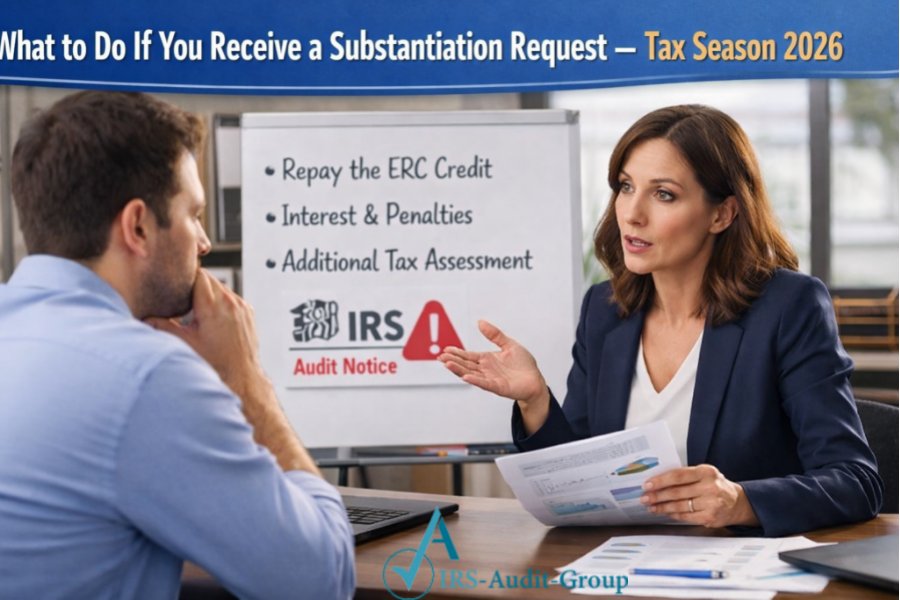
    Why the IRS Has Made Employee Retention Credit Claims a Top Priority in Tax Season 2026— and What to Do If You Receive a Substantiation Request

    As Tax Season 2026 approaches, the Internal Revenue Service (IRS) has intensified its focus on reviewing Employee Retention Credit (ERC) claims. Over the past several years, the ERC program has helped thousands of businesses recover from the economic impact of the COVID-19 pandemic. However, the IRS has also identified a significant number of incorrect or potentially fraudulent claims, leading the agency to prioritize compliance reviews and documentation requests.

    Many taxpayers who filed ERC claims may now receive IRS notices requesting documentation to support those claims. These notices are commonly called substantiation requests. They are part of the IRS process for verifying that a claim meets eligibility requirements under federal tax law.

    Understanding why the IRS is focusing on ERC claims—and how taxpayers should respond to substantiation requests—can help businesses avoid penalties, claim disallowances, and repayment demands.

    Understanding the Employee Retention Credit

    The Employee Retention Credit was created during the COVID-19 pandemic to help employers keep workers on payroll. The credit was introduced under the CARES Act and later expanded through additional relief legislation.

    Eligible employers could claim the credit if they experienced either:

    • A significant decline in gross receipts, or
    • A full or partial suspension of operations due to government orders related to COVID-19.

    The credit allowed businesses to claim refundable payroll tax relief based on qualified wages paid to employees during specific periods in 2020 and 2021. Taxpayers who did not originally claim the credit could later file an amended payroll tax return to request the refund. This is typically done using Form 941-X, which allows employers to correct previously filed employment tax returns. Official ERC eligibility guidance can be reviewed on the IRS website:
    https://www.irs.gov/coronavirus/employee-retention-credit.

    Why the IRS Is Prioritizing ERC Claims in Tax Season 2026

    Because the credit could be worth up to $26,000 per employee, it quickly became one of the largest pandemic-era tax relief programs for businesses.

    High Volume of Questionable Claims

    The IRS has warned that a significant number of ERC claims may not meet eligibility requirements. Many claims were submitted after aggressive marketing campaigns promoted the credit to businesses that may not have qualified. Some third-party promoters encouraged companies to claim ERC refunds based on incomplete or incorrect interpretations of IRS rules. These promoters often charged large contingency fees tied to the refund amount. Due to this widespread activity, the IRS has increased compliance efforts to verify claims and identify improper filings. Official IRS guidance about ERC compliance concerns can be found here:
    https://www.irs.gov/newsroom/businesses-should-review-employee-retention-credit-rules-and-resolve-incorrect-claims-soon

    Large Backlog of ERC Claims

    Millions of ERC claims were filed after the program was introduced. This created a substantial processing backlog for the IRS. To address the backlog, the agency implemented new risk-review procedures. Claims are now screened more closely before refunds are approved. In many cases, the IRS may request documentation before releasing funds. As the IRS continues to work through these claims, ERC reviews have become a major enforcement priority leading into Tax Season 2026.

    Increased Fraud Risk

    The IRS has also identified patterns suggesting potential fraud or widespread eligibility errors. Some claims included incorrect wage calculations. Others claimed the credit without meeting the required revenue decline or shutdown conditions. To protect the tax system, the IRS has expanded enforcement initiatives targeting improper ERC claims.

    Additional IRS warnings regarding incorrect ERC filings can be reviewed here:
    https://www.irs.gov/newsroom/irs-shares-new-warning-signs-of-incorrect-claims-for-employee-retention-credit

    What do IRS ask in a Substantiation Request?

    A substantiation request is part of the IRS review process and does not automatically mean the claim is incorrect. The IRS simply needs evidence confirming that the taxpayer meets the program’s eligibility requirements. Substantiation requests typically ask for records such as:

    • Payroll records showing qualified wages
    • Financial statements demonstrating revenue declines
    • Copies of government shutdown orders affecting business operations
    • Employment tax filings used to claim the credit
    • Documentation showing that wages were not used for multiple tax relief programs

    Providing complete and accurate documentation helps the IRS verify the claim and move the review forward.

    Steps Taxpayers Should Take After Receiving a Substantiation Request

    Review the IRS Notice Carefully

    The first step is to read the IRS notice thoroughly. Each request explains the information required and provides instructions for submitting documents. Taxpayers should also review the response deadline included in the notice. Missing the deadline could delay the review or lead to claim denial.

    Gather Supporting Documentation

    Taxpayers should collect all records related to the ERC claim before responding. This documentation should clearly demonstrate eligibility under IRS rules. Important records may include:

    • Quarterly financial statements showing revenue trends
    • Payroll records detailing qualified wages
    • The government orders that restricted business operations
    • Original payroll tax filings and amended returns

    Organized documentation helps ensure the response addresses the IRS request completely.

    Review the Accuracy of the Claim

    In some cases, taxpayers may discover that their ERC claim contains errors. The IRS encourages businesses to review claims carefully and correct mistakes when necessary.

    If a claim appears inaccurate, taxpayers may explore options to amend or resolve the issue before enforcement actions escalate. IRS information on resolving incorrect ERC claims can be reviewed here:
    https://www.irs.gov/newsroom/businesses-should-review-employee-retention-credit-rules-and-resolve-incorrect-claims-soon

    Submit the Response on Time

    Timely responses are critical. If the IRS does not receive the requested documentation by the deadline, the agency may disallow the ERC claim. Submitting a complete response within the timeframe helps taxpayers avoid unnecessary complications.

    Potential Consequences of Unsupported ERC Claims

    If taxpayers cannot provide sufficient documentation supporting their claim, the IRS may deny the credit and require repayment of any refund already issued.

    Additional consequences may include:

    • Repayment of the ERC refund
    • Interest on the refunded amount
    • Accuracy-related penalties
    • Additional tax assessments

    Businesses that relied on aggressive ERC promoters may face unexpected financial exposure if claims cannot be substantiated.

    Preparing for IRS ERC Reviews During Tax Season 2026

    Because ERC enforcement will remain a major focus during Tax Season 2026, taxpayers should review their records now to ensure documentation is complete. Businesses should confirm that they can demonstrate eligibility through revenue records, payroll data, and documentation of government shutdown orders. Maintaining organized records will help taxpayers respond quickly if the IRS issues a substantiation request.

    How Tax Professional Assistance Can Help During an ERC Review

    Responding to an IRS substantiation request can be complex, especially when the IRS requires detailed payroll records, eligibility analysis, and documentation supporting an ERC claim. In many cases, taxpayers benefit from working with experienced tax professionals who understand IRS procedures and documentation requirements.

    IRS Audit Group specializes in helping taxpayers navigate IRS compliance reviews, including Employee Retention Credit documentation requests. Their team assists businesses by reviewing ERC claims, organizing supporting records, and preparing formal responses to IRS notices. They also help evaluate whether a claim meets IRS eligibility standards and provide guidance if corrections or additional documentation are required.

    By working with tax professionals familiar with IRS audit processes, taxpayers can ensure their responses are accurate, complete, and aligned with current IRS guidelines. This type of support can help reduce the risk of claim denial, penalties, or extended IRS examinations.

    Please get in touch with us for more information.

    Telephone Number: (310) 498-7508

    info@irs-audit-group.com

    Read more

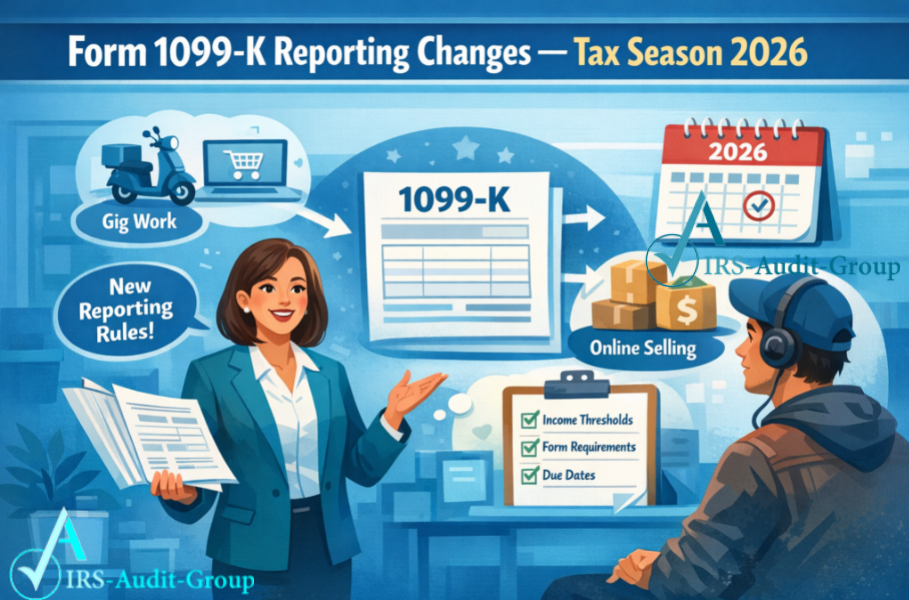
    Form 1099‑K Reporting Changes for Tax Season 2026 – What Gig Workers and Online Sellers Need to Know

    What Is Form 1099‑K?

    Form 1099‑K is issued by payment processors (PayPal, Venmo, Cash App, eBay, Etsy, etc.) to report transactions for goods and services. It helps the IRS track income from online platforms and gig work.

    The Big Change in Tax Season 2026

    In the previous tax season, the IRS had planned to enforce a $600 reporting threshold (meaning anyone earning $600 or more through payment apps would receive a 1099‑K). This caused widespread concern among gig workers and casual sellers. However, in tax season 2026, the One Big Beautiful Bill Act (OBBBA) reversed that rule. The threshold reverted to the previous standard: $20,000 in payments AND 200 transactions per year.

    Comparison: Tax Season 2026 vs. 2025

    Tax SeasonReporting ThresholdWho Receives 1099‑KKey Impact
    2025Planned $600 (single transaction or more)High‑volume sellers, established gig workers, and marketplace businessesWould have dramatically expanded reporting, creating confusion and paperwork
    2026$20,000 AND 200 transactionsHigh‑volume sellers, established gig workers, marketplace businessesLimits reporting to more professional sellers; casual users spared

    Why the Change?

    Lawmakers and the IRS faced backlash over the $600 threshold, which would have flooded taxpayers with forms for small, casual transactions (like selling used furniture or splitting dinner bills). The tax season 2026 revision aims to balance compliance with practicality.

    What Hasn’t Changed?

    • Personal Transfers: Payments between friends/family (gifts, reimbursements) are not taxable income.
    • Income Reporting: Taxpayers must still report all taxable income, even if they don’t receive a 1099‑K.
    • Deadline: Payment apps must issue 1099‑K forms to taxpayers and the IRS by January 31, 2026.

    Who Is Affected in Tax Season 2026?

    • Gig Workers: Freelancers using apps like Upwork, Fiverr, or PayPal for client payments.
    • Online Sellers: Individuals selling on eBay, Etsy, Amazon Marketplace, or Facebook Marketplace.
    • High‑Volume Resellers: Those exceeding $20,000 in sales and 200 transactions.

    Casual sellers (e.g., selling a few personal items online) are no longer burdened with 1099‑K forms unless they cross the threshold.

    What does this Matters to You for Tax Season 2026?

    A common misconception is that if you don’t receive a 1099-K, the money is “tax-free.” This is incorrect.

    • The IRS considers all income taxable, whether it is reported on a form or not.
    • Even without a 1099-K, you are legally required to report your gig earnings on Schedule C or Schedule 1.
    • The OBBBA only changed the reporting requirement for platforms like PayPal and Venmo; it did not change the taxability of the income.

    Practical Guidance for Taxpayers

    • Track Income Independently: Even if you don’t receive a 1099‑K, you must report taxable income.
    • Separate Personal & Business Accounts: Helps avoid confusion between taxable and non‑taxable transfers.
    • Stay Updated: IRS FAQs on Form 1099‑K are updated regularly; check for clarifications.

    Tax Season 2026 rollback of the $600 threshold means fewer unnecessary forms and a return to the more manageable $20,000/200 transaction standard. Still, gig workers and online sellers should remember that thresholds don’t eliminate income reporting requirements. Staying informed, organized, and proactive is the best way to navigate these changes.

    Why IRS Audit Group Matters

    For businesses and individuals preparing for Tax Season 2026, partnering with a firm like IRS Audit Group means you’re not just filing forms — you’re building a defense strategy. Their CPAs specialize in audit prevention, compliance, and representation, ensuring peace of mind in a complex tax environment.

    IRS Audit Group consists of tax professionals, CPAs, enrolled agents, and tax attorneys.  We are located in Los Angeles, California, however, our certified professionals cooperate and work with all IRS offices nationwide. Please get in touch with us for more information.

    Telephone Number: (310) 498-7508

    info@irs-audit-group.com

    Read more

    How IRS Is Helping Small Businesses in Tax Season 2026 with Payroll & Deposit Penalty Relief

    Small businesses entering Tax Season 2026 are facing a harsh reality. Whether it’s natural disasters, system failures, or banking delays, payroll tax obligations remain legally binding and compliance doesn’t pause during disruption. When deposits are late, penalties escalate quickly. However, the IRS has expanded tax relief mechanisms, especially in disaster situations to support small businesses struggling to stay compliant. This guide explains how Tax Season 2026 tax relief programs apply to payroll deposits, what relief options exist, and how businesses can avoid unnecessary penalties.

    WHAT IS PAYROLL TAX DEPOSIT

    Payroll tax deposits are funds employers collect and hold for the federal government.

    These include:

    • Federal income tax withheld from employee wages
    • Social Security taxes
    • Medicare taxes
    • The employer’s share of Social Security and Medicare

    These funds are not the employer’s money. They are trust funds held on behalf of employees. Similar to previous years, in Tax Season 2026, the IRS continues strict enforcement of deposit schedules based on payroll size and frequency. When deposits are late, the IRS can assess penalties along with interest that increase based on how late the payment is. For a full explanation of employment taxes and deposit schedules, taxpayers can review the IRS page here.

    WHEN THE IRS GRANTS DISASTER RELIEF

    The IRS provides tax relief when an area receives a federal disaster declaration. Relief is typically available after FEMA declares a major disaster.

    Tax relief may include:

    • Extended deadlines to file returns
    • Extended deadlines to pay taxes
    • Postponed payroll tax deposit deadlines
    • Automatic penalty abatement for certain late deposits

    Most disaster relief is automatic for taxpayers located in affected ZIP codes. Taxpayers can always check current disaster relief announcements at the IRS Website. To verify whether a county or state is officially declared, FEMA maintains the federal declaration list on the FEMA Website.

    AUTOMATIC PENALTY RELIEF FOR LATE PAYROLL DEPOSITS

    In many federally declared disasters, the IRS automatically abates penalties on late payroll and excise tax deposits. This automatic relief generally applies when:

    • The deposit was due during the disaster period
    • The deposit is made by the extended deadline announced by the IRS

    The IRS typically publishes a specific date by which deposits must be made to qualify for penalty abatement. For example, the IRS has previously announced disaster relief, postponing deadlines in affected states, including payroll deposit relief. One such announcement for Tax Season 2026 for the state of Louisiana can be reviewed here in IRS Website. There is no dedicated page to see announcements for all the states and the IRS will release public notice via https://www.irs.gov/newsroom.

    Employers should carefully read each disaster notice. Automatic relief does not apply to every tax or every situation. If automatic abatement does not apply, employers may still qualify under other penalty relief programs.

    FIRST-TIME PENALTY ABATEMENT (FTA)

    First-Time Penalty Abatement (FTA) is an administrative relief program available to eligible taxpayers with a clean compliance history.

    Small businesses may qualify if:

    • Required returns were filed
    • Taxes were paid or a payment plan was established
    • The employer has not had significant penalties in recent years

    FTA can remove certain penalties, including some payroll-related penalties. It is not always applied automatically. Full details on penalty relief, including FTA, are available here at IRS Website.

    REASONABLE CAUSE RELIEF

    Reasonable cause relief applies when a taxpayer exercises ordinary business care but was still unable to comply due to circumstances beyond their control.

    Common examples include:

    • Natural disasters
    • Bank processing errors
    • Payroll processor system failures
    • Serious illness
    • Death of a responsible individual
    • Records destroyed by fire or flood

    The IRS reviews all facts and circumstances. Documentation is critical. Employers should maintain:

    • Bank statements
    • Email records
    • Payroll system logs
    • Insurance claims
    • Repair invoices

    A written explanation outlining what happened and why the delay occurred strengthens the request. General Penalty relief guidance can be reviewed here at IRS Website.

    IRS PAYMENT PLANS FOR PAYROLL TAXES

    When employers cannot pay payroll taxes in full, the IRS provides payment options such as

    • Instalment agreements
    • Short-term payment plans
    • Online application options

    The IRS Online Payment Agreement tool allows many employers to apply without calling: Online Payment Agreement. Employers can also use EFTPS to schedule future payments electronically: EFTPS (Electronic Federal Tax Payment System).

    IMPORTANT WARNING ABOUT TRUST FUND TAXES

    Payroll withholding taxes belong to employees. Employers hold these funds in trust.

    Failure to deposit withholding taxes can trigger the Trust Fund Recovery Penalty (TFRP). This penalty can make responsible individuals personally liable for unpaid trust fund taxes. Responsible persons may include:

    • Business owners
    • Officers
    • Payroll managers
    • Anyone with authority over financial decisions

    Details about the Trust Fund Recovery Penalty are available here at IRS Website.

    FINAL CHECKLIST FOR SMALL EMPLOYERS

    Small employers can reduce risk by following these steps:

    IRS AUDIT GROUP

    IRS Audit Group consists of tax professionals, CPAs, enrolled agents, and tax attorneys.  We are located in Los Angeles, California and our primary area of expertise is IRS Tax Audit Representation.  However, our certified professionals cooperate and work with all IRS offices nationwide.  Please get in touch with us for more information.

    Telephone Number: (310) 498-7508

    info@irs-audit-group.com

    Read more

    Tax Season 2026: Professional CPA Doesn’t Just Fill Out Forms — He Helps You Avoid IRS Audits

    Taxpayers think of a Certified Public Accountant (CPA) as someone sitting at a desk, punching numbers into tax software, and filing forms with the IRS. However, in reality, a professional CPA is far more than a form filler. The professional is your shield against costly mistakes, your strategist for tax season, and your best defense against the dreaded IRS audit. For businesses and individuals alike, especially during Tax Season 2026, the role of a CPA is about foresight, compliance, and protection.

    What Is an IRS Audit?

    IRS audit is a review of your financial records to ensure that the information reported on your tax return is accurate. The IRS may examine income, deductions, credits, and other details to verify compliance with tax laws. Importantly, being selected for an audit doesn’t automatically mean you’ve done something wrong — sometimes returns are chosen randomly, or because of statistical formulas. For a detailed explanation of the audit process, see the IRS’s official guide: Publication 3498: The Examination Process. IRS Audit Group has a proprietary audit process that is well-aligned with IRS official guidelines.

    Common IRS Audit Triggers

    IRS doesn’t disclose every detail of its audit selection process, but some common triggers include:

    • Unreported Income: If your reported income doesn’t match IRS records (like W-2s or 1099s), expect scrutiny.
    • Excessive Deductions: Claiming unusually high deductions compared to your income can raise red flags.
    • Abusive Tax Schemes: Participation in fraudulent or abusive tax schemes is a major audit trigger.
    • Cash-Heavy Businesses: Restaurants, salons, and other businesses dealing mostly in cash often face audits.

    How CPAs Help You Avoid These Triggers

    • Form Accuracy: CPAs double-check forms like Form 1040 to ensure consistency and accuracy.
    • Documentation Support: They advise on keeping receipts, invoices, and records that back up your claims.
    • Strategic Planning: CPAs guide you on legitimate tax strategies that reduce liability without raising suspicion.
    • Tax Audit Representation: If you are audited, CPAs can represent you before the IRS, ensuring professional communication and defense.

    Why CPAs are Essential in Audit Prevention

    CPA does much more than prepare returns. Here’s how they actively reduce your audit risk:

    • Accurate Reporting: CPAs ensure that income, deductions, and credits are reported correctly, minimizing discrepancies that trigger tax audits.
    • Compliance with IRS Forms: They know which forms apply to your situation and how to complete them properly. For example, if you’re claiming certain deductions, the CPA ensures the right supporting schedules are filed.
    • Audit Red Flag Awareness: CPAs understand what the IRS considers suspicious — such as excessive deductions compared to income — and help you avoid these pitfalls.
    • Taxpayer Rights Protection: CPAs safeguard your rights under the Taxpayer Bill of Rights, ensuring you are treated fairly.

    Your Rights During an Audit

    Every taxpayer has rights during an audit, including:

    • The Right to Be Informed: You must know why you’re being audited.
    • The Right to Quality Service: IRS employees must treat you professionally.
    • The Right to Challenge and Appeal: You can dispute IRS findings and appeal decisions.

    For more details, see the IRS’s Taxpayer Bill of Rights

    A professional CPA is not a form-filler. He is your strategist, your compliance expert, and your advocate. By ensuring accurate reporting, avoiding audit triggers, and protecting your taxpayer rights, CPAs help you navigate tax season with confidence. As Tax Season 2026 approaches, remember: investing in a CPA is investing in protection against audits, penalties, and unnecessary stress.

    Why IRS Audit Group Matters

    For businesses and individuals preparing for Tax Season 2026, partnering with a firm like IRS Audit Group means you’re not just filing forms — you’re building a defense strategy. Their CPAs specialize in audit prevention, compliance, and representation, ensuring peace of mind in a complex tax environment.

    IRS Audit Group consists of tax professionals, CPAs, enrolled agents, and tax attorneys.  We are located in Los Angeles, California; however, our certified professionals cooperate and work with all IRS offices nationwide. Please get in touch with us for more information.

    Telephone Number: (310) 498-7508

    info@irs-audit-group.com

    Read more

    IRS Disaster Relief Explained: Access to State-Wise Filing Deadline Extensions, Key Disasters and Taxes Covered – What Taxpayers Need to Know for Tax Season 2026

    As Tax Season 2026 begins, many taxpayers may get more time to file due to disaster-related tax relief. When natural disasters strike, the IRS often extends tax filing and payment deadlines for people and businesses in affected areas. Knowing whether you qualify for these automatic extensions can help taxpayers avoid penalties and reduce stress during an already difficult recovery period.

    What Is IRS Disaster Relief?

    When the President or FEMA declares a region a federal disaster area, the IRS typically responds by offering automatic tax relief. This relief usually includes extended filing and payment deadlines for individuals and businesses in affected areas. The goal is to provide financial breathing room during recovery, ensuring taxpayers can focus on rebuilding without worrying about immediate tax penalties.

    Key Disasters Covered in Tax Year 2025

    In 2025, several natural disasters prompted IRS relief measures:

    • Wildfires in New Mexico
    • Floods in West Virginia
    • Hurricanes and severe storms across the Southeast
    • Tornado outbreaks in the Midwest

    For each federally declared disaster, the IRS announced specific extensions, often pushing deadlines by several months. On the IRS “Around the Nation” page, you can find a state-by-state rundown of recent disaster-related tax relief announcements. It shows which states and local areas have had tax filing and payment deadlines postponed due to federally declared emergencies. The “Around the Nation” page makes it easy for taxpayers to check if their home or business address qualifies for extended deadlines.

    What Taxes Are Covered?

    The relief isn’t just for your individual income tax return (Form 1040). It typically includes:

    1. 2024 Individual and Business Returns: Originally due in March or April 2025.
    2. Estimated Tax Payments: Quarterly payments originally due in January, April, June, and September 2025.
    3. Payroll and Excise Tax Returns: Quarterly filings due throughout the year.
    4. IRA and HSA Contributions: The deadline to contribute to these accounts for the prior tax year is also extended to the new disaster deadline.

    Note: You do not need to apply for this relief. If your registered address is within the FEMA-declared disaster zone, the IRS computer systems automatically apply the extension and abate late-filing/late-payment penalties.

    How Extensions Work?

    • Automatic Relief: Taxpayers in disaster zones don’t need to apply; the IRS uses address data to identify eligible filers.
    • Extended Deadlines: Filing and payment deadlines (including quarterly estimated taxes, payroll filings, and business returns) are postponed. Each state and its tax relief postponed due dates can be viewed from the “Around the Nation” page.
    • Penalty Waivers: Late filing and payment penalties are waived for the duration of the extension.

    For example, taxpayers in New Mexico affected by wildfires had their April 15, 2025, deadline extended to August 15, 2025. Similarly, businesses in West Virginia flood zones received extensions into the fall.

    Why This Matters?

    Disaster relief is more than just extra time—it prevents compounding financial stress. Without extensions, taxpayers could face penalties and interest while simultaneously dealing with property loss, insurance claims, and rebuilding costs.

    Action Steps for Taxpayers in Disaster Areas

    1. Check IRS Disaster Relief Announcements: Visit the IRS “Tax Relief in Disaster Situations” page for updated lists of eligible counties. This page has redirects to the “Around the Nation” page to show counties affected by different disasters.
    2. Confirm Eligibility: Ensure your address is within the federally declared disaster zone.
    3. Keep Documentation: Maintain FEMA declarations, insurance claims, and IRS notices for records.
    4. File When Ready: Even with extensions, filing early can help secure refunds or credits sooner.

    IRS AUDIT GROUP

    IRS Audit Group consists of tax professionals, CPAs, enrolled agents, and tax attorneys.  We are located in Los Angeles, California and our primary area of expertise is IRS Tax Audit Representation.  However, our certified professionals cooperate and work with all IRS offices nationwide. Please get in touch with us for more information.

    Telephone Number: (310) 498-7508

    info@irs-audit-group.com

    Read more

    Top Seven IRS Audit Red Flags Due to New 2025 Federal Tax Law — How to Prepare and Avoid IRS Audit in the Tax Season 2026

    The 2025 tax law (the “One, Big, Beautiful Bill” or OBBBA) introduced sweeping changes to deductions, credits, and business expensing. While many taxpayers legitimately benefit from larger deductions and updated thresholds, the new rules also create fresh IRS audit risks. Aggressive claims, mismatches between federal and state treatment, and reporting changes (especially for marketplace and gig income) are among the top red flags the IRS will be watching in the coming tax filing season 2026.

    This guide explains the most important IRS audit red flags after the 2025 tax law and practical, step‑by‑step safeguards for taxpayers to avoid problems.

    WHY 2025 CHANGES INCREASE AUDIT RISKS?

    The IRS uses document matching, algorithms, and targeted industry programs to select returns for examination. Two broad reasons the 2025 law increases audit touchpoints:

    1. More complexity and new elections. Permanent 100% bonus depreciation, restored R&D expensing, and new reporting thresholds create additional tax elections that must be properly documented. Errors or overly aggressive positions increase IRS audit risk.
    2. Data matching and reporting shifts. Restored 1099-K thresholds and updated IRS reporting increase the risk of mismatches between third-party data and tax returns, a common trigger for IRS audits.

    TOP IRS AUDIT RED FLAGS (AND HOW TO AVOID THEM) IN TAX SEASON 2026

    1. Poorly documented Section 179/Bonus Depreciation claims: Full bonus depreciation (and higher Section 179 limits) can sharply reduce taxable income in year one. States that decouple may require add‑backs, and the IRS will want proof that the property qualifies and the basis is correct. Aggressive classification (personal vs. business use, listed property) draws attention.

      How to avoid:

      • Keep asset-level purchase invoices, delivery/installation records, and capitalization policies. 
      • Document business purpose and placed‑in‑service dates. 
      • If you operate in a state that decouples from bonus depreciation, model the required state addbacks and clearly document them in the tax workpapers.

      2. Schedule C (sole proprietor) returns with repeated losses or excessive expenses: Schedule C filings historically attract IRS audits. Repeated losses year after year or unusually large deductions (meals, travel, contractor labor, home office) can trigger a closer look for hobby‑loss rules or misstated business activity.

      How to avoid: 

      • Maintain a profit plan, time logs, sales records, and marketing documentation showing a profit motive. 
      • Keep receipts and contemporaneous logs for meals, mileage, and home office expenses. The IRS expects reliable records. See “Audits & Records Requests” for exactly what auditors ask for.

      3. Mismatches on third‑party reporting (1099‑K, 1099‑NEC, W‑2s): The IRS cross‑checks Forms W‑2/1099 against filed returns. If the gross receipts you report differ materially from what payers sent, the return becomes a prime candidate for examination. The 2025 Fact Sheet on Form 1099‑K clarifies reporting rules — but taxpayers still commonly underreport gross receipts or omit deductible offsets.

      How to avoid: Reconcile all 1099s to bank statements and accounting records before filing. Do not assume missing 1099s mean income is non-taxable; the IRS treats all income as taxable unless excluded by law. File an amended return promptly if errors are identified.

      4. Aggressive or unsupported R&D credit claims / large credits with weak substantiation: R&D credits remain attractive but complex. Large or recurring claims without solid project documentation, time studies, and cost support can trigger audits, especially after the 2025 changes to R&D expensing rules.

      How to avoid: 

      • Use project files, payroll records, invoices, lab notebooks, and technical summaries. If you claim credit, prepare a concise technical memo showing qualified activities and the costs allocated. Consider a pre‑filing R&D documentation review.

      5. High charitable deductions, noncash gifts, or appraisal issues: Large charitable deductions, especially for noncash property requiring Form 8283 or appraisals, draw automated screening. The IRS looks for valuation inconsistencies.

      How to avoid: Keep donation receipts, contemporaneous records, and qualified appraisals when required. If you claim a deduction for a vehicle or large property donation, follow Form 8283 and appraisal rules meticulously.

      6. Misuse of credits aimed at individuals (EITC, Child Tax Credit, adoption credit): Refundable credits attract scrutiny because they increase refund exposure. Incomplete eligibility (residency, support tests, AGI thresholds) can prompt automated checks and audits. The IRS recently adjusted many thresholds and credit amounts — know the updated rules.

      How to avoid: Keep documents proving eligibility (birth certificates, custody agreements, school records, proof of residency). When in doubt, consult guidance on the specific credit and error on the side of conservative claims.

      7. Large or unusual business interest expense or international tax positions: Changes to interest expense limits, GILTI/NCTI rules, and international tax provisions require careful calculation. Complex positions without proper transfer pricing support or documentation increase IRS audit risk.

      How to avoid: Maintain transfer pricing studies, contemplate documentation, and a qualified international tax memo. Run sensitivity analyses for different audit outcomes.

      WHY WORKING WITH A TAX PROFESSIONAL MATTERS NOW?

      The 2025 tax law made many valuable benefits available — but with added complexity that raises IRS audit risk if records are weak or taxpayers are careless.

      Tax professionals provide:

      • proactive tax planning around bonus depreciation and Section 179 elections.
      • R&D documentation and credit substantiation. 
      • federal vs. state conformity modeling to avoid surprise state tax bills.
      • audit defense and representation if needed.

      IRS Audit Group can help you review returns before filing, prepare organized work papers, and represent you during any IRS contact. For operational clients, we also provide staff training on audit‑ready recordkeeping.

      IRS AUDIT GROUP

      IRS Audit Group consists of tax professionals, CPAs, enrolled agents, and tax attorneys.  We are located in Los Angeles, California and our primary area of expertise is IRS Tax Audit Representation.  However, our certified professionals cooperate and work with all IRS offices nationwide.  Please get in touch with us for more information.

      Telephone Number: (310) 498-7508

      info@irs-audit-group.com

      KEY OFFICIAL RESOURCES

      Read more

      State Conformity for Tax Season 2026: Which States Adopted (or rejected) the Federal Tax Changes?

      The 2025 federal tax changes (commonly called the “One, Big, Beautiful Bill” or OBBBA) brought sweeping modifications to deductions, credits, and business expensing. While these changes were enacted at the federal level, states decide independently whether — and how — to “conform” to federal tax law. That means some states adopted certain provisions, some selectively adopted them, and others explicitly decoupled to protect state revenues.

      This guide is a state conformity tracker: it explains how conformity works, summarizes which states have adopted or rejected major 2025 federal changes (with links to official guidance), and offers practical advice for taxpayers and businesses.

      WHY STATE CONFORMITY MATTERS?

      When a state “conforms” to the Internal Revenue Code (IRC), it typically uses federal definitions (often based on a specific date) to compute state taxable income. But states can:

      • Adopt the IRC as of a certain date (rolling or fixed conformity), or
      • Pick-and-choose (selective conformity), or
      • Decouple (reject certain federal provisions and require add-backs).

      Because the Tax Year 2025 law reintroduced large federal incentives — especially 100% bonus depreciation (168), restored immediate R&D expense (Section 174 changes), and worker-focused deductions (tips/overtime) states faced potentially large revenue losses. Many reacted by decoupling from some or all of those provisions. The National Conference of State Legislatures (NCSL) provides an ongoing summary of state conformity actions that can be viewed here: https://www.ncsl.org/fiscal/2025-tax-conformity-changes

      MAJOR NATIONAL TRENDS (WHAT MOST STATES ARE DOING)

      • Bonus depreciation & R&D expense: Many states have long chosen not to follow federal bonus depreciation rules. Some states fully disallow bonus depreciation. Others allow it only after taxpayers add it back and deduct it over time. For Tax Season 2026, those states largely kept the same position. They did not adopt the restored and expanded federal bonus depreciation. They continued to require add-backs instead. The same pattern applied to federal R&D expensing changes. Several states required taxpayers to add back R&D expenses rather than deduct them immediately. See the Tax Foundation’s state-by-state analysis to understand which state adopts or decouple. https://taxfoundation.org/wp-content/uploads/2025/07/OBBBA-State-Conformity-Handout.pdf
      StateTax Year 2025 ConformityWhat Changed / Key ImpactAuthoritative Reference
      CaliforniaSelective conformityAdvanced IRC date to Jan. 1, 2025, but excluded major OBBBA provisions. Many federal incentives do not flow through automatically.California Franchise Tax Board – Schedule CA Instructions
      New YorkAdd-backs requiredContinues separate depreciation calculations and requires adjustments for accelerated depreciation.NY Form IT-399 & Instructions
      IllinoisLegislative decouplingEnacted statutory decoupling from federal bonus depreciation and related provisions.Illinois FY-2025 Legislative Summary
      MichiganAdd-backs via formsUpdated individual and corporate forms to adjust for decoupled bonus depreciation and other federal changes.Michigan TY2025 Forms & Guidance
      DelawarePartial conformityPicks up the federal SALT cap increase but does not adopt certain worker-focused deductions (tips/overtime).Delaware Division of Revenue Notices
      Rhode IslandTargeted decouplingLimits bonus depreciation and/or R&D expensing; add-backs required.Link at the end of the table
      MarylandTargeted decouplingDoes not fully adopt federal bonus depreciation or immediate R&D expensing.Link at the end of the table
      New JerseyTargeted decouplingMaintains separate depreciation and expense timing rules.Link at the end of the table
      ConnecticutTargeted decouplingRequires add-backs for certain federal incentives.Link at the end of the table
      MassachusettsTargeted decouplingSelective conformity limits accelerated depreciation benefits.Link at the end of the table
      MinnesotaTargeted decouplingUses fixed conformity date; requires adjustments for newer federal provisions.Link at the end of the table
      PennsylvaniaTargeted decouplingDoes not follow federal bonus depreciation; state adjustments required.Link at the end of the table
      District of ColumbiaExplicit decouplingRejected certain OBBBA worker benefits, including no-tax tips and overtime; revenue redirected to local programs.D.C. Office of Tax and Revenue
      • Worker deductions (tips/overtime): A few jurisdictions (notably the District of Columbia) explicitly rejected or limited the federal “no tax on tips” / “no tax on overtime” provisions to preserve revenue or to fund alternate state programs.

      STATE-BY-STATE SNAPSHOT

      Below are states that took prominent actions to decouple, modify, or otherwise respond to 2025 federal changes. For each state, we include the authoritative link you can direct clients to.

      Aggregated for remaining State: https://taxfoundation.org/research/all/state/big-beautiful-bill-state-tax-impact

      HOW THIS AFFECTS TAXPAYERS — PRACTICAL EXAMPLES

      • Small business buys a $200,000 piece of equipment in 2025. Federally, 100% bonus depreciation may allow a full expense in 2025 — but if your state decoupled (e.g., California, Illinois), you’ll need to add back the bonus depreciation on the state return, increasing state taxable income. That may reduce the federal cash-tax benefit at the state level.
      • Retiree benefitting from the temporary senior deduction (extra $6,000): Some states (including D.C.) chose not to pick up the senior bonus deduction — meaning the retiree may pay more state tax despite lower federal tax.
      • Gig worker and 1099-K changes: The IRS reinstated the $20,000/200-transactions threshold for Form 1099‑K reporting under OBBBA, but some states used different thresholds or retained prior reporting rules — keep careful records and check both federal and state guidance. IRS FAQs: https://www.irs.gov/newsroom/irs-issues-faqs-on-form-1099-k-threshold-under-the-one-big-beautiful-bill-dollar-limit-reverts-to-20000.

      State conformity timelines — what to watch for

      States may update their tax code at any time — some will pass quick “decoupling” bills in reaction to revenue estimates; others will adopt gradual or rolling conformity. The NCSL and Tax Foundation maintain trackers and summaries that are updated frequently. https://www.ncsl.org/fiscal/2025-tax-conformity-changes.

      Where to find authoritative, state-specific guidance (quick links)

      IRS AUDIT GROUP

      IRS Audit Group consists of tax professionals, CPAs, enrolled agents, and tax attorneys.  We are located in Los Angeles, California, and our primary area of expertise is IRS Tax Audit Representation.  However, our certified professionals cooperate and work with all IRS offices nationwide.  Please get in touch with us for more information.

      Telephone Number: (310) 498-7508

      info@irs-audit-group.com

      Read more

      New Changes to U.S. Tax Year 2025/Tax Season 2026: What Individuals & Businesses Must Know?

      The 2025 U.S. tax year, a.k.a. Tax Season 2026, brings significant and wide-ranging changes that affect individuals, businesses, and multi-state taxpayers. This guide compiles the most important federal updates, highlights areas where states may differ, and provides direct links to IRS forms and authoritative guidance so taxpayers can find answers quickly.

      Overview — the new federal baseline
      Congress enacted a major tax package in 2025 that adjusted many 2017 Tax Cuts and Jobs Act (TCJA) era rules and added new taxpayer-focused benefits. The IRS has published summaries and fact sheets describing these changes in their official website. Please click the link: https://www.irs.gov/newsroom/one-big-beautiful-bill-provisions

      We have compiled and simplified the important key changes and benefits that all taxpayers need to know.

      Individual Taxpayer Highlights
      Standard deduction increases (tax year 2025, filed 2026):

      • Single / Married Filing Separately: $15,750 
      • Head of Household: $23,625 
      • Married Filing Jointly: $31,500

      These amounts were increased for inflation and adjusted in law. Higher standard deductions mean more taxpayers will find the standard deduction is advantageous compared to itemizing. Official IRS inflation-adjustment guidance for exact brackets and thresholds is here: https://www.irs.gov/newsroom/irs-releases-tax-inflation-adjustments-for-tax-year-2026-including-amendments-from-the-one-big-beautiful-bill

      Additional Senior Deduction (Temporary Benefit)
      For tax years 2025–2028, taxpayers aged 65+ may receive a bonus deduction (an additional $6,000 on top of the usual age/blind additional standard deduction). This raises the effective standard deduction for many seniors and retirees.

      Child and Family Credits
      The Child Tax Credit (and related family credits) received modest increases and continues to have income-based phaseouts. The Child Tax Credit is worth up to $2,200 per qualifying child. If taxpayers have little or no federal income tax liability, they may qualify for the Additional Child Tax Credit (ACTC), up to $1,700 per qualifying child, depending on the income. Taxpayers must have earned income of at least $2,500 to be eligible for the ACTC.

      Taxpayers qualify for the full amount of the Child Tax Credit for each qualifying child if they meet all eligibility factors and the annual income is not more than $200,000 ($400,000 if filing a joint return). Parents and guardians with higher incomes may be eligible to claim a partial credit.

      For complete eligibility rules, see: IRSChild Tax Credit: https://www.irs.gov/credits-deductions/individuals/child-tax-credit

      Worker-Focused Provisions
      The 2025 law introduced targeted exclusions and deductions for certain types of earned pay, including capped exclusions for qualifying tip income and for some overtime wages. These provisions are limited by income phaseouts and by other eligibility tests. Visit the IRS— Worker deductions & provisions fact sheets for detailed rules: https://www.irs.gov/newsroom/one-big-beautiful-bill-act-tax-deductions-for-working-americans-and-seniors

      Gig Economy Reporting (1099-K, 1099-NEC)


      1099-K threshold: The new law restored the higher reporting threshold for third-party settlement organizations — generally the $20,000 and 200 transactions rule in applicable periods. See the IRS FAQ on Form 1099-K: https://www.irs.gov/newsroom/irs-issues-faqs-on-form-1099-k-threshold-under-the-one-big-beautiful-bill-dollar-limit-reverts-to-20000

      1099-NEC & 1099-MISC: The contractor reporting landscape changed in the legislation. Filers and payers must review IRS instructions for current thresholds and filing rules. IRS — About Form 1099-NEC:https://www.irs.gov/forms-pubs/about-form-1099-nec

      Important reminder: Even if the gig economy workers do not receive a 1099, all taxable income must be reported on your return.

      Business & Pass-Through Entity

      100% bonus depreciation: The legislation made bonus depreciation more favorable in tax season 2026, allowing many qualifying business assets placed in service to be expensed immediately rather than depreciated over many years. This change enhances cash-tax planning for businesses that purchase equipment, machinery, and qualifying property.

      R&D expensing: Domestic research costs became more favorably treated, allowing many businesses to deduct qualifying R&D expenses in the year incurred. This is especially important for tech, manufacturing, and life sciences companies.

      International tax changes (GILTI / NCTI): The international provisions were revised, including changes to the treatment of Global Intangible Low-Taxed Income (GILTI), sometimes referred to in guidance by new names (e.g., Net CFC Tested Income). Multinational corporations should work closely with international tax advisors to model the changes.

      Opportunity zones: The law adjusted the rules around Opportunity Zone investments and made certain provisions permanent, encouraging long-term capital deployment into designated communities.


      Key Dates: https://www.irs.gov/individual-tax-filing

      • Federal filing deadline (tax year 2025 returns): April 15, 2026
      • Typical extension filing deadline (if extension approved): October 15, 2026

      Primary IRS forms and pages (clickable links):

      Other helpful IRS pages:

      IRS AUDIT GROUP

      IRS Audit Group consists of tax professionals, CPAs, enrolled agents, and tax attorneys.  We are located in Los Angeles, California and our primary area of expertise is IRS Tax Audit Representation.  However, our certified professionals cooperate and work with all IRS offices nationwide.  Please get in touch with us for more information.

      Telephone Number: (310) 498-7508

      info@irs-audit-group.com

      Read more
      How to Handle a Dispute with the IRS

      Mistakes in Tax Refunds or Tax Due – How to Handle a Dispute with the IRS? Appeals and Litigation Options

      The deadline for Tax Season 2023 for individuals is over, and those who filed for refunds will be receiving the same within 21 days from the filing date.  But, If the taxpayers have received a notice from the IRS that their taxes are incorrect or that they owe money, they can either pay or dispute if IRS is wrong. There are options available to resolve such disputes. The IRS dispute process is an essential part of the tax system, but it can be complicated and intimidating. Managing a dispute with IRS can be a complex and compelling process for taxpayers. Following are the steps to manage a dispute with the IRS. The first step in managing an IRS dispute is understanding how the process works, and what options are available for appealing or litigating the issue at hand.

      Understanding the IRS Dispute Process

      The IRS dispute procedure consists of numerous steps. Taxpayers can file a dispute if they disagree with the amount of tax they are required to pay or believe the IRS made a mistake in their tax return. If there are any changes that would affect their refund or balance payable, the first step is to file Form 1040X. Taxpayers can submit Form 9465, Form 8857, or Form 843 with the required supporting paperwork if there are no changes. These forms include Instalments Agreement Request, Request for Innocent Spouse Relief, and Claim for Refund and Request for Abatement, respectively. Ensure that taxpayers submit all required forms and documents to initiate the dispute process.

      If there is no communication from the IRS regarding the dispute after 90 days from the filing, it is time to move forward with appealing their decision. To do so, follow these steps:

      Appealing IRS decision

      Taxpayers have the right to appeal an IRS decision, and taxpayers have the right to use the two-step appeals process which involves an administrative appeal. Taxpayers need to submit a written request for reconsideration to the office that made the initial decision within 60 days of receiving a letter of disallowance. This can be done by letter, fax, or online at www.irs.gov/appeals. Taxpayers can request Form 12356-A, which offers guidance on how to complete and submit the appeals with necessary supporting evidence. This phase of the investigation aims to identify why the IRS took certain actions, such as reducing refunds.

      Litigating IRS Dispute

      Taxpayers need to take legal action if they are unable to resolve their dispute with the IRS. The IRS offers several options for litigating disputes that include.

      • Filing a lawsuit against the IRS in court. If a taxpayer has a valid reason for disputing an assessment or collection activity, they can file suit against the IRS in federal court or state court if applicable. Throughout this process, they need a tax attorney who specializes in tax law to represent them.
      • Requesting a management hearing with the Appeals Office Reviewer (AOR) is another option when appealing an IRS decision. AOR evaluation from the relevant evidence before determining whether to grant relief or not. This step does not guarantee relief, but it’s usually the first taken in appeals.

      The IRS dispute process can be confusing, but it’s important to know taxpayers’ options. It is important to understand the steps included and the options available to taxpayers for resolving the issue. This may include communications with IRS and providing additional information to support their position, requesting an appeals conference with an independent appeals officer, or considering mediation. In some cases, litigation may be necessary. Therefore, seeking tax professional advice and guidance throughout the process can help ensure that taxpayer’s rights are protected and they’re able to achieve the best possible outcome. IRS Audit Group is a tax audit representation company that helps taxpayers navigate such time-consuming dispute processes. Contact us for a free consultation. https://irsauditgroup.com/contact/

      Telephone Number: (310) 498-7508

      info@irs-audit-group.com

      Read more

      IRS Audit Group

      Tax attorney in Beverly Hills, California

      468 N Camden Dr #200,
      Beverly Hills, CA 90210, USA

      Call: +1 310 498 7508

      Hours

      Sunday8:00am-5:00pm Monday8:00am-10:00pm Tuesday8:00am-10:00pm Wednesday8:00am-10:00pm Thursday8:00am-10:00pm Friday8:00am-10:00pm Saturday8:00am-10:00pm