

Skip to main content Skip to search
info@irs-audit-group.com   
9465 Wilshire Blvd., Suite 300 Beverly Hills, CA 90212 | 468 N Camden Dr, Suite 200 Beverly Hills, CA 90210

Request a free Consultation

    Mon - Sat: 8:00 -21:00
    + 888 300 6670
    info@IRS-Audit-Group.com

    Archives for Tax

    Understanding AMIC Tax Season 2024 blog

    Understanding the Advanced Manufacturing Investment Credit for Tax Season 2024 – Special Rules for Partnerships and S Corporations

    The Internal Revenue Service (IRS) administers the Advanced Manufacturing Investment Credit (AMIC) in Tax Season 2024.  The objective is to motivate businesses to upgrade their manufacturing processes, and thereby boost competitiveness and stimulate economic growth.   In the fast-paced industrial environment, staying ahead often necessitates significant investments in advanced manufacturing technologies.


    What is Advanced Manufacturing Investment Credit?

    The AMIC (section 48D) is a targeted initiative under the Inflation Reduction Act (IRA) to boost the manufacturing sector, particularly in critical areas such as semiconductors and renewable energy. Offering a direct dollar-for-dollar tax reduction, it provides a significant financial incentive over deductions, spurring investments in advanced manufacturing technologies. This credit underlines the government’s focus on domestic manufacturing resurgence and supply chain security, with unique provisions for credit sale or transfer, enhancing its appeal and offering businesses strategic flexibility for growth and innovation in vital industries.


    How much is the Credit for Tax Season 2024?

    Eligible businesses may claim a tax credit equal to 25% of the qualified investment costs incurred for the purchase of advanced manufacturing equipment and related expenses. Qualified investments include expenditures on tangible property used in domestic manufacturing processes, such as machinery, equipment, and software specifically designed for advanced manufacturing activities.


    Eligible Businesses for Tax Season 2024

    To be eligible for the AMIC, a business must be engaged in manufacturing activities within the United States and must invest in qualified advanced manufacturing technology. Additionally, eligible taxpayers must obtain certification from the Department of Energy (DOE) or the National Institute of Standards and Technology (NIST) confirming that the equipment or process meets the criteria for advanced manufacturing.


    For this overview, an advanced manufacturing facility is defined under proposed regulation section 1.48D-3(f) as a site primarily engaged in producing semiconductors or semiconductor manufacturing equipment. The facility’s assets must be central to semiconductor production or the creation of equipment to manufacture semiconductors.


    Special Rules for Partnerships and S Corporations

    Partnerships and S corporations may allocate the AMIC to their partners or shareholders according to their ownership interests in the business entity. This allows for greater flexibility in distributing tax benefits among multiple stakeholders and can enhance the attractiveness of the credit for businesses structured as pass-through entities.


    How to Claim and What’s the Deadline?

    To claim the AMIC, eligible businesses must file Form 8942, “Application for Certification of Qualified Investments Eligible for Credits and Grants Under the Qualifying Advanced Energy Project Credit,” with the IRS. Additionally, they must adhere to specific deadlines outlined by the IRS to ensure timely processing of their applications and claims.


    The deadline for claiming the AMIC filing for tax year 2023 corresponds to the due date of Tax Season 2024 which is April 15, 2024. Taxpayers can include AMIC for the automatic extension that is due date on Oct. 15, 2024. It’s essential for businesses to adhere to filing deadlines to maximize their tax benefits and avoid potential penalties or interest charges.


    In conclusion, the Advanced Manufacturing Investment Credit represents a valuable opportunity for businesses to invest in advanced manufacturing technologies while reducing their tax liabilities. By leveraging this incentive, companies can accelerate their growth, drive innovation, and strengthen their competitive position in the global marketplace. However, it’s crucial for businesses to carefully assess their eligibility, comply with applicable rules and deadlines, and seek guidance from tax professionals or the IRS when necessary.


    IRS Audit Group

    IRS Audit Group consists of tax professionals, CPAs, enrolled agents, and tax attorneys.  We are located in Los Angeles; California and our primary area of expertise is IRS Tax Audit Representation.  However, our certified professionals cooperate and work with all IRS offices across the country.  Please get in touch with us for more information.  https://irsauditgroup.com/contact/

    Telephone Number: (310) 498-7508

    info@irs-audit-group.com

    Read more
    Recovery Rebate Credit 2024 Tax Season Deadline

    Claim Your Recovery Rebate Credit for 2020 before the Deadline of Tax Season 2024

    As the tax season 2024 approaches, the Internal Revenue Service (IRS) is actively reminding taxpayers across the country about the valuable opportunity to claim the COVID-era Recovery Rebate Credit for the tax years 2020 and 2021. This specific credit is designed as a refundable credit, targeting individuals who did not receive one or more of the Economic Impact Payments (EIPs) that were distributed in 2020 and 2021 as part of the government’s COVID-19 relief. For those who qualify and have not yet filed a tax return for those years, it’s important to act swiftly, as time is running out to claim the money that is rightfully yours.


    When is the Deadline?

    The Deadline for the 2020 Recovery Rebate Credit is Tax Season 2024. To claim the 2020 Recovery Rebate Credit, file a tax return by May 17, 2024. For the 2021 Recovery Rebate Credit, file a tax return by April 15, 2025. Filing by these deadlines is essential, as it ensures that you receive the financial assistance you qualify for, helping to alleviate any financial burdens you may be facing.


    How Much Taxpayer Can Claim?

    The credit’s amount varies based on individual circumstances but could reach up to $1,200 for the first EIP and up to $1,400 for the third EIP, with additional amounts available for qualifying dependents. This credit aims to provide much-needed financial assistance to those who missed out on the direct payments distributed in 2020 and 2021. It serves as a crucial resource for individuals and families facing financial hardships, offering relief during these challenging times.


    Top of Form

    Who is Eligible?

    To qualify for the Recovery Rebate Credit, certain criteria need to be met. You must be either a U.S. citizen or a resident alien, and you cannot be claimed as a dependent by another taxpayer. Additionally, you must have a Social Security number issued before the due date of the tax return. It’s important to note that the 2020 Recovery Rebate Credit can also be claimed for someone who passed away in 2020 or later. These eligibility requirements ensure that the credit is provided to those who truly need it, offering financial support to individuals and families facing economic challenges due to the pandemic.


    How to Claim?

    To claim the Recovery Rebate Credit, it is necessary to file a tax return for the respective year, regardless of whether your income was minimal or non-existent. This filing requirement ensures that you can receive the credit you are entitled to, even if you did not receive any income during the year. For the 2020 tax year, the deadline to file your tax return and claim the credit is May 17, 2024. Similarly, for the 2021 tax year, the deadline is April 15, 2025. It is important to meet these deadlines to ensure that you receive any refund owed to you through the Recovery Rebate Credit.


    What Assistance Does the IRS Provide?

    The IRS provides valuable assistance to taxpayers through the Volunteer Income Tax Assistance (VITA) and Tax Counseling for the Elderly (TCE) programs, offering free tax preparation services. These programs are specifically designed to aid eligible taxpayers in filing their tax returns accurately and claiming any credits or refunds they may be entitled to receive. The VITA Locator Tool and the hotline at 800-906-9887 can be utilized to easily locate the nearest VITA site, ensuring that individuals have access to the assistance they need. This support is invaluable, especially for those with limited income or resources, helping them navigate the tax filing process effectively.


    IRS Audit Group

    IRS Audit Group consists of tax professionals, CPAs, enrolled agents, and tax attorneys.  We are located in Los Angeles; California and our primary area of expertise is IRS Tax Audit Representation.  However, our certified professionals cooperate and work with all IRS offices across the country.  Please contact us for more information.  https://irsauditgroup.com/contact/

    Telephone Number: (310) 498-7508

    info@irs-audit-group.com

    Read more
    Blog_Employee Retention Credit Claims for Tax Season 2024

    Employee Retention Credit Claims for Tax Season 2024 – Find Seven IRS Warnings on Incorrect ERTC Claims

    The Employee Retention Credit (ERC), or the Employee Retention Tax Credit (ERTC), is a tax credit scheme available to eligible businesses and tax-exempt organizations. Its purpose was to encourage businesses to retain their employees amidst the challenges posed by the COVID-19 pandemic.


    Who is eligible?

    Employers who qualify can access the credit if they have paid qualified wages to their employees between March 12, 2020, and January 1, 2022. The eligibility criteria and the amount of credit that can be claimed depend on the timing of the business impacts. It’s important to note that the Employee Retention Credit (ERC) is specifically designed for businesses and is not available to individuals.


    How much is the credit?

    The ERC for Tax Season 2024 is determined by taking a percentage of the qualified wages disbursed to employees. To calculate the credit, the maximum limit for qualified wages per employee is set at $10,000 for each calendar quarter. This means that any wages exceeding this amount will not be considered when determining the credit.


    New Changes in ERC Claims for Tax Season 2024

    • Businesses that initially received Paycheck Protection Program (PPP) loans were not eligible for the Employee Retention Credit (ERC). However, new legislation now permits these businesses to retroactively claim the ERC for wages not covered by forgiven PPP loan funds.
    • Originally, the ERC was limited to businesses facing operational suspensions or revenue declines. Recent changes now allow businesses affected by COVID-19-related closures or reduced hours to qualify for the credit.
    • The credit limit for each employee has been raised to a higher amount.


    IRS Issues 7 Warnings For Incorrect Claims

    Despite its initial intent to offer essential economic support to employers facing financial challenges due to COVID-19, the IRS found itself overwhelmed with applications. A considerable number of these claims were either from ineligible applicants or sought an unreasonably high amount of Employee Retention Credit. The surge in misleading promotions by third-party entities further contributed to the erroneous claims. In response to this influx of questionable claims, the IRS is taking decisive action. This includes tax audits of ERC claims, imposing a temporary halt on the processing of new claims, and initiating criminal investigations into both promoters and businesses associated with improper claims.


    To find whether the business is eligible or not, The IRS has an interactive ERC Eligibility Checklist that tax professionals and taxpayers can use to check potential eligibility for ERC.

    If already claimed or applied, the IRS issues the below seven key warning signs that help businesses identify if their ERC claim may be ineligible.

    1. Too many quarters are being claimed.
    2. Government orders that don’t qualify.
    3. Too many employees and wrong calculations
    4. Business citing supply chain issues.
    5. Businesses claiming ERC for too much of a tax period.
    6. Businesses didn’t pay wages or didn’t exist during the eligibility period.
    7. The promoter says there’s nothing to lose.


    Voluntary Disclosure Program in Tax Season 2024

    To resolve and avoid penalty or interest, the IRS advises businesses to assess their eligibility for the ERC claim. Some businesses, unintentionally misled by promoters, may have filed incorrect claims for the ERC. To rectify this, businesses that received the credit but do not meet the ERC rules should consider participating in the ERC Voluntary Disclosure Program before the March 22 deadline in Tax season 2024. This program enables taxpayers to repay only 80% of the mistakenly received ERC, avoiding certain penalties and interest, while also providing protection against future tax audits of the relevant employment returns.


    Additionally, for employers who haven’t yet received the ERC refund from the IRS but now believe they are ineligible (or partially ineligible), the ERC Withdrawal Program offers an avenue to avoid potential penalties and interest. However, this option is only available if the employer’s claim has not been selected for an IRS Audit. Importantly, the ERC withdrawal program remains effective even after March 22, 2024.


    If an employer determines their claim was ineligible or partially ineligible, it is better to consult with a tax professional about taking advantage of the ERC Voluntary Disclosure Program or the ERC Withdrawal Program as soon as possible.


    IRS Audit Group

    IRS Audit Group consists of tax professionals, CPAs, enrolled agents, and tax attorneys.  We are located in Los Angeles; California and our primary area of expertise is IRS Tax Audit Representation.  However, our certified professionals cooperate and work with all IRS offices across the country.  Please contact us for more information.  https://irsauditgroup.com/contact/

    Telephone Number: (310) 498-7508

    info@irs-audit-group.com

    Read more
    IRS blog_10 IRS Audits misuse of corporate resources

    Corporate Executives and Tax Season 2024: What You Need to Know about IRS Audits on Corporate Resource Usage

    In tax season 2024, the Internal Revenue Service (IRS) began to conduct thorough examinations on the utilization of corporate jets for personal reasons.  Chief Executive Officers (CEOs) and other top-level executives will fall under such IRS scrutiny.  This practice is a component of the IRS’s initiative to deter the misuse of corporate resources for individual benefits, as this could lead to inaccurate income reporting and tax fraud.


    What is this Activity About?

    IRS is actively targeting CEOs who utilize office jets for personal reasons as part of their ongoing endeavors to guarantee accurate reporting and taxation of all income, including additional benefits such as private jet usage. In instances where executives choose to employ corporate jets for personal travel, the value of this privilege is regarded as taxable income, ensuring fairness and compliance with tax regulations.


    Who Should Be Aware of This?

    It is crucial for CEOs, CFOs, and other high-ranking executives who possess the privilege of utilizing corporate jets to have a comprehensive understanding of the regulations and guidelines governing their usage. Equally important, accounting and tax professionals who bear the responsibility of documenting and reporting expenses associated with corporate jets should also possess a thorough knowledge of these rules. The rules and regulations pertaining to the utilization of corporate jets are of utmost importance for CEOs, CFOs, and other top executives who have the privilege of accessing these aircraft. It is imperative that they familiarize themselves with these guidelines to ensure compliance.


    How to Keep Documentation on Private and Business Trips

    It is crucial to have accurate documentation in order to differentiate between private and business trips. This involves keeping a comprehensive record of every flight, which should include the specific date, destination, purpose, and individuals who were on board. Furthermore, it is important to document and allocate any expenses associated with the flight, such as fuel, maintenance, and crew costs, in order to distinguish between business and personal use.


    Is There a Penalty if the IRS Finds Misuse?

    Should the IRS find that a CEO or any other executives have utilized a corporate jet for personal reasons inappropriately, there are potential penalties and tax implications that may follow. The executives would be required to include the value of the personal use of the jet as taxable income on their tax return. Failure to disclose this income could lead to penalties and interest accrual on the outstanding tax amount. In such cases, it is crucial for executives to accurately report any personal use of corporate assets, such as a jet, to avoid any legal repercussions.


    The penalties and interest that may be imposed for failing to report personal use of a corporate jet can vary depending on the specific circumstances of the case. It is advisable for executives to seek tax professionals’ advice and guidance to ensure that they are fulfilling their tax obligations correctly and avoiding any potential legal issues. By being proactive and diligent in their tax reporting, executives can mitigate the risk of facing penalties and interest charges from the IRS.

    Utilizing a private jet for personal use may result in notable tax consequences for chief executive officers and other top-level executives. Maintaining precise documentation and adhering to tax regulations are essential in order to steer clear of fines and investigations by the IRS. Consulting with a tax expert can provide valuable assistance in guaranteeing adherence to regulations and reducing the risk of tax obligations.


    IRS Audit Group

    IRS Audit Group consists of tax professionals, CPAs, enrolled agents, and tax attorneys.  We are located in Los Angeles; California and our primary area of expertise is IRS Tax Audit Representation.  However, our certified professionals cooperate and work with all IRS offices across the country.  Please contact us for more information.  https://irsauditgroup.com/contact/

    Telephone Number: (310) 498-7508

    info@irs-audit-group.com

    Read more
    IRS blog on tax relief and Filing Extension

    How to Claim Tax Relief Measures in Tax Season 2024 for the Storm and Disaster Victims in Federally Declared Disaster Areas

    Every year, based on the Federal Emergency Management Agency’s (FEMA) federally declared disaster areas, the IRS will implement administrative disaster tax relief measures. For the Tax Season 2024, the IRS made special tax law provisions to provide affected individuals and businesses with additional time to file returns, pay taxes, and complete other time-sensitive tasks. This assistance is specifically tailored for taxpayers who are affected by a disaster declared at the federal level, guaranteeing that they receive essential assistance during difficult circumstances. It is important to note that certain conditions may need to be met in order to qualify for the tax relief and provisions offered by the IRS. By following the established procedures and guidelines, disaster victims can benefit from the assistance provided by the government to alleviate the financial burden caused by the disaster.


    The relief for the tax season 2024 extends the deadlines for filing and paying taxes that fell between Sept. 10, 2023, and June 17, 2024. This means that individuals and businesses affected in the disaster regions will now have until June 17, 2024, to submit their returns and settle any outstanding taxes from this period.


    Who Qualifies for the Extension in Tax Season 2024?

    In order to be eligible for an extension on filing your taxes, it is required that you are a resident or business situated in a region identified by the Federal Emergency Management Agency (FEMA) as a federally declared disaster area. This encompasses not only the main area impacted by the disaster but also the surrounding areas that have been affected.


    Furthermore, the IRS is prepared to collaborate with any taxpayer residing outside the disaster zone but whose essential records are required to comply with a deadline falling within the extension period are situated in the impacted region. Taxpayers eligible for assistance and residing beyond the disaster zone must reach out to the IRS at 866-562-5227 for further guidance and support. This provision also encompasses individuals who participated in relief efforts and are associated with a reputable governmental or charitable institution.


    What is included in the Extension?

    Extension generally encompasses a range of tax deadlines, which can include filing income tax returns, making quarterly estimated income tax payments, and submitting different business tax returns. Additionally, extension can be utilized for other tax-related tasks, like requesting an extension for an individual tax return or making contributions to an IRA. The June 17, 2024, deadline will now apply to the following activities.

    • Individual income tax returns and payments normally due on April 15, 2024.
    • 2023 contributions to IRAs and health savings accounts for eligible taxpayers.
    • 2023 quarterly estimated income tax payments normally due on Sept. 15, 2023, and Jan. 16, 2024.
    • Quarterly payroll and excise tax returns normally due on Oct. 31, 2023, and Jan. 31 and April 30, 2024.
    • Calendar-year partnership and S corporation returns normally due on March 15, 2024.
    • Calendar-year corporation and fiduciary returns and payments normally due on April 15, 2024.
    • Calendar-year tax-exempt organization returns normally due on May 15, 2024.


    How to Claim the Extension?

    Taxpayers residing in a federally declared disaster area who qualify for the extension do not have to take any action to receive it. The IRS will recognize individuals located in the designated disaster zone and grant them an extension on their tax deadlines without requiring any additional steps. In the event that you receive a penalty notification from the IRS due to late filing or payment of taxes, you have the option to contact the phone number provided on the notice to request a waiver of the penalty.


    The tax relief measures have been implemented as a component of a well-coordinated federal initiative aimed at addressing the extensive harm inflicted by these calamities. These measures have been devised after careful evaluation of the local damage assessments conducted by FEMA, ensuring that the relief efforts are targeted toward the areas most affected by the disasters.


    IRS Audit Group

    IRS Audit Group consists of tax professionals, CPAs, enrolled agents, and tax attorneys.  We are located in Los Angeles; California and our primary area of expertise is IRS Tax Audit Representation.  However, our certified professionals cooperate and work with all IRS offices across the country.  Please contact us for more information.  https://irsauditgroup.com/contact/

    Telephone Number: (310) 498-7508

    info@irs-audit-group.com

    Read more
    AFV Credit Blog

    Tax Season 2024 – Business Credit for Alternative Fuel Vehicle Refueling Property

    What is the Credit?

    Alternative Fuel Vehicle (AFV) Refueling Property credit is the credit given to taxpayers under section 30C credit. The taxpayers must have installed and utilized a certified vehicle refueling and recharging station at their residential or commercial properties in the tax year 2023 per the detailed eligibility criteria.


    Eligibility Criteria

    The criteria to qualify for the AFV Refueling Property credit is to have a property that must either store or dispense clean-burning fuel or recharge electric motor vehicles. Along with that:

    • The property must be placed in service during the tax year 2023.
    • The property should have an original use that began with the taxpayer.
    • The property must be used primarily in the U.S. and U.S. territories.
    • The installation must be either on business property or a main home.

    To be eligible, all qualified fueling equipment also must be installed in a population census tract that is a low-income community or not an urban area.


    How Much is the Credit for the Tax Season 2024?

    The credit for qualified refueling property as of January 1, 2023, is as follows:

    • 6% credit with a maximum credit of $100,000 for each single item of property, for properties that are subject to depreciation.
    • 30% credit with $100,000 limit, for businesses that meet the prevailing wage and apprenticeship requirements.
    • 30% of the cost with a maximum credit of $1,000 per item, for the qualifying properties that are not subject to depreciation.
    • 30% of the cost of qualified property with a maximum total credit allowed of $30,000 per location for depreciable property and $1,000 per location for all the qualifying properties (including personal property) that is being placed in service before January 1, 2023.


    What are the Key Changes in Tax Season 2024?

    According to Notice 2024-20, the property placed in service as of Jan 1, 2022, to Dec 31, 2032, must follow the below qualifications, credits, and transfer options:

    1. Modification of Section 30C Credit Limitation:
      • The IRS adjusted the limitation on the 30C credit, changing it from being based on the location of the property to being based on every single item of qualified AFV refueling property.
      • For depreciable property, the credit is limited to $100,000 per item. For non-depreciable property, the limit is $1,000 per item.
    2. Requirement for Eligible Census Tract:
      • The IRS introduced a requirement that qualified alternative fuel vehicle refueling property must be placed in service in an “eligible census tract”.
      • Eligible census tracts are defined as low-income communities or areas that are not urban.
      • To know if the property is eligible the taxpayers must determine the GEOID (an 11-digit ID) of the property and crosscheck with the GEOID in appendix A and B of the notice. If the property’s GEOID is listed in the notice, then the property is eligible for credit.
      • To help determine if an installation location is in a qualified census tract, please see Argonne National Laboratory’s 30C Tax Credit Eligibility Locator tool and list of frequently asked questions.
    3. Clarification on Property Eligibility:
      • The IRS clarified that the property will still be considered qualified AFV refueling property even if it can charge and discharge electricity from a vehicle battery to an external load.
    4. Modification of Qualified Property Definition:
      • The definition of qualified AFV refueling property was amended to include depreciable property designed specifically to charge two- and three-wheeled electric vehicles primarily used on public streets, roads, or highways.
    5. Adjustment of Credit Amount:
      • The IRS reduced the credit amount for depreciable qualified alternative fuel vehicle refueling property from 30% to 6%.
      • An enhanced credit amount is provided for such property that is part of a qualified alternative fuel vehicle refueling project meeting certain criteria.
    6. Option for Applicable Entity Election:
      • Applicable entities, defined in section 6417(d)(1)(A), can choose to make an election under section 6417 to treat the credit amount as a payment against the tax imposed by the Code.
      • The amount of the section 30C credit, if treated as a general business credit under section 38, is considered an applicable credit.
    7. Transfer Option for Eligible Taxpayers:
      • Eligible taxpayers can opt to transfer all or a portion of their section 30C credit determined for any taxable year to an unrelated taxpayer by making an election under section 6418.


    How to Claim the Credit?

    Partners and S corporations having AFV Refueling Property placed in service during the tax year 2023, can be reported and claimed by filling the Form 8911 (PDF), for more instructions visit https://www.irs.gov/pub/irs-pdf/i8911.pdf. Other taxpayers can report the credit directly online 1s of part III of Form 3800(PDF) which is general business credit, for more instructions visit https://www.irs.gov/instructions/i3800.


    IRS Audit Group

    IRS Audit Group consists of tax professionals, CPAs, enrolled agents, and tax attorneys.  We are located in Los Angeles; California and our primary area of expertise is IRS Tax Audit Representation.  However, our certified professionals cooperate and work with all IRS offices nationwide.  Please contact us for more information.  https://irsauditgroup.com/contact/

    Telephone Number: (310) 498-7508

    info@irs-audit-group.com

    Read more
    Blog on Employer Provided Childcare Credit

    What is Employer-Provided Childcare Credit for Tax Season 2024 and its Tax Benefits?

    The Employer-Provided Childcare Credit is a tax credit that is specifically designed for employers who offer childcare assistance to their employees.  This assistance can be provided in different ways, including the provision of onsite childcare facilities, financial support for childcare expenses, or the distribution of vouchers for childcare services.  The main purpose of this tax credit is to assist employers in covering the expenses associated with providing these valuable benefits while promoting their commitment to supporting working parents in their workforce.  By providing childcare services to employees, businesses can take advantage of this credit and potentially reduce their tax liability.  This credit aims to support employers in their efforts to offer a family-friendly work environment and promote work-life balance for their employees.


    What is the Credit?

    Taxpayers are encouraged to offer childcare services to their employees through the employer-provided childcare credit.  For the tax season 2024, the maximum limit of $150,000 per year is allowed.  This credit is calculated as 25% of the qualified childcare facility expenditures, along with an additional 10% of the qualified childcare resource and referral expenditures that are paid or incurred during the tax year.  By providing this credit, the government aims to incentivize employers to support their employees with childcare options.


    Eligible Expenditures

    In order to qualify for the credit, an employer must have made payments or accrued expenses for childcare that meet the criteria during the tax year 2023 which is basically filed on Tax Season 2024.  These expenses should be specifically intended to provide childcare services to the employees.  Eligible expenditure includes the below.

    • The expenses related to obtaining, building, renovating, or extending a property that is utilized as a qualified childcare facility by the taxpayer.
    • The taxpayer’s qualified childcare facility costs encompass operational expenses, such as payments made to support childcare workers through training, scholarship programs, and offering higher compensation to employees with advanced childcare training.
    • Qualified resource and referral expenses consist of payments made or expenses incurred under a contract with a qualified childcare facility to provide childcare services to the taxpayer’s employees.


    How To Claim the Employer-Provided Childcare Credit

    1. Calculate the Credit: Calculate the overall amount of eligible childcare expenses that were accrued throughout the tax year 2023.  These expenses might include running childcare facilities on-site, supporting childcare costs, or issuing vouchers for childcare services.
    2. Complete Form 8882: While filing for the tax season 2024, fill in the required fields on Form 8882, specifically designed for claiming the “Credit for Employer-Provided Childcare Facilities and Services.” This involves providing accurate information on the total childcare expenses that qualify and the number of employees who have benefited from the childcare assistance.
    3. Attach Form 8882 to Tax Return: Ensure that you include Form 8882 along with your business tax return, such as Form 1120 for corporations, Form 1065 for partnerships, or Form 1040 for sole proprietors.
    4. Include the Credit Amount on Tax Return: On your tax return, make sure to input the credit amount from Form 8882 on the designated line.  This credit will effectively lower the liability for the tax season 2024.
    5. Maintain Records: It is important to maintain precise records of eligible childcare expenses, along with any relevant documents like invoices, receipts, and payroll records.  These records might be necessary in the event of an audit.

    Consult with a Tax Professional:  To ensure that you are correctly claiming and maximizing the benefits of the Employer-Provided Childcare Credit, it is recommended to seek guidance from a tax professional due to the intricate nature of tax laws related to this credit.


    IRS Audit Group

    IRS Audit Group consists of tax professionals, CPAs, enrolled agents, and tax attorneys.  We are located in Los Angeles; California and our primary area of expertise is IRS Tax Audit Representation.  However, our certified professionals cooperate and work with all IRS offices across the country.  Please get in touch with us for more information.  https://irsauditgroup.com/contact/

    Telephone Number: (310) 498-7508

    info@irs-audit-group.com

    Read more
    IRS blog on Small Businesses tax in 2024

    Small Businesses in Tax Season 2024 – Key Considerations for Your Tax Filings

    Effective tax planning plays a crucial role in the smooth operations of any business.  With the ever-changing tax environment, it is imperative for small business owners to stay updated and adopt the right strategies to enhance their tax management and ultimately boost profitability.  As the tax season 2024 begins, small businesses need to have in place strategies to minimize their tax liability.


    Stay Up to date with Tax Law Changes

    It is crucial for small business owners to stay updated on the frequent changes in tax laws for effective tax planning.  In tax season 2024, it is particularly important for them to closely monitor any updates or amendments to tax laws that could have an impact on their businesses.  This encompasses changes in tax rates, deductions, credits, and compliance requirements.  To ensure awareness of any changes that may affect their business, consulting with a tax professional or regularly referring to reliable sources like the IRS official website is highly recommended.


    Small Business Tax Law Changes for Tax Season 2024

    The 2024 tax season has introduced many significant tax changes, whether you are filing a personal or business tax return.  For business, there are many tax deductions and credit changes that can significantly affect the tax liability.  For instance, business owners were deducting 100% of the cost of work-related meals and beverages at restaurants during the pandemic for the years 2021 and 2022.  For tax season 2024, it is reduced to 50% of the cost back to the 2020 level.


    Entrepreneurs operating small businesses can avail increased standard mileage rates for business-related travel.  For those utilizing their cars for business purposes, a deduction of 65.5 cents per mile driven is allowable for the entirety of the 2023 tax year.  Notably, this reflects an increase of 3 cents from the midyear rate recorded in 2022.


    Bonus depreciation, established under the Tax Cuts and Jobs Act (TCJA) of 2017, provides business owners with the opportunity to depreciate a significant portion of the expenses associated with a qualified asset.  Under TCJA provisions, business proprietors were permitted to depreciate 100% of the expenses related to qualified assets placed in service between September 27, 2017, and January 1, 2023.  However, for assets put into service in the year 2023, the bonus depreciation rate will gradually decrease by 20% each subsequent year.


    Optimize Deductions and Credits

    Utilizing deductions and credits can be advantageous in reducing taxable income and decreasing tax obligations.  Small business owners are encouraged to make use of all the deductions and credits available to them in order to minimize their tax burden.  Some common deductions for small businesses include expenses such as:

    • Deductible business expenses may cover rent, utilities, supplies, and employee salaries.
    • Small businesses can deduct equipment purchases, either fully or through depreciation.
    • Home-based businesses can deduct a portion of home-related expenses like mortgage interest, property taxes, and utilities.
    • Small businesses offering health insurance coverage may be eligible for a deduction on premium costs.

    Small business owners should not only focus on deductions but also consider the various tax credits that are available to them.  These credits can provide significant financial benefits.  Some of the common tax credits that small businesses can explore include the Research and Development (R&D) Tax Credit, which encourages businesses to invest in innovation and development, the Work Opportunity Tax Credit (WOTC), which provides incentives for hiring individuals from certain target groups, and the Small Business Health Care Tax Credit, which helps small businesses provide health insurance to their employees.  By taking advantage of these tax credits, small business owners can reduce their tax liability and potentially save a substantial amount of money.


    Take Advantage of Retirement Plans

    Contributing to retirement plans like SEP-IRAs, SIMPLE IRAs, or solo 401(k) plans can offer tax benefits and financial security for small business owners.  These contributions are typically tax-deductible and can lower taxable income, while also allowing owners to save for retirement.


    Maintain Meticulous Records

    Keeping organized and detailed records of income, expenses, receipts, invoices, and other financial documents is essential for effective tax planning and compliance.  These records not only ensure adherence to tax laws but also provide valuable information for maximizing deductions and credits.

    Small business owners should create a plan to pay estimated taxes every quarter to avoid penalties and meet tax obligations.  Seeking assistance from a tax professional can help accurately calculate these payments based on the business’s income and expenses.


    IRS Audit Group

    IRS Audit Group comprises tax professionals, CPAs, enrolled agents, and attorneys.  We are located in Los Angeles; California and our primary area of expertise is IRS Tax Audit Representation.  However, our certified professionals cooperate and work with all IRS offices across the country.  Please contact us for more information.  https://irsauditgroup.com/contact/

    Telephone Number: (310) 498-7508

    info@irs-audit-group.com

    Read more
    Corporate Transparency ACT Requirements Blog

    Corporate Transparency Act (CTA) – Key Reporting Requirements, Process, Deadlines and Penalties in Tax Season 2024

    What is the Corporate Transparency Act?

    The Corporate Transparency Act (CTA) was enacted by Congress as part of the National Defense Authorization Act (NDAA) for Fiscal Year 2021 to combat financial crimes, including money laundering, terrorist financing, and other illicit activities facilitated by anonymous shell companies. The CTA’s reporting requirements will come into effect on tax season 2024 starting from January 1, 2024.


    One of the key provisions of the CTA is the requirement for certain types of businesses to disclose their beneficial ownership information (BOI) to the Financial Crimes Enforcement Network (FinCEN). Beneficial owners refer to individuals who have a significant portion of a company’s equity or voting rights. In the past, it was relatively easy for individuals to establish shell companies without revealing their true ownership, enabling illicit actors to engage in financial activities anonymously. The CTA addresses this issue by mandating businesses to provide comprehensive information about their beneficial owners, including their full legal names, dates of birth, current addresses, and unique identification numbers. This information is stored in a confidential FinCEN database accessible to authorized government agencies, law enforcement, and financial institutions conducting due diligence. BOI reporting is not an annual requirement unless a company needs to update or correct information, a report only needs to be submitted once.


    Who has to file for BOI?

    Entities obligated to disclose information are referred to as reporting companies, and they come in two distinct categories:

    Domestic Reporting Companies: Domestic reporting companies encompass corporations, limited liability companies, and other entities established through the submission of documents to a secretary of state or a similar office within the United States. These entities are formed and operate within the legal framework of the United States.


    Foreign Reporting Companies: Foreign reporting companies are entities, such as corporations and limited liability companies, constituted under the laws of a foreign country. However, they have elected to conduct business in the United States by formally registering through the submission of relevant documentation to a secretary of state or a comparable office. This registration signifies their commitment to complying with reporting requirements in the U.S., ensuring transparency and regulatory adherence in their operations.


    There are exemptions to the reporting requirements of the BOI for certain entities which are categorized into 23 types. These exemptions include publicly traded companies, certain financial institutions regulated by federal or state agencies, and entities that demonstrate low risk for money laundering or terrorist financing based on specific criteria. It is important to find out whether your company is eligible for exemption through the small entity compliance guide provided by FinCEN.


    Key Reporting Requirements for Tax Season 2024

    A reporting company will have to report the following as stated by FinCEN:

    • Its legal name;
    • Any trade names, “doing business as” (d/b/a), or “trading as” (t/a) names;
    • The current street address of its principal place of business if that address is in the United States (for example, a U.S. reporting company’s headquarters), or, for reporting companies whose principal place of business is outside the United States, the current address from which the company conducts business in the United States (for example, a foreign reporting company’s U.S. headquarters);
    • Its jurisdiction of formation or registration; and
    • Its Taxpayer Identification Number (or, if a foreign reporting company has not been issued a TIN, a tax identification number issued by a foreign jurisdiction and the name of the jurisdiction).

    A reporting company will also have to indicate whether it is filing an initial report, a correction, or an update of a prior report.

    For each individual who is a beneficial owner, a reporting company will have to provide:

    • The individual’s name;
    • Date of birth;
    • Residential address; and
    • An identifying number from an acceptable identification document such as a passport or U.S. driver’s license, and the name of the issuing state or jurisdiction of the identification document (for examples of acceptable identification, see Question F.5).

    The reporting company will also have to report an image of the identification document used to obtain the identifying number in item 4.


    Reporting Process

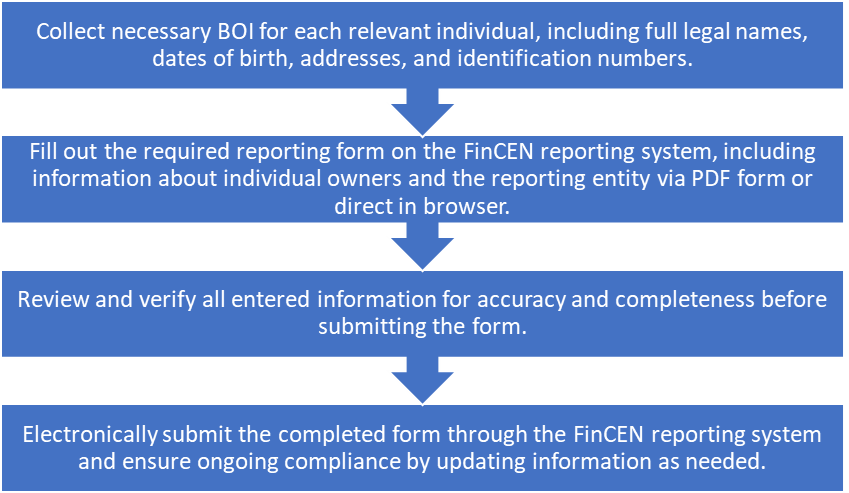
    The reporting companies can file electronically through a secure filing system available via FinCEN’s BOI E-Filing website. The E-Filing portal permits a reporting company to choose one of the following filing methods to submit a BOI:

    • Upload the finalized PDF version of the BOI report and submit it online.
    • Fill out a Web-based version of the BOI report and submit it online.

    A reporting company may submit its BOI report through either of these methods, both of which require the filing to be done online as BOIRs cannot be mailed or faxed to FinCEN. Step-by-Step process is defined in the below image.

    Corporate Transparency Act (CTA) – Key Reporting Requirements, Process Blog

    FinCEN expects that reporting companies can file by themselves through guidance given on the official website. However, reporting companies that need help meeting their reporting obligations can consult with tax professional service providers such as tax lawyers or accountants.


    Deadlines for BOI Filing

    1. A reporting company established or registered for business activities before January 1, 2024, is granted until January 1, 2025, to submit its initial BOI report.
    2. In the case of a reporting company created or registered in 2024, the timeline for filing extends to 90 calendar days from the point of receiving actual or public notice confirming the effectiveness of its creation or registration.
    3. For reporting companies formed or registered on or after January 1, 2025, the window for filing the initial BOI report is condensed to 30 calendar days from the receipt of actual or public notice affirming the effectiveness of the company’s creation or registration.


    Penalties for Non-compliance to CTA

    Within 90 days of the original report deadline, the reporting companies must correct a mistake or inaccuracy or submit reports to avoid penalties. However, failure to comply with BOI reporting obligations may result in civil and criminal repercussions. Under the CTA, intentional violations of BOI reporting requirements can lead to civil penalties of up to $500 for each day of non-compliance. Additionally, individuals may face criminal penalties, including imprisonment for up to two years and a fine of up to $10,000.

    Potential violations may include intentionally neglecting to submit a BOI report, knowingly submitting a false BOI, or purposefully neglecting to correct or update previously reported BOI. It is crucial to adhere to reporting obligations and promptly rectify any errors to avoid potential legal consequences outlined by the CTA.


    IRS Audit Group

    IRS Audit Group comprises tax professionals, CPAs, enrolled agents, and attorneys.  We are located in Los Angeles; California and our primary area of expertise is IRS Tax Audit Representation.  However, our certified professionals cooperate and work with all IRS offices across the country.  Please contact us for more information.  https://irsauditgroup.com/contact/

    Telephone Number: (310) 498-7508

    info@irs-audit-group.com
    Read more
    Blog on Smart Strategies for max refund

    Tax Refund in 2024 – What to know about Tax Filing and Refunds for Tax Season 2024

    Tax season 2024 is here, and it brings a blend of excitement and unease for numerous taxpayers. While taxes may not be exciting for all, there is one element of tax season that nearly everyone looks forward to the possibility of getting a tax refund. In 2024, navigating the complex realm of tax laws and regulations can be overwhelming, but by implementing effective strategies, you can maximize your refund and boost the amount of money you receive.

    To optimize your tax refund, it is crucial to maintain a high level of documentation throughout the year. It is always advisable to meticulously document all sources of income, expenses, and financial activities associated with your taxes. This entails retaining receipts for deductible expenditures like charitable contributions, medical bills, and business-related costs. By consistently keeping accurate records, you will have all the essential paperwork readily accessible for tax season 2024. This will simplify the process of claiming deductions and credits that have the potential to enhance your refund amount.


    Tax Deductions and Credits

    Maximizing deductions and credits can significantly lower your taxable income and boost your tax refund. It is crucial to make the most of these valuable tools in tax season 2024 by exploring all the deductions and credits that you are eligible for. Some commonly claimed deductions include expenses related to education, medical costs, and mortgage interest, among others. Follow the below key strategies to reduce taxable income.

    1. Homeowners who choose to itemize their deductions have the opportunity to benefit from the mortgage interest deduction. This tax provision allows individuals who own a home to deduct the interest they pay on their mortgage from their taxable income. By taking advantage of this deduction, homeowners can potentially reduce their overall tax liability and enjoy the financial advantages of owning a property. It serves as an incentive for individuals to invest in homeownership and provides a valuable tax benefit for those who qualify. Find whether you are eligible for mortgage interest deduction here.
    2. Taxpayers who choose to itemize their deductions have the opportunity to deduct the amount they paid in state and local income taxes, foreign income taxes along with any property taxes they have paid. This deduction, known as the State and Local Taxes (SALT) deduction, allows individuals to reduce their taxable income by the total amount they have paid in these taxes throughout the year. By taking advantage of this deduction, taxpayers can potentially lower their overall tax liability and keep more of their hard-earned money. As an individual, your deduction of state and local income, general sales, and property taxes is limited to a combined total deduction of $10,000 for the tax season 2024. You can check your eligibility for foreign income tax deductions here.
    3. Certain educational expenses, including tuition fees and interest on student loans, are eligible for deductions and credits. These deductions and credits provide individuals with the opportunity to reduce their taxable income and potentially lower their overall tax liability. By taking advantage of these benefits, individuals can alleviate some of the financial burden associated with pursuing higher education and make it more affordable for themselves or their dependents. It is important to consult with a tax professional or refer to the relevant tax laws and regulations to ensure eligibility and maximize the available deductions and credits for educational expenses.
    4. By making contributions to a retirement account, such as a 401(k) or IRA, you have the opportunity to reduce your taxable income and potentially receive a larger refund. This means that the money you contribute towards your retirement savings can positively impact your overall financial situation. By taking advantage of these retirement contribution options, you not only secure your future but also enjoy the immediate benefit of reducing your tax liability for the 2024 tax season and potentially receiving a higher refund.
    5. Tax-efficient investment strategies can play a crucial role in optimizing your tax refund. One effective approach is to consider contributing to a Health Savings Account (HSA) or Flexible Spending Account (FSA), which enables you to allocate pre-tax funds specifically for medical expenses. By doing so, you not only lower your taxable income but also have the potential to boost your refund. Another avenue to explore is investing in tax-exempt municipal bonds, which offer income that is exempt from federal taxes. This can significantly enhance your overall tax efficiency and contribute to a more favorable refund outcome.


    Seek Out for Tax Professionals

    Navigating the complexities of the tax code can be challenging, and failing to take advantage of deductions or credits could result in a smaller refund. It is advisable to consider the help of a qualified tax professional who can ensure compliance with tax laws while maximizing your refund. Although there may be associated costs, the potential for increased savings and peace of mind may outweigh the expense. In summary, to maximize your tax refund, it is important to plan, stay organized, utilize available deductions and credits, contribute to retirement accounts, and seek professional assistance when necessary. By employing these strategies, taxpayers can make the most of tax season 2024 and keep more money in their pockets, bringing them closer to achieving their financial goals.


    IRS Audit Group

    IRS Audit Group consists of tax professionals, CPAs, enrolled agents, and tax attorneys.  We are located in Los Angeles; California and our primary area of expertise is IRS Tax Audit Representation.  However, our certified professionals cooperate and work with all IRS offices nationwide.  Please contact us for more information.  https://irsauditgroup.com/contact/

    Telephone Number: (310) 498-7508

    info@irs-audit-group.com

    Read more

    IRS Audit Group

    Tax attorney in Beverly Hills, California

    9465 Wilshire Blvd., Suite 300 Beverly Hills, CA 90212

    468 N Camden Dr, Suite 200 Beverly Hills, CA 90210

    2901 West Coast Hwy Suite 200 Newport Beach, CA 92663

    Phone: 310-498-7508

    Fax : 310-300-1653

    Hours

    Sunday8:00am-5:00pm Monday8:00am-10:00pm Tuesday8:00am-10:00pm Wednesday8:00am-10:00pm Thursday8:00am-10:00pm Friday8:00am-10:00pm Saturday8:00am-10:00pm