

Skip to main content Skip to search
info@irs-audit-group.com   
9465 Wilshire Blvd., Suite 300 Beverly Hills, CA 90212 | 468 N Camden Dr, Suite 200 Beverly Hills, CA 90210

Request a free Consultation

    Mon - Sat: 8:00 -21:00
    + 888 300 6670
    info@IRS-Audit-Group.com

    Posts by ErezDikla

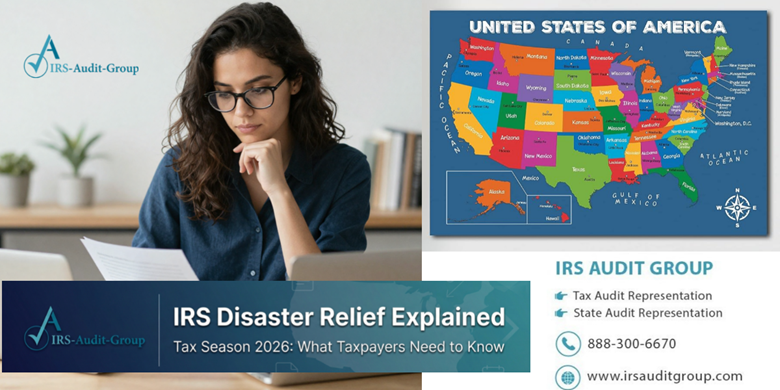
    IRS Disaster Relief Explained: Access to State-Wise Filing Deadline Extensions, Key Disasters and Taxes Covered – What Taxpayers Need to Know for Tax Season 2026

    As Tax Season 2026 begins, many taxpayers may get more time to file due to disaster-related tax relief. When natural disasters strike, the IRS often extends tax filing and payment deadlines for people and businesses in affected areas. Knowing whether you qualify for these automatic extensions can help taxpayers avoid penalties and reduce stress during an already difficult recovery period.

    What Is IRS Disaster Relief?

    When the President or FEMA declares a region a federal disaster area, the IRS typically responds by offering automatic tax relief. This relief usually includes extended filing and payment deadlines for individuals and businesses in affected areas. The goal is to provide financial breathing room during recovery, ensuring taxpayers can focus on rebuilding without worrying about immediate tax penalties.

    Key Disasters Covered in Tax Year 2025

    In 2025, several natural disasters prompted IRS relief measures:

    • Wildfires in New Mexico
    • Floods in West Virginia
    • Hurricanes and severe storms across the Southeast
    • Tornado outbreaks in the Midwest

    For each federally declared disaster, the IRS announced specific extensions, often pushing deadlines by several months. On the IRS “Around the Nation” page, you can find a state-by-state rundown of recent disaster-related tax relief announcements. It shows which states and local areas have had tax filing and payment deadlines postponed due to federally declared emergencies. The “Around the Nation” page makes it easy for taxpayers to check if their home or business address qualifies for extended deadlines.

    What Taxes Are Covered?

    The relief isn’t just for your individual income tax return (Form 1040). It typically includes:

    1. 2024 Individual and Business Returns: Originally due in March or April 2025.
    2. Estimated Tax Payments: Quarterly payments originally due in January, April, June, and September 2025.
    3. Payroll and Excise Tax Returns: Quarterly filings due throughout the year.
    4. IRA and HSA Contributions: The deadline to contribute to these accounts for the prior tax year is also extended to the new disaster deadline.

    Note: You do not need to apply for this relief. If your registered address is within the FEMA-declared disaster zone, the IRS computer systems automatically apply the extension and abate late-filing/late-payment penalties.

    How Extensions Work?

    • Automatic Relief: Taxpayers in disaster zones don’t need to apply; the IRS uses address data to identify eligible filers.
    • Extended Deadlines: Filing and payment deadlines (including quarterly estimated taxes, payroll filings, and business returns) are postponed. Each state and its tax relief postponed due dates can be viewed from the “Around the Nation” page.
    • Penalty Waivers: Late filing and payment penalties are waived for the duration of the extension.

    For example, taxpayers in New Mexico affected by wildfires had their April 15, 2025, deadline extended to August 15, 2025. Similarly, businesses in West Virginia flood zones received extensions into the fall.

    Why This Matters?

    Disaster relief is more than just extra time—it prevents compounding financial stress. Without extensions, taxpayers could face penalties and interest while simultaneously dealing with property loss, insurance claims, and rebuilding costs.

    Action Steps for Taxpayers in Disaster Areas

    1. Check IRS Disaster Relief Announcements: Visit the IRS “Tax Relief in Disaster Situations” page for updated lists of eligible counties. This page has redirects to the “Around the Nation” page to show counties affected by different disasters.
    2. Confirm Eligibility: Ensure your address is within the federally declared disaster zone.
    3. Keep Documentation: Maintain FEMA declarations, insurance claims, and IRS notices for records.
    4. File When Ready: Even with extensions, filing early can help secure refunds or credits sooner.

    IRS AUDIT GROUP

    IRS Audit Group consists of tax professionals, CPAs, enrolled agents, and tax attorneys.  We are located in Los Angeles, California and our primary area of expertise is IRS Tax Audit Representation.  However, our certified professionals cooperate and work with all IRS offices nationwide. Please get in touch with us for more information.

    Telephone Number: (310) 498-7508
    info@irs-audit-group.com

    Read more

    Top Seven IRS Audit Red Flags Due to New 2025 Federal Tax Law — How to Prepare and Avoid IRS Audit in the Tax Season 2026

    The 2025 tax law (the “One, Big, Beautiful Bill” or OBBBA) introduced sweeping changes to deductions, credits, and business expensing. While many taxpayers legitimately benefit from larger deductions and updated thresholds, the new rules also create fresh IRS audit risks. Aggressive claims, mismatches between federal and state treatment, and reporting changes (especially for marketplace and gig income) are among the top red flags the IRS will be watching in the coming tax filing season 2026.

    This guide explains the most important IRS audit red flags after the 2025 tax law and practical, step‑by‑step safeguards for taxpayers to avoid problems.

    WHY 2025 CHANGES INCREASE AUDIT RISKS?

    The IRS uses document matching, algorithms, and targeted industry programs to select returns for examination. Two broad reasons the 2025 law increases audit touchpoints:

    1. More complexity and new elections. Permanent 100% bonus depreciation, restored R&D expensing, and new reporting thresholds create additional tax elections that must be properly documented. Errors or overly aggressive positions increase IRS audit risk.
    2. Data matching and reporting shifts. Restored 1099-K thresholds and updated IRS reporting increase the risk of mismatches between third-party data and tax returns, a common trigger for IRS audits.

    TOP IRS AUDIT RED FLAGS (AND HOW TO AVOID THEM) IN TAX SEASON 2026

    1. Poorly documented Section 179/Bonus Depreciation claims: Full bonus depreciation (and higher Section 179 limits) can sharply reduce taxable income in year one. States that decouple may require add‑backs, and the IRS will want proof that the property qualifies and the basis is correct. Aggressive classification (personal vs. business use, listed property) draws attention.

      How to avoid:

      • Keep asset-level purchase invoices, delivery/installation records, and capitalization policies. 
      • Document business purpose and placed‑in‑service dates. 
      • If you operate in a state that decouples from bonus depreciation, model the required state addbacks and clearly document them in the tax workpapers.

      2. Schedule C (sole proprietor) returns with repeated losses or excessive expenses: Schedule C filings historically attract IRS audits. Repeated losses year after year or unusually large deductions (meals, travel, contractor labor, home office) can trigger a closer look for hobby‑loss rules or misstated business activity.

      How to avoid: 

      • Maintain a profit plan, time logs, sales records, and marketing documentation showing a profit motive. 
      • Keep receipts and contemporaneous logs for meals, mileage, and home office expenses. The IRS expects reliable records. See “Audits & Records Requests” for exactly what auditors ask for.

      3. Mismatches on third‑party reporting (1099‑K, 1099‑NEC, W‑2s): The IRS cross‑checks Forms W‑2/1099 against filed returns. If the gross receipts you report differ materially from what payers sent, the return becomes a prime candidate for examination. The 2025 Fact Sheet on Form 1099‑K clarifies reporting rules — but taxpayers still commonly underreport gross receipts or omit deductible offsets.

      How to avoid: Reconcile all 1099s to bank statements and accounting records before filing. Do not assume missing 1099s mean income is non-taxable; the IRS treats all income as taxable unless excluded by law. File an amended return promptly if errors are identified.

      4. Aggressive or unsupported R&D credit claims / large credits with weak substantiation: R&D credits remain attractive but complex. Large or recurring claims without solid project documentation, time studies, and cost support can trigger audits, especially after the 2025 changes to R&D expensing rules.

      How to avoid: 

      • Use project files, payroll records, invoices, lab notebooks, and technical summaries. If you claim credit, prepare a concise technical memo showing qualified activities and the costs allocated. Consider a pre‑filing R&D documentation review.

      5. High charitable deductions, noncash gifts, or appraisal issues: Large charitable deductions, especially for noncash property requiring Form 8283 or appraisals, draw automated screening. The IRS looks for valuation inconsistencies.

      How to avoid: Keep donation receipts, contemporaneous records, and qualified appraisals when required. If you claim a deduction for a vehicle or large property donation, follow Form 8283 and appraisal rules meticulously.

      6. Misuse of credits aimed at individuals (EITC, Child Tax Credit, adoption credit): Refundable credits attract scrutiny because they increase refund exposure. Incomplete eligibility (residency, support tests, AGI thresholds) can prompt automated checks and audits. The IRS recently adjusted many thresholds and credit amounts — know the updated rules.

      How to avoid: Keep documents proving eligibility (birth certificates, custody agreements, school records, proof of residency). When in doubt, consult guidance on the specific credit and error on the side of conservative claims.

      7. Large or unusual business interest expense or international tax positions: Changes to interest expense limits, GILTI/NCTI rules, and international tax provisions require careful calculation. Complex positions without proper transfer pricing support or documentation increase IRS audit risk.

      How to avoid: Maintain transfer pricing studies, contemplate documentation, and a qualified international tax memo. Run sensitivity analyses for different audit outcomes.

      WHY WORKING WITH A TAX PROFESSIONAL MATTERS NOW?

      The 2025 tax law made many valuable benefits available — but with added complexity that raises IRS audit risk if records are weak or taxpayers are careless.

      Tax professionals provide:

      • proactive tax planning around bonus depreciation and Section 179 elections.
      • R&D documentation and credit substantiation. 
      • federal vs. state conformity modeling to avoid surprise state tax bills.
      • audit defense and representation if needed.

      IRS Audit Group can help you review returns before filing, prepare organized work papers, and represent you during any IRS contact. For operational clients, we also provide staff training on audit‑ready recordkeeping.

      IRS AUDIT GROUP

      IRS Audit Group consists of tax professionals, CPAs, enrolled agents, and tax attorneys.  We are located in Los Angeles, California and our primary area of expertise is IRS Tax Audit Representation.  However, our certified professionals cooperate and work with all IRS offices nationwide.  Please get in touch with us for more information.

      Telephone Number: (310) 498-7508
      info@irs-audit-group.com

      KEY OFFICIAL RESOURCES

      Read more

      State Conformity for Tax Season 2026: Which States Adopted (or rejected) the Federal Tax Changes?

      The 2025 federal tax changes (commonly called the “One, Big, Beautiful Bill” or OBBBA) brought sweeping modifications to deductions, credits, and business expensing. While these changes were enacted at the federal level, states decide independently whether — and how — to “conform” to federal tax law. That means some states adopted certain provisions, some selectively adopted them, and others explicitly decoupled to protect state revenues.

      This guide is a state conformity tracker: it explains how conformity works, summarizes which states have adopted or rejected major 2025 federal changes (with links to official guidance), and offers practical advice for taxpayers and businesses.

      WHY STATE CONFORMITY MATTERS?

      When a state “conforms” to the Internal Revenue Code (IRC), it typically uses federal definitions (often based on a specific date) to compute state taxable income. But states can:

      • Adopt the IRC as of a certain date (rolling or fixed conformity), or
      • Pick-and-choose (selective conformity), or
      • Decouple (reject certain federal provisions and require add-backs).

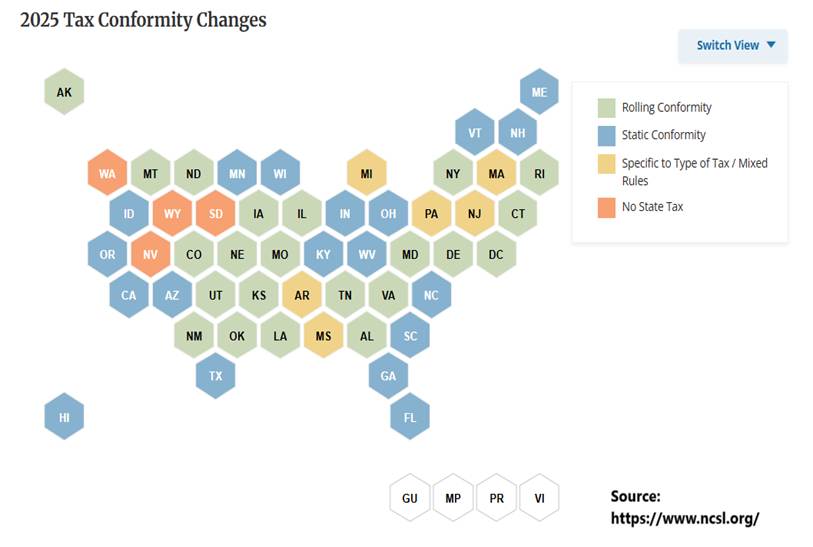
      Because the Tax Year 2025 law reintroduced large federal incentives — especially 100% bonus depreciation (168), restored immediate R&D expense (Section 174 changes), and worker-focused deductions (tips/overtime) states faced potentially large revenue losses. Many reacted by decoupling from some or all of those provisions. The National Conference of State Legislatures (NCSL) provides an ongoing summary of state conformity actions that can be viewed here: https://www.ncsl.org/fiscal/2025-tax-conformity-changes

      MAJOR NATIONAL TRENDS (WHAT MOST STATES ARE DOING)

      • Bonus depreciation & R&D expense: Many states have long chosen not to follow federal bonus depreciation rules. Some states fully disallow bonus depreciation. Others allow it only after taxpayers add it back and deduct it over time. For Tax Season 2026, those states largely kept the same position. They did not adopt the restored and expanded federal bonus depreciation. They continued to require add-backs instead. The same pattern applied to federal R&D expensing changes. Several states required taxpayers to add back R&D expenses rather than deduct them immediately. See the Tax Foundation’s state-by-state analysis to understand which state adopts or decouple. https://taxfoundation.org/wp-content/uploads/2025/07/OBBBA-State-Conformity-Handout.pdf
      StateTax Year 2025 ConformityWhat Changed / Key ImpactAuthoritative Reference
      CaliforniaSelective conformityAdvanced IRC date to Jan. 1, 2025, but excluded major OBBBA provisions. Many federal incentives do not flow through automatically.California Franchise Tax Board – Schedule CA Instructions
      New YorkAdd-backs requiredContinues separate depreciation calculations and requires adjustments for accelerated depreciation.NY Form IT-399 & Instructions
      IllinoisLegislative decouplingEnacted statutory decoupling from federal bonus depreciation and related provisions.Illinois FY-2025 Legislative Summary
      MichiganAdd-backs via formsUpdated individual and corporate forms to adjust for decoupled bonus depreciation and other federal changes.Michigan TY2025 Forms & Guidance
      DelawarePartial conformityPicks up the federal SALT cap increase but does not adopt certain worker-focused deductions (tips/overtime).Delaware Division of Revenue Notices
      Rhode IslandTargeted decouplingLimits bonus depreciation and/or R&D expensing; add-backs required.Link at the end of the table
      MarylandTargeted decouplingDoes not fully adopt federal bonus depreciation or immediate R&D expensing.Link at the end of the table
      New JerseyTargeted decouplingMaintains separate depreciation and expense timing rules.Link at the end of the table
      ConnecticutTargeted decouplingRequires add-backs for certain federal incentives.Link at the end of the table
      MassachusettsTargeted decouplingSelective conformity limits accelerated depreciation benefits.Link at the end of the table
      MinnesotaTargeted decouplingUses fixed conformity date; requires adjustments for newer federal provisions.Link at the end of the table
      PennsylvaniaTargeted decouplingDoes not follow federal bonus depreciation; state adjustments required.Link at the end of the table
      District of ColumbiaExplicit decouplingRejected certain OBBBA worker benefits, including no-tax tips and overtime; revenue redirected to local programs.D.C. Office of Tax and Revenue
      • Worker deductions (tips/overtime): A few jurisdictions (notably the District of Columbia) explicitly rejected or limited the federal “no tax on tips” / “no tax on overtime” provisions to preserve revenue or to fund alternate state programs.

      STATE-BY-STATE SNAPSHOT

      Below are states that took prominent actions to decouple, modify, or otherwise respond to 2025 federal changes. For each state, we include the authoritative link you can direct clients to.

      Aggregated for remaining State: https://taxfoundation.org/research/all/state/big-beautiful-bill-state-tax-impact

      HOW THIS AFFECTS TAXPAYERS — PRACTICAL EXAMPLES

      • Small business buys a $200,000 piece of equipment in 2025. Federally, 100% bonus depreciation may allow a full expense in 2025 — but if your state decoupled (e.g., California, Illinois), you’ll need to add back the bonus depreciation on the state return, increasing state taxable income. That may reduce the federal cash-tax benefit at the state level.
      • Retiree benefitting from the temporary senior deduction (extra $6,000): Some states (including D.C.) chose not to pick up the senior bonus deduction — meaning the retiree may pay more state tax despite lower federal tax.
      • Gig worker and 1099-K changes: The IRS reinstated the $20,000/200-transactions threshold for Form 1099‑K reporting under OBBBA, but some states used different thresholds or retained prior reporting rules — keep careful records and check both federal and state guidance. IRS FAQs: https://www.irs.gov/newsroom/irs-issues-faqs-on-form-1099-k-threshold-under-the-one-big-beautiful-bill-dollar-limit-reverts-to-20000.

      State conformity timelines — what to watch for

      States may update their tax code at any time — some will pass quick “decoupling” bills in reaction to revenue estimates; others will adopt gradual or rolling conformity. The NCSL and Tax Foundation maintain trackers and summaries that are updated frequently. https://www.ncsl.org/fiscal/2025-tax-conformity-changes.

      Where to find authoritative, state-specific guidance (quick links)

      IRS AUDIT GROUP

      IRS Audit Group consists of tax professionals, CPAs, enrolled agents, and tax attorneys.  We are located in Los Angeles, California, and our primary area of expertise is IRS Tax Audit Representation.  However, our certified professionals cooperate and work with all IRS offices nationwide.  Please get in touch with us for more information.

      Telephone Number: (310) 498-7508

      info@irs-audit-group.com

      Read more

      New Changes to U.S. Tax Year 2025/Tax Season 2026: What Individuals & Businesses Must Know?

      The 2025 U.S. tax year, a.k.a. Tax Season 2026, brings significant and wide-ranging changes that affect individuals, businesses, and multi-state taxpayers. This guide compiles the most important federal updates, highlights areas where states may differ, and provides direct links to IRS forms and authoritative guidance so taxpayers can find answers quickly.

      Overview — the new federal baseline
      Congress enacted a major tax package in 2025 that adjusted many 2017 Tax Cuts and Jobs Act (TCJA) era rules and added new taxpayer-focused benefits. The IRS has published summaries and fact sheets describing these changes in their official website. Please click the link: https://www.irs.gov/newsroom/one-big-beautiful-bill-provisions

      We have compiled and simplified the important key changes and benefits that all taxpayers need to know.

      Individual Taxpayer Highlights
      Standard deduction increases (tax year 2025, filed 2026):

      • Single / Married Filing Separately: $15,750 
      • Head of Household: $23,625 
      • Married Filing Jointly: $31,500

      These amounts were increased for inflation and adjusted in law. Higher standard deductions mean more taxpayers will find the standard deduction is advantageous compared to itemizing. Official IRS inflation-adjustment guidance for exact brackets and thresholds is here: https://www.irs.gov/newsroom/irs-releases-tax-inflation-adjustments-for-tax-year-2026-including-amendments-from-the-one-big-beautiful-bill

      Additional Senior Deduction (Temporary Benefit)
      For tax years 2025–2028, taxpayers aged 65+ may receive a bonus deduction (an additional $6,000 on top of the usual age/blind additional standard deduction). This raises the effective standard deduction for many seniors and retirees.

      Child and Family Credits
      The Child Tax Credit (and related family credits) received modest increases and continues to have income-based phaseouts. The Child Tax Credit is worth up to $2,200 per qualifying child. If taxpayers have little or no federal income tax liability, they may qualify for the Additional Child Tax Credit (ACTC), up to $1,700 per qualifying child, depending on the income. Taxpayers must have earned income of at least $2,500 to be eligible for the ACTC.

      Taxpayers qualify for the full amount of the Child Tax Credit for each qualifying child if they meet all eligibility factors and the annual income is not more than $200,000 ($400,000 if filing a joint return). Parents and guardians with higher incomes may be eligible to claim a partial credit.

      For complete eligibility rules, see: IRSChild Tax Credit: https://www.irs.gov/credits-deductions/individuals/child-tax-credit

      Worker-Focused Provisions
      The 2025 law introduced targeted exclusions and deductions for certain types of earned pay, including capped exclusions for qualifying tip income and for some overtime wages. These provisions are limited by income phaseouts and by other eligibility tests. Visit the IRS— Worker deductions & provisions fact sheets for detailed rules: https://www.irs.gov/newsroom/one-big-beautiful-bill-act-tax-deductions-for-working-americans-and-seniors

      Gig Economy Reporting (1099-K, 1099-NEC)


      1099-K threshold: The new law restored the higher reporting threshold for third-party settlement organizations — generally the $20,000 and 200 transactions rule in applicable periods. See the IRS FAQ on Form 1099-K: https://www.irs.gov/newsroom/irs-issues-faqs-on-form-1099-k-threshold-under-the-one-big-beautiful-bill-dollar-limit-reverts-to-20000

      1099-NEC & 1099-MISC: The contractor reporting landscape changed in the legislation. Filers and payers must review IRS instructions for current thresholds and filing rules. IRS — About Form 1099-NEC:https://www.irs.gov/forms-pubs/about-form-1099-nec

      Important reminder: Even if the gig economy workers do not receive a 1099, all taxable income must be reported on your return.

      Business & Pass-Through Entity

      100% bonus depreciation: The legislation made bonus depreciation more favorable in tax season 2026, allowing many qualifying business assets placed in service to be expensed immediately rather than depreciated over many years. This change enhances cash-tax planning for businesses that purchase equipment, machinery, and qualifying property.

      R&D expensing: Domestic research costs became more favorably treated, allowing many businesses to deduct qualifying R&D expenses in the year incurred. This is especially important for tech, manufacturing, and life sciences companies.

      International tax changes (GILTI / NCTI): The international provisions were revised, including changes to the treatment of Global Intangible Low-Taxed Income (GILTI), sometimes referred to in guidance by new names (e.g., Net CFC Tested Income). Multinational corporations should work closely with international tax advisors to model the changes.

      Opportunity zones: The law adjusted the rules around Opportunity Zone investments and made certain provisions permanent, encouraging long-term capital deployment into designated communities.


      Key Dates: https://www.irs.gov/individual-tax-filing

      • Federal filing deadline (tax year 2025 returns): April 15, 2026
      • Typical extension filing deadline (if extension approved): October 15, 2026

      Primary IRS forms and pages (clickable links):

      Other helpful IRS pages:

      IRS AUDIT GROUP

      IRS Audit Group consists of tax professionals, CPAs, enrolled agents, and tax attorneys.  We are located in Los Angeles, California and our primary area of expertise is IRS Tax Audit Representation.  However, our certified professionals cooperate and work with all IRS offices nationwide.  Please get in touch with us for more information.

      Telephone Number: (310) 498-7508
      info@irs-audit-group.com

      Read more
      Top Three Dirty Dozen Scams Listed by IRS in Tax Season 2025

      Beware of Tax Scams: How to Protect Yourself from the Top Three Dirty Dozen Scams Listed by IRS in Tax Season 2025

      As the 2025 tax season begins, tax scams are occurring more frequently, posing risks to taxpayers and making it crucial to stay informed about potential fraud schemes. Fraudsters continuously exploit taxpayers’ lack of tax knowledge, stress, and urgency to steal money or sensitive information. The IRS Dirty Dozen list for 2025 highlights the most prevalent and dangerous tax scams that taxpayers should be aware of to avoid falling victim to fraud.


      As a trusted tax audit representation firm, IRS Audit Group encourages taxpayers to stay vigilant and informed about these scams to safeguard their finances and personal data. Below, we discuss three of the most significant tax scams from the 2025 IRS Dirty Dozen list and provide essential tips on how to avoid them.


      1. Phishing and Smishing Scams

      Phishing (email scams) and smishing (text message scams) are among the most common tactics used by scammers to steal personal and financial information, such as Social Security numbers, banking details, and credit card information.


      How It Works

      • Scammers send fraudulent emails or text messages that appear to come from legitimate organizations like the IRS or a bank.
      • These messages often contain malicious links or attachments that install malware or redirect the taxpayer to fake websites.
      • Unsuspecting taxpayers who click on these links may unknowingly provide scammers with their sensitive information.


      How to Avoid Phishing and Smishing Scams

      • Be Skeptical – If you receive an unsolicited email or text asking for personal or financial information, it’s likely a scam. IRS does not ask for such details.
      • Use Multi-Factor Authentication (MFA) – Adding an extra layer of security to your accounts can help prevent unauthorized access.
      • Keep Your Devices Updated – Ensure your smartphone, computer, and other devices have the latest security updates to protect against malware.
      • Verify the Source – Always check the sender’s email address or phone number and contact the organization directly using official channels.


      1. Inflated Refund Claims

      Some fraudsters manipulate tax returns to artificially increase refunds, luring taxpayers into schemes that can lead to serious legal consequences.


      How It Works

      • False Promises – Scammers guarantee unusually high refunds without reviewing the taxpayer’s actual financial details.
      • Fraudulent Tax Preparers – Some unethical preparers ask taxpayers to sign blank forms or submit false information.
      • Unrealistic Deductions or Credits – Fraudsters claim deductions or credits that the taxpayer does not qualify for.
      • Fees Based on Refund Amount – Scammers charge fees based on the size of the refund, which is illegal and unethical.


      How to Avoid Inflated Refund Scams

      • Choose a Trusted Tax Preparer – Ensure your tax preparer is licensed and reputable. Avoid “ghost” preparers who refuse to sign returns.
      • Review Your Return – Before signing, check that all deductions and credits are accurate and legitimate.
      • Ignore Promises of Large Refunds – If an offer sounds too good to be true, it probably is.
      • Report Suspicious Activity – File a report with the IRS using Form 3949-A or through the IRS Whistleblower Program.


      1. Fake Tax Payments via Prepaid Cards

      Scammers may impersonate IRS agents and demand tax payments via prepaid debit or gift cards, leading unsuspecting taxpayers to lose money with no way to recover it.


      How It Works

      • Posing as IRS Officials – Scammers call or email claiming that the taxpayer owes back taxes and must pay immediately.
      • Demanding Unusual Payment Methods – Instead of traditional IRS payment methods, scammers insist on prepaid debit cards or gift cards (such as iTunes or Google Play cards).
      • Threats and Urgency – Scammers create a sense of fear by threatening arrest, fines, or asset seizures if immediate payment is not made.
      • Stealing the Funds – Once the taxpayer provides the prepaid card information, the scammer drains the funds, making recovery almost impossible.


      How to Avoid Fake Tax Payment Scams

      • Never Pay Taxes with Prepaid Cards – The IRS does not accept tax payments via prepaid or gift cards.
      • Verify the Caller’s Identity – If someone claims to be from the IRS, hang up and call the IRS directly at their official number.
      • Do Not Share Personal Information Over the Phone – The IRS will never demand sensitive information over an unsolicited phone call.
      • Monitor Financial Accounts – Regularly check your bank accounts for suspicious activity.


      Stay Protected Against Tax Scams in this Tax Season 2025

      By staying informed about the IRS Dirty Dozen scams and following best practices, taxpayers can significantly reduce their risk of falling victim to fraud in the 2025 tax season and beyond.


      If you have concerns about tax scams or need professional representation for an IRS audit, IRS Audit Group is here to help. Our team of tax professionals, CPAs, enrolled agents, and tax attorneys specializes in IRS Tax Audit Representation and works with all IRS offices nationwide.


      📞 Contact Us Today 🔗 IRS Audit Group
      📧 info@irs-audit-group.com
      📞 (310) 498-7508

      Read more
      Navigating the 2025 Tax Season: Essential Tax Relief Measures and Financial Assistance for California Wildfire Victims

      Navigating the 2025 Tax Season: Essential Tax Relief Measures and Financial Assistance for California Wildfire Victims

      California is known for its frequent and severe wildfires, particularly in the summer and fall. These fires can have a devasting impact on communities, ecosystems, and the economy. In January 2025, Southern California was hit by a series of devasting wildfires, most notably the Palisades Fire and the Eaton Fire, which caused substantial damage in the Los Angeles area. These fires have become the focus of recovery efforts and financial relief programs, particularly in the 2025 tax filing season.


      Impact of Wildfires on Tax Season 2025

      As tax season 2025 begins, victims of California wildfires may have special obstacles in completing their taxes and may need additional relief or extensions. Fortunately, both the Federal Government and California state authorities provide tax help for those affected by disasters like wildfires.


      Tax Relief Measures for Wildfire Victims

      Tax filing extension:

      The IRS provides automatic filing extensions to individuals and businesses affected by wildfires. This gives taxpayers in declared disaster zones extra time to file their returns without incurring penalties. Generally, the filing date is extended to October 15, 2025.

      The California Franchise Tax Board (FTB) also offers similar extensions for state taxes.


      Casualty Loss Deductions:

      FEMA (Federal Emergency Management Agency) assisted payments to wildfire victims are not taxable. As a result, taxpayers do not need to include disaster relief assistance as income on their tax returns. If your home or business is in a declared disaster zone, you may be eligible for special tax benefits or deductions due to wildfire damage.


      State-Specific Relief:

      California provides programs that allow taxpayers to postpone property tax payments or reduce assessed property values in response to wildfire damage, offering further relief to individuals affected.


      Automatic Filing Extensions:

      If you live in an affected location, the IRS will automatically provide you an extension to file your taxes. You do not need to take any more steps to obtain this extension.


      Local relief measures:

      In addition to Federal and State relief, various local government initiatives also provide tax relief or financial help, which include property tax deferrals or extensions, and support programs to assist businesses recover and maintaining operations.


      Steps to Take During Tax Season 2025 If You Are a Wildfire Victim

      1. Claim casualty losses: Keep track of and document all wildfire-related damages (ex: home damage car damage, lost possession, etc.).
      2. Consult a Tax professional: It is recommended that you speak with a tax professional who can walk you through the procedure, especially when it comes to seeking disaster-related tax relief.
      3. Check for Relief Programs: Check for updates from the IRS and the California Franchise Tax Board (FTB) on new or expanded relief programs for wildfire victims. You may also be qualified for disaster assistance programs, which provide financial assistance in addition to tax benefits.
      4. Document Your Payments: Keep detailed records of any fire-related losses and expenses, including receipts, photographs, and evidence of any relief payments received.


      The recent wildfires have already caused significant challenges for individuals and businesses in California, but with available tax relief measures and recovery programs, those affected have a better chance of rebuilding and recovering their financial stability during the 2025 tax season. The wildfire victims can reduce the strain of recovery and receive much-needed financial assistance by taking advantage of the available tax relief measures by Ithe RS.


      IRS AUDIT GROUP

      IRS Audit Group consists of tax professionals, CPAs, enrolled agents, and tax attorneys.  We are located in Los Angeles, California and our primary area of expertise is IRS Tax Audit Representation.  However, our certified professionals cooperate and work with all IRS offices nationwide.  Please get in touch with us for more information.

      https://irsauditgroup.com/contact/

      Telephone Number: (310) 498-7508

      info@irs-audit-group.com

      Read more
      Maximize Your Refund in This Tax Season 2025

      Maximize Your Refund in This Tax Season 2025: A Step-by-Step Guide to Tax Filing, Tracking, and Resolving IRS Refund Issues with Expert Help

      As the Tax Season 2025 begins, tax refund also becomes a commonly used term while filing the taxes with the IRS. A tax refund is the money that the IRS returns to the taxpayers if they’ve overpaid the taxes. Filing your tax return is an important step in meeting tax obligations and potentially earning a tax refund if overpaid. Tracking your tax refund status is simple, and the IRS provides a few useful tools to keep you updated. Below is the step-by-step guide on how the tax refund process works, and what support system does the IRS provide in tax refund?


      1. File your Tax Return

      Filing your tax return with the IRS is the initial step to getting your tax refund. To file tax returns, collect all necessary documents including W-2s, 1099s, receipts for deductions, etc. Complete the tax return using Form 1040 or other applicable forms.

      E-file: This is the fastest way of tax filing using electronic tax preparation software (ex: Turbo Tax, H&R Block, etc.) or directly through the IRS e-file system.

      Paper file: If you choose, you can send a paper return to the IRS.


      Mistakes in tax filing can result in delays or even tax audits. If you encounter discrepancies, our tax professionals can review your return to ensure compliance and accuracy.


      1. IRS Processes Your Tax Return

      Once you have filed your tax return, the IRS will process your tax return by checking the following.

      Review for accuracy: In this step, the IRS will check your information such as social security numbers, income, deductions, and credits are correct.

      Calculation of Refund: the amount of tax refund you’re entitled to will be calculated, based on total tax payments (via withholding or estimated payments) and the taxes owed.


      1. IRS Issues Your Refund

      Here is how your refund will be issued by the IRS:

      Direct Deposit: This is the fastest option for tax refund, if you choose direct deposit on your tax return, the IRS will send your refund directly to your bank account. If you e-filed your return and there are no issues, by direct deposit you will get your refund in 21 days or less.

      Paper Check: if you’ve opted for the paper check, the IRS will mail your refund to your address. Paper check refunds will typically take about 6 to 8 weeks to process and mail.


      1. Track Your Refund

      The IRS offers simple and reliable tools, that enable you to check the status of your refund after filing. The “Where’s My Refund?” tool is the simplest and most reliable way to check your return status online. You can get it through the IRS website or their mobile app. On mobile, you can use the IRS official app “IRS2Go” to track your refund status.


      Steps to Use the “Where’s My Refund?” Tool:

      Step 1: Open your web browser and visit the IRS official website.

      Step 2: On the “Where’s My Refund” page, enter the required information.

      • Social Security Number (SSN), or Individual Taxpayer Identification Number (ITIN)
      • Choose your filing status from the list (single, married filing jointly, head of household, etc.)
      • Enter the exact refund amount including any cents, as shown on your tax return

      Step 3: Click on the “Submit” button after entering your information to access the refund status

      Step 4: View your refund status.

      The tool will display one of the following statuses:

      • Return received – the IRS has received and it is processing your tax return
      • Refund approved – your tax return is approved by the IRS, and it will be sent soon
      • Refund sent – your refund has been issued either by direct deposit or paper check

      Step 5: Check for daily updates.

      Once a day the IRS will update the “Where is My Refund’ tool, usually overnight. So, for the most up-to-date information, check the IRS website once a day.


      How to use IRS2Go?

      Step 1: Download the App from the Google Play Store (Android) or the Apple App Store (iOS).

      Step 2: After downloading, open the app, and select the “Where is My Refund’ option.

      Step 3: Enter the Required Information (SSN, ITIN, etc.)

      Step 4: Check Your Refund Status


      1. Call the IRS (if needed)

      If you can’t access the IRS website or mobile app, or if you have specific questions regarding your refund status, you can call the IRS refund hotline: 1-800-829-1040.


      While the IRS provides tools to track your tax refund, discrepancies can sometimes arise. If you face issues with your tax refund—such as refund delays, tax audits, or incorrect refund amounts—our expert tax audit representation team is here to help.


      IRS AUDIT GROUP

      IRS Audit Group consists of tax professionals, CPAs, enrolled agents, and tax attorneys.  We are located in Los Angeles, California and our primary area of expertise is IRS Tax Audit Representation.  However, our certified professionals cooperate and work with all IRS offices nationwide.  Please get in touch with us for more information.

      https://irsauditgroup.com/contact/

      Telephone Number: (310) 498-7508

      info@irs-audit-group.com

      Read more
      Energy Efficient Home Improvement Credit and the Residential Clean Energy Property Credit

      Energy Efficient Home Improvement Credit and the Residential Clean Energy Property Credit – Check Out the Latest Changes for Tax Year 2024-2025

      What is the Energy Efficient Home Improvement Credit?

      The Energy Efficient Home Improvement Credit is a tax incentive for homeowners who make qualified energy-efficient improvements to their homes. This credit allows taxpayers to claim up to 30% of certain qualified expenses, including energy efficiency improvements, residential clean energy property, and home energy audits. The maximum credit one can claim in this tax season 2025 is $3,200 if taxpayers make qualified energy-efficient improvements to your home after Jan. 1, 2023.


      What is the Residential Clean Energy Property Credit?

      The Residential Clean Energy Property Credit is a tax credit for homeowners investing in renewable energy systems like solar, wind, geothermal, fuel cells, or battery storage technology.


      Who is Eligible?

      To qualify for the Energy Efficient Home Improvement Credit, the home must be your primary residence, located in the United States, and an existing home that you improve or add onto. For the Residential Clean Energy Property Credit, you may claim the credit for improvements to your main home, whether you own or rent it. The credit applies to new or existing homes located in the United States.


      How to Apply?

      To apply for these credits, taxpayers need to file IRS Form 5695 with their tax return. Make sure to keep records of your qualified expenses, including receipts and manufacturer certifications, to support your claim.


      What are the New Changes for the Tax Year 2024-2025?

      For the Energy Efficient Home Improvement Credit, starting from tax season 2025.


      • Qualified Manufacturer Requirement: No credit will be allowed for an item unless it is produced by a qualified manufacturer recognized by the IRS.
      • PIN Reporting: Taxpayers must report the Product Identification Number (PIN) for each qualifying item on their tax return to claim the credit.


      For the Residential Clean Energy Property Credit, the credit percentage rate remains at 30% for property installed through 2032, but it will phase down to 26% for property placed in service in 2033 and 22% for property placed in service in 2034.


      These credits provide a significant opportunity for homeowners to invest in energy-efficient and renewable energy improvements, reducing their tax burden while contributing to a more sustainable future.


      Eligibility Requirements for Energy Efficient Home Improvement Credit

      1. Primary Residence: The home must be your primary residence and located in the United States.
      2. Existing Home: The credit applies to improvements made to an existing home, not a new home.
      3. Qualified Improvements: The improvements must meet specific energy efficiency standards, such as:
      4. Business Use: If you use your home partly for business, the credit is based on the share of expenses allocable to non-business use.


      Eligibility Requirements for Residential Clean Energy Property Credit

      1. Main Home: The credit applies to improvements made to your main home, whether you own or rent it. The home must be located in the United States.
      2. Qualified Clean Energy Property: The property must be new and meet specific requirements, such as:
        • Solar electric panels and solar water heaters must be certified for performance by the Solar Rating & Certification Corporation or a comparable entity. To get certified by the Solar Rating & Certification Corporation (SRCC), manufacturers must apply for OG-100 (solar collectors) or OG-300 (solar water heating systems) certification. They need to submit an application with product specifications, undergo testing at an SRCC-recognized lab, and pass a performance review. Upon approval, SRCC issues certification, which may require periodic renewal. For details, visit the SRCC Application Resources.
        • Wind turbines, geothermal heat pumps, and fuel cells must meet the highest efficiency tier established by the Consortium for Energy Efficiency (CEE). To qualify for the Energy Efficient Home Improvement Credit, wind turbines, geothermal heat pumps, and fuel cells must meet the highest efficiency tier established by the Consortium for Energy Efficiency (CEE). For detailed information on these efficiency tiers, please refer to the CEE Tiers and ENERGY STAR page.
        • Battery storage technology must have a capacity of 3 kilowatt-hours or greater.
      3. Business Use: If you use your home partly for business, the credit is based on the share of expenses allocable to non-business use.


      The Energy Efficient Home Improvement Credit and the Residential Clean Energy Property Credit provide valuable incentives for homeowners to invest in energy-efficient and renewable energy improvements. These credits not only reduce your tax burden but also contribute to a more sustainable and eco-friendly future. By understanding the eligibility requirements, maintaining proper documentation, and staying informed about the latest changes, taxpayers can take full advantage of these credits and make impactful improvements to their homes. Keep in mind the importance of keeping accurate records and verifying that the products you install meet the required standards to ensure a smooth application process.


      IRS Audit Group consists of tax professionals, CPAs, enrolled agents, and tax attorneys.  We are located in Los Angeles, California, and our primary area of expertise is IRS Tax Audit Representation.  However, our certified professionals cooperate and work with all IRS offices nationwide.  Please get in touch with us for more information.


      Contact

      Telephone Number: (310) 498-7508

      info@irs-audit-group.com

      Read more
      Alternative Dispute Resolution (ADR) in Tax Season 2025

      Alternative Dispute Resolution (ADR) in Tax Season 2025: Find Fast Track Settlement (FTS) Pilot Programs of IRS in 2025

      Tax disputes between the IRS and taxpayers often arise due to discrepancies in tax filings, misinterpretation of tax laws, or IRS audits. When a taxpayer undergoes a tax audit, they might contest the IRS’s evaluation, which can necessitate the use of Alternative Dispute Resolution (ADR).  ADR is a series of processes that allow taxpayers and the IRS to resolve tax problems outside of the typical litigation or formal appeals processes. The purpose of ADR is to provide taxpayers with a speedier, less expensive, and more flexible way to resolve issues with the IRS while reducing the adversarial nature of tax disputes.


      This tax season 2025, the IRS has made significant modifications to its ADR programs to improve their efficiency, accessibility, and fairness. To enhance efficiency and accessibility, the IRS has introduced three pilot programs focusing on the Fast Track Settlement (FTS) and Post-Appeals Mediation (PAM) processes. These initiatives, effective from January 15, 2025, to January 15, 2027, aim to expedite dispute resolutions between taxpayers and the IRS.


      Overview of the Pilot Programs

      1. Expansion of FTS Eligibility: Traditionally, FTS was available to specific taxpayer segments. In the tax season 2025, the new pilot program broadens eligibility, allowing a wider range of taxpayers under examination in the Large Business and International (LB&I), Small Business/Self-Employed (SB/SE), and Tax Exempt/Government Entities (TE/GE) divisions to participate. This expansion aims to facilitate quicker resolutions by involving Appeals earlier in the examination process.
      2. “Last Chance” FTS: This pilot introduces an opportunity for cases that have already been through the traditional Appeals process without resolution to re-enter FTS. By doing so, it provides a final chance for settlement before potential litigation, promoting efficiency and reducing the burden on both taxpayers and the IRS.
      3. Concurrent Use of FTS and PAM: Previously, participation in FTS precluded taxpayers from utilizing PAM. The new pilot removes this restriction, allowing taxpayers to engage in both ADR processes. This change encourages the use of multiple resolution avenues, enhancing the likelihood of timely settlements.


      Implications for Taxpayers

      These pilot programs reflect the IRS’s commitment to making ADR processes more efficient and accessible. By expanding eligibility and providing additional opportunities for resolution, taxpayers can expect a more streamlined experience when addressing disputes. The concurrent use of FTS and PAM, in particular, offers flexibility, enabling taxpayers to explore multiple pathways to resolve their issues without the constraints of previous limitations.


      Why ADR Matters in IRS Audits

      IRS audits are conducted to verify the accuracy of tax returns, ensuring that taxpayers comply with federal tax laws. If an audit results in additional tax liabilities, penalties, or other disputes, taxpayers can challenge the IRS’s findings through appeals or ADR. The new FTS programs offer a faster, less adversarial way to resolve tax disputes compared to lengthy appeals or litigation.


      How an IRS Audit Representation Firm Can Help

      If you or your business is undergoing an IRS audit, working with a professional IRS audit representation firm can significantly improve your chances of a favorable outcome. These experts can:

      • Guide you through the audit process
      • Represent you in ADR proceedings, including FTS and PAM
      • Negotiate settlements with the IRS to minimize liabilities.
      • Ensure compliance with tax laws to prevent future audits.


      The IRS’s introduction of new ADR pilot programs in the 2025 tax season reflects its commitment to making tax dispute resolutions faster and more accessible. Taxpayers undergoing an IRS audit now have improved options to resolve disputes efficiently through expanded FTS eligibility and mediation opportunities. If you are facing an IRS audit and need professional representation, seeking help from an IRS audit representative firm can be the key to a smoother resolution.


      IRS Audit Group consists of tax professionals, CPAs, enrolled agents, and tax attorneys.  We are located in Los Angeles, California, and our primary area of expertise is IRS Tax Audit Representation.  However, our certified professionals cooperate and work with all IRS offices nationwide.  Please get in touch with us for more information.


      Contact

      Telephone Number: (310) 498-7508
      info@irs-audit-group.com

      Read more
      EITC and News for the Tax Season 2025

      Earned Income Tax Credit (EITC) and its Benefits – EITC Celebrates 50th Anniversary – EITC and News for the Tax Season 2025

      Introduced in 1975, the Earned Income Tax Credit (EITC) is celebrating its 50th anniversary in this 2025 tax season. EITC provides financial relief to millions of working families and individuals with low to moderate incomes. In the previous Tax Season, 2024, approximately 23 million workers and families received about $64 billion from EITC, with the average recipient receiving $2,743.


      The EITC has made significant updates to its program to benefit taxpayers in this filing season of 2025. Below are the several changes that taxpayers must be aware of.


      1. Increased Maximum Credit

      The maximum credit has increased to $7,830 (up from $7,430 in 2023) for taxpayers with three or more qualifying children. For taxpayers with two qualifying children, the credit is up to $6,804. For taxpayers with one qualifying child, it is up to $3,995. The maximum credit for taxpayers with no qualifying children is $600 (up from $560). Individuals without children are eligible for the EITC, which provides credit even if they do not have dependents.


      1. Broader Eligibility

      Income limits have been increased a little for the 2025 tax season, making EITC available to a greater pool of eligible workers, particularly those with modest incomes. Investment income must be $11,600 or less to qualify for EITC, ensuring that the people who earn money from investments will also qualify for the credit.


      1. Tax Refunds for Eligible Workers

      For qualifying workers, EITC can provide a significant refund, reducing tax payments or even resulting in a refund if no taxes are payable. Even those workers without children owe no federal income tax, they may be eligible for a return through the EITC.


      1. Enhanced Filing Procedures with IP PIN

      To combat identity theft and streamline processing, the IRS now allows taxpayers to electronically file returns even if a dependent has been claimed on a separate, previously filed return. This is possible if the primary taxpayer on the subsequent return includes a valid Identity Protection Personal Identification Number (IP PIN). This change aims to reduce processing times and expedite refunds for those affected by duplicate dependent claims. Taxpayers without an IP PIN will have their e-filed returns rejected if a dependent has already been claimed by another filer. To obtain an IP PIN, taxpayers can use the IRS’s online tool, ensuring they have this six-digit number to protect their tax filings.


      Who is Eligible for the EITC in Tax Season 2025?

      The EITC is designed to benefit low-to-moderate-income workers, particularly those with children. Eligibility for the 2024 tax year (filed in Tax Season 2025) depends on income level, filing status, and the number of qualifying children.


      Basic Eligibility Requirements:

      • Must have earned income from employment, self-employment, or certain disability payments.
      • Investment income must be $11,600 or less for the tax year 2024.
      • Must have a valid Social Security number for themselves, their spouse (if filing jointly), and any qualifying children.
      • Cannot file as “Married Filing Separately.”
      • Must be a U.S. citizen or resident alien all year.
      • Cannot claim foreign earned income exclusion.


      How to Claim the EITC


      Step 1: Determine Eligibility: Use the IRS EITC Assistant Tool to confirm eligibility. Workers also may visit the Child-related tax benefits comparison page to learn more about basic eligibility rules for the EITC and several other tax credits

      Step 2: File a Federal Tax Return: Even if not required to file due to low income, taxpayers must file a tax return (Form 1040) and include Schedule EIC if they have qualifying children.

      Step 3: Provide Required Information: Include earned income details (W-2s, 1099s, self-employment records). If claiming children, provide Social Security numbers and details proving residency.

      Step 4: Choose E-File for Faster Processing: E-file with Direct Deposit for the fastest refund.

      Step 5: Expect Delayed Refunds If Claiming EITC: Due to anti-fraud measures, the IRS cannot issue refunds before mid-February if the return includes EITC or Additional Child Tax Credit (ACTC).


      IRS AUDIT GROUP

      IRS Audit Group consists of tax professionals, CPAs, enrolled agents, and tax attorneys.  We are located in Los Angeles, California, and our primary area of expertise is IRS Tax Audit Representation.  However, our certified professionals cooperate and work with all IRS offices nationwide.  Please get in touch with us for more information.


      Contact

      Telephone Number: (310) 498-7508

      info@irs-audit-group.com

      Read more

      IRS Audit Group

      Tax attorney in Beverly Hills, California

      9465 Wilshire Blvd., Suite 300 Beverly Hills, CA 90212

      468 N Camden Dr, Suite 200 Beverly Hills, CA 90210

      2901 West Coast Hwy Suite 200 Newport Beach, CA 92663

      Phone: 310-498-7508

      Fax : 310-300-1653

      Hours

      Sunday8:00am-5:00pm Monday8:00am-10:00pm Tuesday8:00am-10:00pm Wednesday8:00am-10:00pm Thursday8:00am-10:00pm Friday8:00am-10:00pm Saturday8:00am-10:00pm