

Skip to main content Skip to search
info@irs-audit-group.com   
468 N Camden Dr, Beverly Hills, CA 90210 | 2901 West Coast Hwy, Suite 200, Newport Beach, CA 92663

Request a free Consultation

    Mon - Sat: 8:00 -21:00
    + 888 300 6670
    info@IRS-Audit-Group.com

    Sales

    WOTC Tax Benefits

    What is Work Opportunity Tax Credit? How Employers Can Benefit from the Same?

    The Work Opportunity Tax Credit (WOTC) is a federal tax credit that businesses can use to offset the cost of hiring people from specific target groups who have consistently encountered significant barriers to employment. WOTC initiatives help to improve workplace diversity and make it easier for all citizens to acquire decent jobs.

    The Consolidated Appropriation Act, 2021 authorized the extension of the Work Opportunity Tax Credit until December 31, 2025. This means taxpayers can claim the credit on or before Dec 31, 2025, for such eligible hiring. Needless to say, WOTC is only for one time per employee and cannot be claimed for re-hired.

    Eligible Businesses for WOTC

    There is no specific limit on business size to be eligible under this scheme. Any size of business is eligible for the work opportunity tax credit if it hires candidates from qualified groups. This credit is available to both taxpayers and certain tax-exempt employers operating in the United States and some U.S. territories. Basically, the employers must fall under the below criteria as

    • Taxpayers that can claim the credit against income taxes
    • Tax-exempt employers can claim the credit only against payroll taxes and only for wages paid to members of the qualified veteran targeted group.

    Target Groups Qualified under WOTC

    Any employers can claim WOTC for the below-targeted groups under section 51 of the Code. The employee must be a certified member of any one of the following groups to proceed with the claim.

    • Veterans
    • Recipients state assistance under part A of title IV of the Social Security Act (SSA)
    • Individuals who have previously served time in prison or who have been convicted of a felony
    • People who live in empowerment zones or rural renewal counties
    • Individuals who have been referred to an employer after completing a rehabilitation plan or program
    • People whose families receive supplemental nutrition assistance under the Food and Nutrition Act of 2000
    • Recipients of supplemental security income benefits under title XVI of the SSA
    • Individuals experiencing long-term unemployment

    How much can be claimed?

    The amount of tax credit under the WOTC program varies based on the employee’s target group, total hours worked, and total qualified wages earned. For instance,

    • If the qualified employee has worked for at least 400 hours and is still in the first year of employment, WOTC is equal to 40% of up to $6,000 wages paid or incurred with a maximum credit of $2,400 for an employee
    • If the eligible employee has 120 to 399 hours of service, then a 25% rate applies to wages
    • Up to $24,000 in wages may be considered in determining the WOTC for certain qualified veteran targeted group

     Procedure to Claim WOTC

    Taxpayers and Tax-exempt organizations can apply through different IRS Forms to claim WOTC. But all need to complete Form 8850 which is a Pre-Screening Notice and Certification Request to certify that the employee is qualified under the target group. These documents must be submitted to the State Workforce Agency not the IRS within 28 days of the new employee’s start date. Once the State Workforce Agency certifies the employee, Taxpayers can file Form 5884 (Work Opportunity Credit) and tax-exempt employers file Form 5884-C (Work Opportunity Credit for Qualified Tax-Exempt Organizations Hiring Qualified Veterans) to claim the WOTC.

    IRS Audit Group is a Tax Audit Representation Firm in Los Angeles, California. Our Tax professionals act on the behalf of the taxpayer during an IRS audit. The IRS audit process can terrify some taxpayers but the Taxpayer Bill of Rights states that individuals can seek help from an IRS tax representative like us to represent them during the IRS audit. Don’t Panic, if you have received a mail for IRS Audit but act fast by contacting us immediately for the next step.

    https://irsauditgroup.com/contact/

    Telephone Number: (310) 498-7508

    Email address: info@irs-audit-group.com
    Read more
    Qualified Opportunity Fund and Tax Filling - 2022

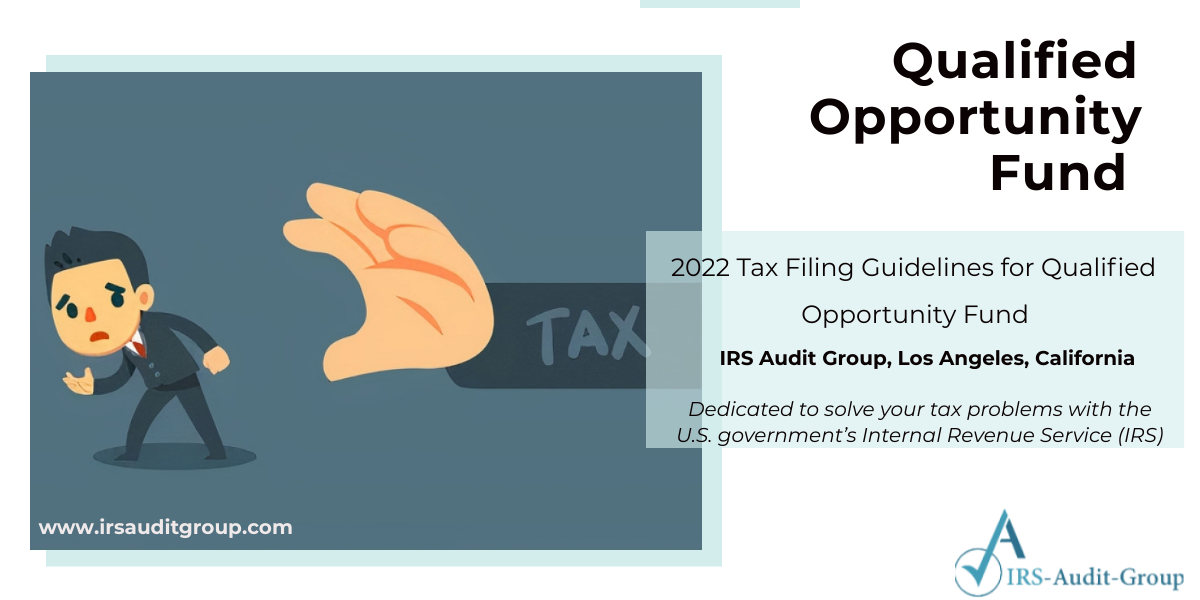
    Qualified Opportunity Fund and Tax Filling – 2022 Tax Filing Guidelines for Qualified Opportunity Fund

    Qualified Opportunity Fund (QOF) is an investment vehicle formed as a company or partnership with the goal of investing in property within Qualified Opportunity Zones. This program was formed per the 2017 Tax Cuts and Jobs Act to provide a tax incentive for private, long-term investment in economically distressed communities. There are thousands of low-income communities in all 50 states, the District of Columbia and five U.S. territories that are designated as Qualified Opportunity Zones. Taxpayers can invest in these zones through Qualified Opportunity Funds. This type of opportunity funds assists taxpayers in giving tax advantages and rewards to investors.

    Certain types of businesses cannot be included in opportunity funds, even if it falls within opportunity zones. Following are types of business which are not included in opportunity funds.

    • Golf courses
    • Country clubs
    • Massage parlors
    • Hot tub facilities
    • Suntan facilities
    • Racetracks or other facilities used for gambling
    • Liquor stores

    Eligibility Criteria

    To certify and maintain a Qualified Opportunity Fund, an entity must:

    • Be a partnership, corporation, or LLC that is treated as a partnership or corporation, and it must have filed a federal income tax return;
    • Be organized for the purpose of investing in Qualified Opportunity Zone property under the laws in one of the 50 states, the District of Columbia, a U.S. possession, or a federally recognized Indian tribal government: and
    • Hold 90% of its assets in Qualified Opportunity Zone property.

    IRS Form Required to Certify as a Qualified Opportunity Fund

    The entity must file Form 8996, QOF, with the qualifying partnership or corporation’s federal tax return each year to attest and retain its status as a Qualified Opportunity Fund. The entity must file Form 8996 by the due date for 2022 tax return (including extensions).

    Form 8996 is used to:

    • Certify the corporation or partnership is organized to invest in Qualified Opportunity Zone property.
    • Report that it meets the 90% investment standard of section 1400Z-2.
    • Figure the penalty if it fails to meet the 90% investment standard.

    Benefits to the Taxpayers

    The QOF basically provides tax deferral to the capital gains if the taxpayer elects to do so. The basis in the QOF investment becomes zero when one elect to defer the gain. The longer the investment in the QOF, the higher the basis grows. The tax benefit received is determined by the length of time one retains the Qualified Opportunity Fund investment. For instance

    • After five years, a taxpayer who defers gains through a Qualified Opportunity Fund investment obtains a 10% step-up in tax basis
    • It will be followed by another 5% step-up after seven years. Note that the taxpayer must have invested before December 31, 2019, to receive the entire 15% step-up in tax base. The taxpayer will have held the investment in the fund for seven years when the tax is triggered at the end of 2026, thereby qualifying for the 15% increase in tax basis.
    • If the taxpayer holds the investment in the QOF for at least 10 years, then such taxpayer may be able to permanently exclude gain resulting from a qualifying investment when it is sold or exchanged.

    A team of tax attorneys from IRS Audit Groups helps taxpayers in filling their IRS return for 2022. We are certified tax lawyers who represent taxpayers during any IRS audit. We can resolve common tax problems to complex audit sessions to help comply our clients. Get free consultation by calling or filling the enquiry from our website below

    https://irsauditgroup.com/contact/

    Telephone Number: (310) 498-7508

    Email address: info@irs-audit-group.com

    Read more

    How to Approach Sales Tax Audit – Tips from IRS Audit Group Newport Beach

    Tax

    To deal with budget shortfalls, state governments revenue agencies continue stepping up their efforts in raising revenue through sales tax audits.

    You never ask for it, but you have been selected for and will be notified of a sales tax audit. At that point in time you may get confused – What should you do and what you should not? Most companies are not regularly audited by the state for sales and use tax purposes, so it is unlikely you have previously handled an audit. While the requested lists of records and documents that will be reviewed appear straightforward, there is much more to handling a sales tax audit. There are a lot of potential pitfalls during the interaction with auditors that may occur as you address the questions they typically ask.

    Here are a few tips to Manage Your Sales and Use Tax Audit from IRS Audit Group Newport Beach. The best practices as listed below need to be considered in such situation.

    Hire an external representative tax expert. IRS Audit Group Newport Beach has a pool of experts specializing in State Sales Tax matter. Once you are identified for audit, it is better to initiate communication with experts. They can discuss the audit process with you, provide some background on various sampling methods, and provide insights on specific industry issues targeted by the state. Also, make them aware of the initial schedules vs. revised schedules.
    Ask your tax expert from if it is appropriate to perform a refund study or reverse audit at the same time to identify potential opportunities for refunds. IRS Audit Group Newport Beach can provide immediate solutions to such questions.
    Do not engage in contingent fee arrangements on questioned items by the auditor unless you have already made the first pass. Otherwise, you may be paying them on reductions for errors made by the auditor or obvious exempt transactions.
    If sales state tax auditors are doing a refund study/reverse audit, their fee should not be based on savings in periods outside the audit period. Their fee should always be based on offsets actually granted by the state. Payment should be made at the end of the audit, or a provision should be included to reverse any offsets not allowed.
    A sales tax audit is not an ordinary occurrence. Therefore, you need to invest the proper efforts internally or with external assistance from experts like IRS Audit Group Newport Beach.

    Lastly, be ready to play defence. Do not assume all questioned sales and purchases are taxable. Familiarize yourself with the regulations of your state with the help of expert advice from IRS Audit Group Newport Beach. Once you are convinced that questioned item should not be assessed, go ahead and challenge it. Also, understand any sampling techniques employed by the auditor, and be sure samples used are representative of your operations. If you have not experienced a sales tax audit before, and unfamiliar with your state’s regulations, or you have identified significant problem areas in your self-review, you may want to consider engaging a tax advisor to assist in your defence.

    IRS Audit Group Newport Beach professionals are knowledgeable and experienced in assisting companies undergoing state sales and use tax audits as well as conducting overpayment reviews. Let IRS Audit Group Newport Beach help you navigate the audit landscape.

    Telephone Number: (310) 498-7508
    info@irs-audit-group.com

    Read more

    IRS Audit Group

    Tax attorney in Beverly Hills, California

    468 N Camden Dr #200,
    Beverly Hills, CA 90210, USA

    Call: +1 310 498 7508

    Hours

    Sunday8:00am-5:00pm Monday8:00am-10:00pm Tuesday8:00am-10:00pm Wednesday8:00am-10:00pm Thursday8:00am-10:00pm Friday8:00am-10:00pm Saturday8:00am-10:00pm