

Skip to main content Skip to search
info@irs-audit-group.com   
468 N Camden Dr, Beverly Hills, CA 90210 | 2901 West Coast Hwy, Suite 200, Newport Beach, CA 92663

Request a free Consultation

    Mon - Sat: 8:00 -21:00
    + 888 300 6670
    info@IRS-Audit-Group.com

    finacial

    Blog on IRS Dirty Dozen Scam Alerts

    Navigating Tax Season 2024 Safely: 12 Important Scam Alerts by IRS

    As the Tax Season 2024 is here, so are potential scams and fraudulent activities, prompting the IRS to issue warnings about common schemes. Here’s a compilation of important facts about various scams and advice by the IRS for Tax Season 2024.


    False Fuel Tax Credit Claims

    Taxpayers should be highly cautious of false Fuel Tax Credit claims, as warned by the IRS in its Dirty Dozen list for Tax Season 2024. Scammers often target individuals with promises of significant refunds through illegitimate claims for this credit, exploiting unawareness of its eligibility criteria. Vigilance, verification of information, and reliance on official IRS resources are crucial to avoid falling prey to these scams, emphasizing the importance of a thorough review process to ensure accurate and lawful tax filings.


    Untrustworthy Tax Preparers (Ghost Preparers)

    Taxpayers must remain vigilant against untrustworthy tax preparers, a prominent warning from the IRS’s Dirty Dozen list for Tax Season 2024. The term “ghost preparers” refers to individuals who may not sign tax returns they prepare, leaving taxpayers vulnerable to potential fraud and identity theft. These preparers often promise inflated refunds or charge exorbitant fees, exploiting unsuspecting individuals. Taxpayers must verify the credentials of their tax preparers, ensuring they are qualified, registered, and reputable. Relying on certified tax professionals and maintaining awareness of red flags can help protect against financial losses and legal complications during tax filing.


    Fake Charities Exploiting Taxpayer Generosity

    The IRS’s inclusion of fake charities in its “Dirty Dozen” list underscores the risks taxpayers face during tax season. These scams prey on people’s goodwill, using deceptive tactics to extract money without benefiting genuine charitable causes. IRS advises to beware of scammers who might use email communications or manipulate caller IDs to deceive people into donating funds to charities. These fraudsters often target groups such as seniors and those with limited English proficiency. Taxpayers must remain vigilant, verifying the legitimacy of charities before donating.


    Offer in Compromise Mills

    Another scam for Tax Season 2024 is pricey offer-in-compromise (OIC) “mills” that falsely claim their services are necessary to resolve IRS debt. The OIC program offered by the IRS is a beneficial avenue for taxpayers struggling to settle their federal tax debts, and reputable companies are providing legitimate assistance. However, the IRS advises individuals to invest a few moments in reviewing the resources provided on IRS.gov to ascertain if they qualify for the OIC program. This step helps individuals avoid costly promoters and ensures they understand the eligibility criteria thoroughly before seeking assistance.


    Helpful Scammers Offering to Set Up Online Accounts

    The IRS warns against scammers offering to set up online accounts. The IRS Online Account serves as a convenient tool for individuals to access their tax information. However, it has also become a target for identity thieves who exploit it to file fraudulent tax returns and claim hefty refunds in the victim’s name. Taxpayers should avoid sharing sensitive personal data over the phone, email, or social media to protect themselves and avoid getting caught up in these scams.


    Aggressive Promoters Making Questionable ERC Claims

    The IRS’s “Dirty Dozen” for tax season 2024 list includes a warning about aggressive promoters who entice taxpayers into making questionable claims for the Employee Retention Credit (ERC). This scam targets small businesses, urging them to engage in activities that could lead to tax non-compliance and penalties. Taxpayers are advised to exercise caution and seek reliable tax professionals’ advice to avoid falling victim to these deceptive practices. As the IRS is continuing tax audits and investigations for false claims of ERC, it emphasizes the availability of a special withdrawal program for businesses to rectify erroneous claims and ensure compliance with tax regulations.


    Phishing And Smishing Scams

    The IRS has launched its annual “Dirty Dozen” campaign with a strong warning about phishing and smishing scams. These deceptive tactics involve fraudulent emails (phishing) and text messages (smishing) that appear to be from legitimate sources, such as the IRS or financial institutions, but are designed to steal sensitive information like Social Security numbers or financial details. The IRS doesn’t initiate contact with taxpayers by email, text messages, or social media channels to request personal or financial information.


    High-Income Filers: Targeted by Illegal Tax Schemes

    The improper art donation deductions, charitable remainder annuity trusts (CRATs), and monetized installment sales are all illegal tax schemes targeting high-income filers. These schemes exploit loopholes or misinterpretations of tax laws, posing significant risks of tax evasion and penalties for those involved.


    Beware of Spear phishing and “New Client” Scams

    In the ongoing spear phishing attacks targeting tax professionals and businesses, these attacks typically involve fraudulent emails or messages designed to deceive recipients into disclosing confidential information, such as login credentials or financial data, under the guise of legitimate communication. Moreover, the surge in “new client” scams adds another layer of vulnerability, as fraudsters exploit the trust between tax professionals and their clients to gain access to sensitive information or perpetrate financial fraud. Tax professionals and businesses must exercise caution, implement robust cybersecurity measures, and educate employees about the signs of phishing attempts to mitigate the risk of falling victim to these malicious schemes.


    Social Media Tax Advice: Risks and Pitfalls for Taxpayers

    Taxpayers should be wary of relying on social media platforms like TikTok for tax advice, as these channels can be rife with inaccurate or misleading information. Scammers frequently exploit these platforms to propagate fraudulent schemes, encompassing both common tax documents like Form W-2 and more obscure ones like Form 8944. One prevalent scam circulating on social media advises individuals to manipulate income details on Form W-2 and file electronically, falsely promising substantial refunds. Similarly, misinformation surrounding Form 8944 misleads taxpayers into believing they can use it to secure refunds from the IRS, irrespective of their actual tax liabilities. However, Form 8944 is exclusively designated for tax professionals seeking waivers to file paper returns and is inapplicable to individual taxpayers. Falling prey to such scams can lead to severe penalties and legal consequences for filing fraudulent tax returns. Therefore, taxpayers must exercise vigilance, seek guidance from reputable sources, and avoid succumbing to scams on social media platforms to safeguard their financial interests.


    Bogus Tax Avoidance Strategies and International Schemes

    As the annual taxpayer awareness campaign ends, it’s crucial to highlight the threat posed by bogus tax avoidance strategies and schemes with international elements. These schemes often promise unrealistic or exaggerated tax savings through intricate structures or offshore accounts, luring taxpayers into non-compliance with tax laws and risking severe penalties or legal consequences. With globalization and advancements in technology, scammers exploit cross-border transactions and offshore entities to conceal income, evade taxes, and exploit loopholes in tax regulations. Taxpayers must remain vigilant, seek advice from tax professionals, and ensure compliance with tax laws to avoid falling victim to these deceptive schemes and safeguard their financial well-being.


    IRS is highlighting various scams through its “Dirty Dozen” campaign for Tax Season 2024. This list will be updated to include all dozen scams as and when the IRS publishes about these scams. By remaining vigilant, reporting suspicious activities, and engaging certified tax professionals, taxpayers can protect themselves from financial losses, identity theft, and legal complications during tax filing season.


    IRS AUDIT GROUP

    IRS Audit Group consists of tax professionals, CPAs, enrolled agents, and tax attorneys.  We are located in Los Angeles; California and our primary area of expertise is IRS Tax Audit Representation.  However, our certified professionals cooperate and work with all IRS offices across the country.  Please contact us for more information.  https://irsauditgroup.com/contact/

    Telephone Number: (310) 498-7508

    info@irs-audit-group.com

    Read more
    First Quarter Estimated Tax Payment

    IRS Reminder for Tax Season 2024: First Quarter Estimated Tax Payment Deadline for Estimated Tax – April 15, 2024

    In this tax season 2024, the IRS sets deadlines for taxpayers to pay their taxes, including estimated tax payments not subject to withholding. The first quarter estimated tax payment deadline for 2024 is April 15. This blog delves into the details of this deadline, its significance, who it affects, why it exists, penalties for non-compliance, exemptions, tools for estimation, required forms, and IRS support.


    When is the Deadline?

    April 15 is the deadline for tax season 2024 to submit first quarter estimated tax payments to the IRS. This deadline is crucial for individuals and businesses with income sources that do not have taxes withheld, such as self-employment income, interest, dividends, and rental income.


    Who Needs to File?

    This deadline primarily affects self-employed individuals, freelancers, independent contractors, sole proprietors, partners in partnerships, and shareholders in S corporations. It also includes individuals who receive income from sources where taxes are not automatically withheld.


    Reason for Quarterly Payments

    Taxpayers are required to make estimated tax payments quarterly because of the pay-as-you-go system in the U.S. tax system. This system ensures that taxes on income earned during the year are paid throughout the year, rather than waiting until the following year. This helps in avoiding large tax bills at the end of the year and ensures a steady flow of revenue for the government.


    Types of Income

    When estimating quarterly tax payments, taxpayers need to ensure they include all forms of earned income, encompassing regular employment income, part-time work or side jobs, earnings from selling goods or services (typically reported on Form 1099-K), and various other sources like interest, dividends, capital gains, alimony, and rental income. It’s crucial to incorporate all income, including those not subject to withholding, to accurately calculate and fulfill tax obligations, thereby avoiding penalties or underpayment issues.


    Penalties for Late Filing

    Failure to file estimated tax payments by April 15 can result in penalties. The penalty amount varies depending on factors like the amount of tax owed and the duration of the delay. Taxpayers can use IRS penalty calculators or consult IRS publications to understand the potential penalties they might face.


    Estimation and Required Documentation

    To report and pay estimated taxes, individuals and businesses to file Form 1040-ES. This form includes worksheets for calculating the estimated tax amount and payment vouchers for submitting payments to the IRS. Additionally, there are online calculators and tax preparation software that can assist in accurately estimating tax liabilities based on income and deductions. It is also advisable to engage certified tax professionals to avoid any tax disputes, penalties, or IRS audits in the future.


    Exemptions and Due Date Extensions

    Certain groups of taxpayers, including farmers and fishers, recent retirees, individuals with disabilities, those receiving irregular income and victims of disasters are eligible for exceptions to penalties and special regulations.

    Following recent disasters, eligible taxpayers in TennesseeConnecticutWest VirginiaMichiganCalifornia, and Washington have an extended deadline for tax season 2024 for estimated tax payments until June 17, 2024. Similarly, eligible taxpayers in AlaskaMaine and Rhode Island have until July 15, 2024, and eligible taxpayers in Hawaii have until Aug. 7, 2024. For more information, visit Tax Relief in disaster situations.

    In addition, taxpayers who live or have a business in Israel, Gaza, or the West Bank, and certain other taxpayers affected by the terrorist attacks in the State of Israel, have until Oct. 7, 2024, to make estimated tax payments.


    IRS Support and Assistance

    The IRS provides various resources and support for taxpayers regarding estimated tax payments. This includes to include the Interactive Tax Assistanttax topics and frequently asked questions, and assistance through phone or in-person support at IRS offices or tax assistance centers.


    IRS AUDIT GROUP

    IRS Audit Group consists of tax professionals, CPAs, enrolled agents, and tax attorneys.  We are located in Los Angeles; California and our primary area of expertise is IRS Tax Audit Representation.  However, our certified professionals cooperate and work with all IRS offices across the country.  Please contact us for more information.  https://irsauditgroup.com/contact/

    Telephone Number: (310) 498-7508

    info@irs-audit-group.com

    Read more
    Failing-IRS-Audit blog

    Consequences of Failing an IRS Audit – Why It Is Crucial to Hire a Tax Professional for IRS Audit Representation

    A solid grasp of tax laws and regulations is essential for businesses to effectively handle their financial matters. Nevertheless, even with meticulous attention, errors can occur, which may result in complications when it comes to complying with tax laws and regulations.  In a few circumstances, these errors might prompt a tax audit by the Internal Revenue Service (IRS). Failing an IRS audit can result in severe outcomes, such as monetary fines and harm to the organization’s image.  In this article, we’ll explore what could happen if a business fails an IRS audit, highlighting the importance of taking proactive steps to comply with tax rules and seeking help from knowledgeable tax professionals to protect businesses from these challenges.


    Financial Consequences

    1. Penalties and Fines: Failing an IRS audit can result in hefty penalties and fines. These penalties can be imposed for underreporting income, overstating deductions, or other inaccuracies in tax filings. The financial impact of these penalties can be substantial and may strain the resources of the business.
    2. Additional Taxes: Besides penalties, businesses need to pay additional taxes if an audit reveals unreported income or disallowed deductions. These additional tax liabilities and accrued interest can further exacerbate the financial burden on the business.
    3. Legal Costs: In cases of serious non-compliance or suspected tax evasion, businesses incur legal costs defending themselves against IRS scrutiny. Legal representation can be expensive, adding to the overall financial strain caused by the audit process.


    Reputational Consequences

    1. Loss of Trust: Failing an IRS audit can damage a business’s reputation and erode trust among stakeholders, including customers, suppliers, and investors. Public knowledge of non-compliance issues can tarnish the business’s image and undermine its credibility in the marketplace.
    2. Negative Publicity: News of an IRS audit or allegations of tax evasion can attract negative publicity, further harming the business’s reputation. Negative media coverage can have lasting effects on consumer perception and may drive away customers and business partners.
    3. Regulatory Scrutiny: Failing an IRS audit triggers increased scrutiny from other regulatory bodies, including state tax authorities and industry regulators. This additional scrutiny can disrupt business operations and add further strain to the business’s reputation and resources.


    Importance of Proactive Compliance Measures and Professional Representation

    1. Maintaining Accurate Records: Businesses need to maintain accurate financial records and documentation to support their tax filings. Proactive record-keeping can help businesses identify and address potential compliance issues before they escalate into audit triggers.
    2. Seeking Professional Guidance: Engaging qualified tax professionals from a reputed tax audit representation firm can provide businesses with expert guidance on navigating complex tax laws and regulations. Professional representation during an IRS audit can help businesses present their case effectively and minimize the risk of adverse outcomes.
    3. Co-operating with Authorities: Businesses should cooperate fully with IRS auditors and provide requested information promptly. Transparency and cooperation demonstrate a commitment to compliance and may help mitigate penalties and fines.


    If you have received notification from the IRS which is usually via. mail for IRS Audit, don’t panic but don’t delay. It is important to read the mail completely and understand the reason stated for the audit, the next step to be taken, or the documents requested by the IRS. To navigate these challenges, it is recommended to engage a tax audit representation firm like the IRS Audit Group.


    IRS AUDIT GROUP

    IRS Audit Group consists of tax professionals, CPAs, enrolled agents, and tax attorneys.  We are located in Los Angeles; California and our primary area of expertise is IRS Tax Audit Representation.  However, our certified professionals cooperate and work with all IRS offices across the country.  Please contact us for more information.  https://irsauditgroup.com/contact/

    Telephone Number: (310) 498-7508

    info@irs-audit-group.com
    Read more
    IRS Blog_14_Common Tax Filing Mistakes to Avoid for Tax Season 2024

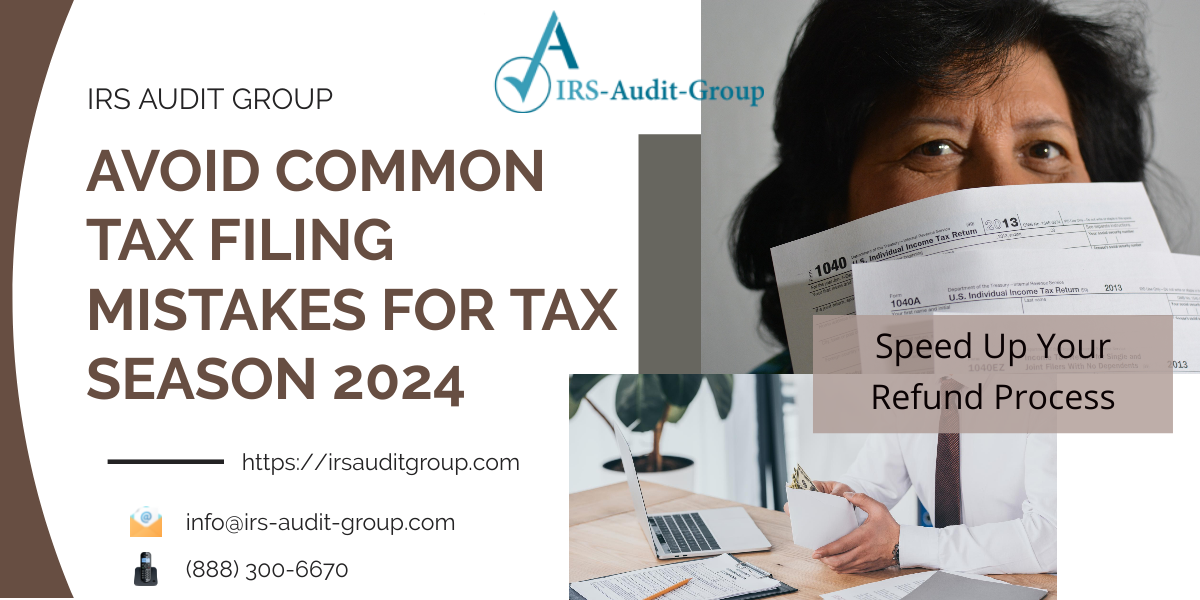
    Avoid Common Tax Filing Mistakes for Tax Season 2024 – IRS Guidance to Speed Up the Refund Process

    The Internal Revenue Service (IRS) has instructed taxpayers to avoid errors on their federal tax returns and expedite their refunds for the Tax Season. These guidelines aim to assist in submitting returns that are thorough, precise, and free of mistakes.  To help you navigate through Tax Season 2024 smoothly, here are some tips to avoid tax return mistakes and optimize your refund.


    GATHER ALL TAX DOCUMENTS

    Start gathering all necessary documents well before the 2024 tax filing deadline. This includes W-2 forms, 1099s, receipts for deductions, investment statements, and any other relevant financial documents. Having everything organized will make the tax preparation process much smoother and reduce the chances of overlooking important information.


    USE ELECTRONIC FILING

    The IRS recommends that taxpayers and their tax professionals leverage electronic filing channels, including IRS Free File or other certified e-file service providers. Furthermore, certain taxpayers in 12 States have the option to participate in the Direct File pilot program. Electronic filing offers the advantage of reducing mathematical inaccuracies and pinpointing potential tax credits or deductions for which the taxpayer may be eligible. It is imperative for taxpayers to conduct a thorough review of their tax returns to guarantee precision and compliance. Electing electronic filing and opting for direct deposit represent the most expeditious and secure methods to receive refunds.


    USE THE CORRECT FILING STATUS

    Tax software platforms are designed to mitigate errors by guiding users through the selection process of their tax return filing status. For this tax season 2024, individuals who are uncertain about their appropriate filing status can utilize the Interactive Tax Assistant available on IRS.gov. This tool aids individuals in determining the correct filing status, especially in situations where multiple statuses may be applicable.


    DOUBLE-CHECK PERSONAL DETAILS

    Taxpayers are required to provide precise information including the name, date of birth, and Social Security number (SSN) for each dependent listed on their individual income tax return. It is imperative that the SSN and individual’s name are entered accurately, reflecting the information as it appears on the Social Security card. In instances where a dependent or spouse does not possess an SSN and is ineligible to acquire one, an assigned Individual Taxpayer Identification Number (ITIN) should be furnished in place of the SSN.


    FILE YOUR DIGITAL ASSETS TRANSACTIONS

    All filers of Forms 1040, 1040-SR, 1040-NR, 1041, 1065, 1120, and 1120S must indicate their response to the digital asset question by selecting “Yes” or “No”. This question must be addressed by all taxpayers, irrespective of whether they participated in digital asset transactions during the tax year 2023. Furthermore, taxpayers are obligated to report all income derived from digital asset transactions.

    For comprehensive guidelines regarding when to affirm “yes” and instructions on reporting digital asset-related income, individuals are advised to refer to the IRS.gov Digital Assets section.


    REPORT ALL TAXABLE INCOME

    Failure to report income may result in penalties and interest. Income tax information can help prevent errors that slow down the process and help find missed deductions or credits. Taxpayers should have all their income information ready before they begin filing their taxes. IRS can even conduct tax audits on such filings and may ask for further documents or even visit the premises for field audits.


    DOUBLE CHECK ROUTING AND ACCOUNT NUMBERS

    Taxpayers have the flexibility to choose to have their federal income taxes deposited into one, two, or three accounts of their choice. Bank documentation containing correct numbers and account numbers is important, especially when a refund is required, to reduce the risk of delays or the refund being sent to an undesirable location. Taxpayers also have the opportunity to use their refunds to purchase US Savings Bonds, thus making the most of their tax refunds.


    SIGN AND DATE THE TAX FILINGS

    If filing a joint tax return, both spouses must sign and date the document. For those independently preparing and electronically submitting their taxes, authentication involves entering the adjusted gross income (AGI) from the previous year. Taxpayers seeking guidance can consult resources like “Validating Your Electronically Filed Tax Return” for assistance with any questions they may have.


    ACCURATE MAILING ADDRESS

    Taxpayers and tax professionals are urged to opt for electronic filing whenever possible. However, if a paper tax return must be submitted, it’s vital to confirm the accurate mailing address. This verification can be carried out on the official IRS website, IRS.gov, or by referring to the instructions provided with Form 1040. This precautionary step is essential for minimizing processing delays caused by incorrect mailing addresses.


    KEEP A COPY

    After completing their tax filing, individuals should proactively produce duplicates of their signed returns and any accompanying schedules for their records. Maintaining these copies simplifies future tax preparations and assists in revising calculations, especially when filing amended returns. Moreover, it is recommended that taxpayers hold onto records supporting their reported income, deductions, or credits until the statutory period for that specific tax return expires. This proactive approach ensures adherence to regulatory standards and streamlines potential inquiries or audits by tax authorities.


    IRS AUDIT GROUP

    IRS Audit Group consists of tax professionals, CPAs, enrolled agents, and tax attorneys.  We are located in Los Angeles; California and our primary area of expertise is IRS Tax Audit Representation.  However, our certified professionals cooperate and work with all IRS offices across the country.  Please contact us for more information.  https://irsauditgroup.com/contact/

    Telephone Number: (310) 498-7508

    info@irs-audit-group.com
    Read more
    IRS blog on tax relief and Filing Extension

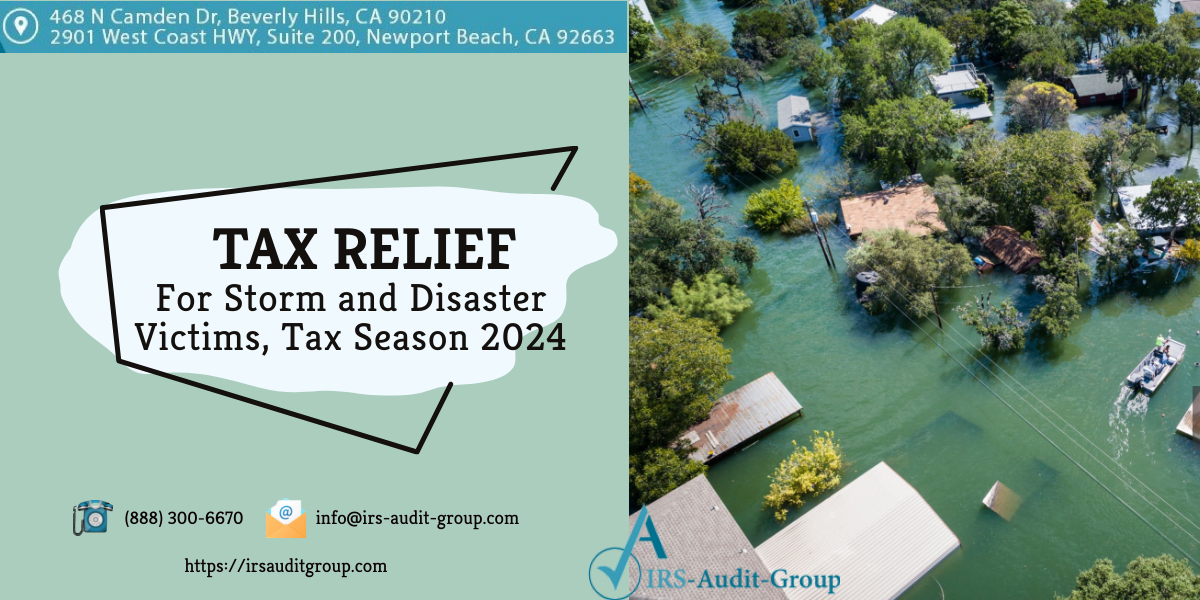
    How to Claim Tax Relief Measures in Tax Season 2024 for the Storm and Disaster Victims in Federally Declared Disaster Areas

    Every year, based on the Federal Emergency Management Agency’s (FEMA) federally declared disaster areas, the IRS will implement administrative disaster tax relief measures. For the Tax Season 2024, the IRS made special tax law provisions to provide affected individuals and businesses with additional time to file returns, pay taxes, and complete other time-sensitive tasks. This assistance is specifically tailored for taxpayers who are affected by a disaster declared at the federal level, guaranteeing that they receive essential assistance during difficult circumstances. It is important to note that certain conditions may need to be met in order to qualify for the tax relief and provisions offered by the IRS. By following the established procedures and guidelines, disaster victims can benefit from the assistance provided by the government to alleviate the financial burden caused by the disaster.


    The relief for the tax season 2024 extends the deadlines for filing and paying taxes that fell between Sept. 10, 2023, and June 17, 2024. This means that individuals and businesses affected in the disaster regions will now have until June 17, 2024, to submit their returns and settle any outstanding taxes from this period.


    Who Qualifies for the Extension in Tax Season 2024?

    In order to be eligible for an extension on filing your taxes, it is required that you are a resident or business situated in a region identified by the Federal Emergency Management Agency (FEMA) as a federally declared disaster area. This encompasses not only the main area impacted by the disaster but also the surrounding areas that have been affected.


    Furthermore, the IRS is prepared to collaborate with any taxpayer residing outside the disaster zone but whose essential records are required to comply with a deadline falling within the extension period are situated in the impacted region. Taxpayers eligible for assistance and residing beyond the disaster zone must reach out to the IRS at 866-562-5227 for further guidance and support. This provision also encompasses individuals who participated in relief efforts and are associated with a reputable governmental or charitable institution.


    What is included in the Extension?

    Extension generally encompasses a range of tax deadlines, which can include filing income tax returns, making quarterly estimated income tax payments, and submitting different business tax returns. Additionally, extension can be utilized for other tax-related tasks, like requesting an extension for an individual tax return or making contributions to an IRA. The June 17, 2024, deadline will now apply to the following activities.

    • Individual income tax returns and payments normally due on April 15, 2024.
    • 2023 contributions to IRAs and health savings accounts for eligible taxpayers.
    • 2023 quarterly estimated income tax payments normally due on Sept. 15, 2023, and Jan. 16, 2024.
    • Quarterly payroll and excise tax returns normally due on Oct. 31, 2023, and Jan. 31 and April 30, 2024.
    • Calendar-year partnership and S corporation returns normally due on March 15, 2024.
    • Calendar-year corporation and fiduciary returns and payments normally due on April 15, 2024.
    • Calendar-year tax-exempt organization returns normally due on May 15, 2024.


    How to Claim the Extension?

    Taxpayers residing in a federally declared disaster area who qualify for the extension do not have to take any action to receive it. The IRS will recognize individuals located in the designated disaster zone and grant them an extension on their tax deadlines without requiring any additional steps. In the event that you receive a penalty notification from the IRS due to late filing or payment of taxes, you have the option to contact the phone number provided on the notice to request a waiver of the penalty.


    The tax relief measures have been implemented as a component of a well-coordinated federal initiative aimed at addressing the extensive harm inflicted by these calamities. These measures have been devised after careful evaluation of the local damage assessments conducted by FEMA, ensuring that the relief efforts are targeted toward the areas most affected by the disasters.


    IRS Audit Group

    IRS Audit Group consists of tax professionals, CPAs, enrolled agents, and tax attorneys.  We are located in Los Angeles; California and our primary area of expertise is IRS Tax Audit Representation.  However, our certified professionals cooperate and work with all IRS offices across the country.  Please contact us for more information.  https://irsauditgroup.com/contact/

    Telephone Number: (310) 498-7508

    info@irs-audit-group.com

    Read more
    Tax Season 2023 deadline

    2023 Tax Season Starts from January 23, 2023 – What are the Important Deadlines Taxpayers and Tax Professionals Need to Know in Tax Filing

    The Internal Revenue Service (IRS) will begin accepting tax filings on January 23, 2023. This time IRS has hired more employees to help the taxpayers for a seamless experience. Taxpayers can contact IRS customer representatives through telephone and online tools as given in this link. People can also visit the IRS official website to check on the basic question under the FAQ section before contacting the customer representative team.

    IRS Free Service Programs

    IRS has various free services to help taxpayers with tax filing.

    • The IRS’s Volunteer Income Tax Assistance and Tax Counselling for the Elderly programs are few that offer free basic tax return preparation to qualified individuals. Eligibility for the same can be checked on the above links.
    • IRS Free File Program also opened on Jan 13, 2023. The service providers in this program will accept completed returns and file them electronically once it is open on Jan 23. This free file program is available only for taxpayers with AGI (Adjusted Gross Income) of $73,000 or less in 2022.
    • For people in the service like the military community, the department of defense provides a free tax resource called MilTax. It includes software for tax preparation and electronic filing. It offers individualized assistance from tax advisers and up-to-date tax filing information. With MilTax, qualified taxpayers can file a federal tax return and up to three state taxes electronically for free.

    Many software providers and tax professionals are already preparing taxpayers’ returns and will file them once the window is open. Therefore, IRS advises taxpayers to choose their tax professionals wisely. There are various types of tax return preparers, including enrolled agents, certified public accountants, tax attorneys, and others who don’t have professional credentials. It has even provided guidelines on selecting tax preparers through this link.

    Importance of IRS Tax Credits

    The IRS recommends individuals and tax professionals review their tax situations, so they don’t miss out on important tax credits like Earned Income Tax Credit (EITC) and Additional Child Tax Credit (ACTC). IRS even set an awareness day on Jan 27, 2023, to make them understand the benefits of the EITC program. EITC helps low- and moderate-income workers and families.

    Information on IRS Refunds

    Taxpayers are advised to collect and submit accurate information for error-free returns filing. This will avoid delays in processing refunds if any. If taxpayers choose direct deposit and there are no issues with their tax return, then IRS expects that most taxpayers will get their refund within 21 days of filing electronically. But taxpayers with EITC and ACTC will receive their refunds in mid-February due to processing time in identifying fraudulent refunds under the 2015 PATH Act. Taxpayers can check their refund status through Where’s My Refund? Link. This link will show an updated status by February 18, 2023, for early EITC/ACTC filers. Further, individuals can securely log in to their IRS Online Account to access personal tax account information, such as the balance, payments made, and tax records, including adjusted gross income.

    National Due Date to File a 2022 Tax Return

    This year the due date for tax season 2023 will be April 18, instead of April 15, unlike last year. Weekends and the District of Columbia’s Emancipation Day holiday affect the deadline, and thus the extension is given for the individuals. The taxpayers also need to file for an extension before Apr 18, if they need time to file the tax returns. Taxpayers requesting an extension will have until Monday, October 16, 2023, to file.

    Key Deadlines to Remember

    Jan 13 IRS Free File opens
    Jan 23 IRS begins the 2023 tax season and starts accepting to process individual 2022 tax returns.
    Jan 27 EITC Awareness Day
    Apr 18 Deadline for 2022 tax return or request an extension
    Oct 16 Due date to file 2022 tax returns who is requesting an extension


    IRS Audit Group

    IRS Audit Group consists of tax professionals, CPAs, enrolled agents, and tax attorneys. We are located in Los Angeles; California and our primary area of expertise is IRS Tax Audit Representation. But our certified professionals cooperate and work with all IRS offices across the country. Please contact us for more information. https://irsauditgroup.com/contact/

    Telephone Number: (310) 498-7508

    info@irs-audit-group.com

    Read more
    Exempt Organizations and Deadline for Filing IRS Returns

    Exempt Organizations and Deadline for Filing IRS Returns for Tax Exempt Organizations for the Tax Season 2022

    The Section 501(c)(3) Internal Revenue Code specifies that any Tax-exempt organizations need to be organized and operated exclusively for exempt purposes. Also, it needs to ensure that none of its earnings inure to any private shareholder or individual.  In this context, the private inurement means that the assets of the organization must not be used to benefit a single person excessively.

    Here are a few types of Exempt Organizations.

    • Charitable Organizations
    • Churches and Religious Organizations
    • Private Foundations
    • Political Organizations
    • Other Non-profits

      The IRS requires most tax-exempt organizations to file annual tax returns. Even though most tax-exempt non-profit organizations do not pay federal taxes, these entities are required to file an informational return with the IRS.  Hence, such entities need to file their IRS return for this tax season 2022.

     The annual reporting return for tax-exempt organizations is referred to as a Form 990. Most of the tax-exempt organizations need to file an annual return, and it can be done electronically. The financial activity of an organization determines which form it must file, as shown in the chart below.

    Status Form to File
    Gross receipts normally ≤ $50,000 990-N
    Gross receipts < $200,000, and Total assets < $500,000 990-EZ or 990
    Gross receipts ≥ $200,000, or Total assets ≥ $500,000 990
    Private foundation – regardless of financial status 990-PF

     The deadline for the tax season 2022 has been fixed as May 16 to file IRS return by the tax-exempt organizations. Taxpayers who need more time to file beyond the May 16 deadline can request Form 8868 which is the Application for Extension of Time to File an Exempt Organization Return. This form will provide a 6-month automatic extension. Extending the time to file a return does not extend the deadline to pay tax in circumstances where tax is payable. Organizations requesting an extension are encouraged to complete Form 8868 electronically, according to the IRS.

    Extended Support From IRS

    IRS helps taxpayers, board members, volunteers, and officers in filling returns to comply with their tax filing obligations. Therefore, it lists few modernized e-File (MeF) providers who have passed the IRS Assurance Testing System (ATS) requirements for Software Developers of electronic Exempt Organizations. The list of such service providers can be found using the below IRS webpage

    https://www.irs.gov/charities-non-profits/tax-year-2021-exempt-organizations-modernized-e-file-mef-providers

    IRS Audit Group is a Tax Audit Representation firm in Los Angeles, California. We are a team of tax attorneys having hands-on experience in dealing with IRS audit process. We help you file your tax return for 2022 complying with all obligations and represent you on IRS audit. Contact us to get free consultation to understand your issues. https://irsauditgroup.com/contact/

    Telephone Number: (310) 498-7508

    Email address: info@irs-audit-group.com

    Read more
    IRS on FABR

    IRS Tax Guidelines for Foreign Bank and Financial Accounts

    What is FBAR?

    According to the Bank Secrecy Act, one must declare and keep records of certain foreign financial accounts, such as bank accounts, brokerage accounts, and mutual funds, to the Treasury Department every year. The accounts are reported on a Financial Crimes Enforcement Network (FinCEN) Form 114 called a Report of Foreign Bank and Financial Accounts (FBAR). The annual due date for filing FBARs for foreign financial accounts is April 15th of every year.

    Who must file FBAR?

    A citizen, resident, corporation, partnership, limited liability company, trust, or estate in the United States must file an FBAR to report if they have a financial interest in or signature or other authority over at least one financial account located outside the United States and its aggregate value of those foreign financial accounts exceeded $10,000 at any time during the calendar year reported.

    However, you are exempt from reporting foreign financial accounts if they are:

    • Correspondent/Nostro accounts
    • Owned by a governmental entity
    • Owned by an international financial institution
    • Maintained a U.S. military banking facility,
    • Held in an individual retirement account (IRA) of which you’re an owner or beneficiary,
    • Held in a retirement plan of which you’re a participant or beneficiary, or
    • Part of a trust of which you’re a beneficiary,  if a U.S. person (trust, trustee of the trust or agent of the trust) files an FBAR reporting these accounts.

    Further taxpayers don’t have to file an FBAR for the tax year 2022 if you meet the following criteria:

    • All your foreign financial accounts are reported on a consolidated FBAR, or
    • You jointly own all your foreign financial accounts with your spouse and:
      • You completed and signed FinCEN Form 114a authorizing your spouse to file on your behalf, and your spouse reports the jointly owned accounts on a timely-filed signed FBAR.

    Note: Your eligibility for this exception is unaffected by your filing status, such as married-filing-jointly or married-filing-separately.

    How to file the FBAR?

    The FBAR must be filed online using FinCEN’s (Financial Crimes Enforcement Network) BSA E-Filing System. The FBAR is not filed with the federal tax return. You need to call FinCEN’s Resource Centre to request an exemption from e-filing if you want to file your FBAR on paper. If FinCEN authorises your request, you will get a printed FBAR form to fill out and mail to the IRS.

    If you wish someone else to file your FBAR on your behalf, fill out FinCEN Report 114a, Record of Authorization to Electronically File FBARs, and provide it to them. FinCEN Report 114a is not submitted with the FBAR; instead, retain it for your records and make it available to FinCEN or the IRS upon request.

    Deadline to file for the Tax year 2021

    The FBAR is an annual report that is due on April 15 of the year reported. If taxpayers miss the FBAR annual due date of April 15, they will get an automatic extension until October 15. To file the FBAR, you do not need to request an extension.

    More information related FBAR filing and other resources available on the IRS website here – https://www.irs.gov/businesses/small-businesses-self-employed/report-of-foreign-bank-and-financial-accounts-fbar

    IRS Audit Group are a team of Tax Professionals, CPAs, Enrolled Agents and Tax Attorneys, primarily specializing in Internal Revenue Services (IRS) Tax Audit Representation. We resolve your tax audit issues and represent on behalf of you to the IRS. Call us to get free consultation from our tax professional to understand our Tax audit concerns.

    Telephone Number: (310) 498-7508

    Email address: info@irs-audit-group.com

    Read more

    RELEVANE OF ACCOUNT AUDIT AND MULTIPLE TYPES OF AUDITS

    audit

    There are multiple purposes for auditing of any enterprise.  It is mandatory for all publicly listed companies to audit their financial statements, and subsequently make it available to the public.   Audited financial statements can be used for improving internal controls or for assessing the financial position or performance of an entity.  The elements of financial transparency which results out of audit help in establishing a good relationship with investors and the company.

    While preparing for an audit, it’s important to set internal controls and policies that are monitored and reviewed by the internal audit team.  The auditing group which performs such audit collects substantial information relevant to the enterprise, and issues statement or opinion about the quality and integrity of the company’s operations and financial status.  During the statutory audit, the auditor has to review the processes and procedures by which the financial information was prepared.  That is, the auditor has to check if the preparation of the company’s financial reports is aligned with GAAP or other applicable reporting frameworks.  Statutory audits underscore the importance of financial reporting in corporate transparency.

    There are multiple types of audit as elaborated below;

    Financial – Financial audits typically look into the accounting controls present in the general ledger or sub-ledger systems.  Financial statement auditing is the focus of our external auditors.

    Operational – Operational audits focus on the review and assessment of a business process.  The activities of the business process may result in a direct or indirect financial impact on the organization.  Internal Audit primarily focuses on operational audits but can extend the scope to include accounting procedures that can impact financial reporting.

    Compliance – Compliance audits review the level of compliance with internal policies or external regulatory requirements.

    Information Systems – Audits of Information Systems look at the overall infrastructure and network controls that relate to the security of the network and the systems.  Such audit includes technical operations, data center operations, project management procedures, and application controls.

    Integrated Audits – Integrated audits look at controls that address financial, operational, compliance and information systems risks.  These audits are typically centered on a business cycle or a specific part of a process.

    Auditors protect the public from investing in companies that use corrupt business practices or that attempt to defraud investors with false financial statements.  They also provide assurance to investors and creditors that company funds are handled appropriately.  By reviewing financial statements and digging into accounting records, auditors can determine if the financial statements and records accurately depict the company’s true financial profile.

    Telephone Number: (310) 498-7508
    info@irs-audit-group.com

    Read more

    IRS Audit Group

    Tax attorney in Beverly Hills, California

    468 N Camden Dr #200,
    Beverly Hills, CA 90210, USA

    Call: +1 310 498 7508

    Hours

    Sunday8:00am-5:00pm Monday8:00am-10:00pm Tuesday8:00am-10:00pm Wednesday8:00am-10:00pm Thursday8:00am-10:00pm Friday8:00am-10:00pm Saturday8:00am-10:00pm