
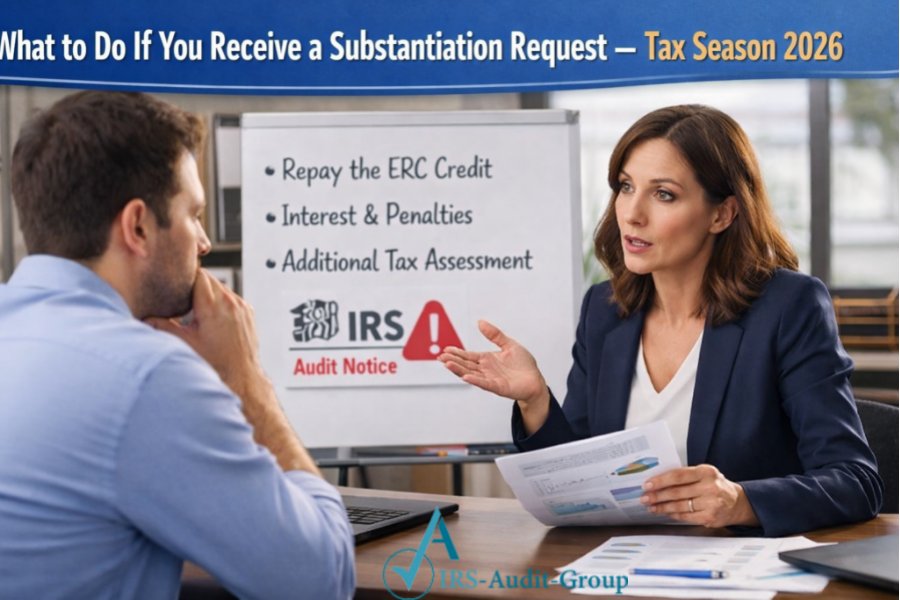
As Tax Season 2026 approaches, the Internal Revenue Service (IRS) has intensified its focus on reviewing Employee Retention Credit (ERC) claims. Over the past several years, the ERC program has helped thousands of businesses recover from the economic impact of the COVID-19 pandemic. However, the IRS has also identified a significant number of incorrect or potentially fraudulent claims, leading the agency to prioritize compliance reviews and documentation requests.
Many taxpayers who filed ERC claims may now receive IRS notices requesting documentation to support those claims. These notices are commonly called substantiation requests. They are part of the IRS process for verifying that a claim meets eligibility requirements under federal tax law.
Understanding why the IRS is focusing on ERC claims—and how taxpayers should respond to substantiation requests—can help businesses avoid penalties, claim disallowances, and repayment demands.
Understanding the Employee Retention Credit
The Employee Retention Credit was created during the COVID-19 pandemic to help employers keep workers on payroll. The credit was introduced under the CARES Act and later expanded through additional relief legislation.
Eligible employers could claim the credit if they experienced either:
- A significant decline in gross receipts, or
- A full or partial suspension of operations due to government orders related to COVID-19.
The credit allowed businesses to claim refundable payroll tax relief based on qualified wages paid to employees during specific periods in 2020 and 2021. Taxpayers who did not originally claim the credit could later file an amended payroll tax return to request the refund. This is typically done using Form 941-X, which allows employers to correct previously filed employment tax returns. Official ERC eligibility guidance can be reviewed on the IRS website:
https://www.irs.gov/coronavirus/employee-retention-credit.
Why the IRS Is Prioritizing ERC Claims in Tax Season 2026
Because the credit could be worth up to $26,000 per employee, it quickly became one of the largest pandemic-era tax relief programs for businesses.
High Volume of Questionable Claims
The IRS has warned that a significant number of ERC claims may not meet eligibility requirements. Many claims were submitted after aggressive marketing campaigns promoted the credit to businesses that may not have qualified. Some third-party promoters encouraged companies to claim ERC refunds based on incomplete or incorrect interpretations of IRS rules. These promoters often charged large contingency fees tied to the refund amount. Due to this widespread activity, the IRS has increased compliance efforts to verify claims and identify improper filings. Official IRS guidance about ERC compliance concerns can be found here:
https://www.irs.gov/newsroom/businesses-should-review-employee-retention-credit-rules-and-resolve-incorrect-claims-soon
Large Backlog of ERC Claims
Millions of ERC claims were filed after the program was introduced. This created a substantial processing backlog for the IRS. To address the backlog, the agency implemented new risk-review procedures. Claims are now screened more closely before refunds are approved. In many cases, the IRS may request documentation before releasing funds. As the IRS continues to work through these claims, ERC reviews have become a major enforcement priority leading into Tax Season 2026.
Increased Fraud Risk
The IRS has also identified patterns suggesting potential fraud or widespread eligibility errors. Some claims included incorrect wage calculations. Others claimed the credit without meeting the required revenue decline or shutdown conditions. To protect the tax system, the IRS has expanded enforcement initiatives targeting improper ERC claims.
Additional IRS warnings regarding incorrect ERC filings can be reviewed here:
https://www.irs.gov/newsroom/irs-shares-new-warning-signs-of-incorrect-claims-for-employee-retention-credit
What do IRS ask in a Substantiation Request?
A substantiation request is part of the IRS review process and does not automatically mean the claim is incorrect. The IRS simply needs evidence confirming that the taxpayer meets the program’s eligibility requirements. Substantiation requests typically ask for records such as:
- Payroll records showing qualified wages
- Financial statements demonstrating revenue declines
- Copies of government shutdown orders affecting business operations
- Employment tax filings used to claim the credit
- Documentation showing that wages were not used for multiple tax relief programs
Providing complete and accurate documentation helps the IRS verify the claim and move the review forward.
Steps Taxpayers Should Take After Receiving a Substantiation Request
Review the IRS Notice Carefully
The first step is to read the IRS notice thoroughly. Each request explains the information required and provides instructions for submitting documents. Taxpayers should also review the response deadline included in the notice. Missing the deadline could delay the review or lead to claim denial.
Gather Supporting Documentation
Taxpayers should collect all records related to the ERC claim before responding. This documentation should clearly demonstrate eligibility under IRS rules. Important records may include:
- Quarterly financial statements showing revenue trends
- Payroll records detailing qualified wages
- The government orders that restricted business operations
- Original payroll tax filings and amended returns
Organized documentation helps ensure the response addresses the IRS request completely.
Review the Accuracy of the Claim
In some cases, taxpayers may discover that their ERC claim contains errors. The IRS encourages businesses to review claims carefully and correct mistakes when necessary.
If a claim appears inaccurate, taxpayers may explore options to amend or resolve the issue before enforcement actions escalate. IRS information on resolving incorrect ERC claims can be reviewed here:
https://www.irs.gov/newsroom/businesses-should-review-employee-retention-credit-rules-and-resolve-incorrect-claims-soon
Submit the Response on Time
Timely responses are critical. If the IRS does not receive the requested documentation by the deadline, the agency may disallow the ERC claim. Submitting a complete response within the timeframe helps taxpayers avoid unnecessary complications.
Potential Consequences of Unsupported ERC Claims
If taxpayers cannot provide sufficient documentation supporting their claim, the IRS may deny the credit and require repayment of any refund already issued.
Additional consequences may include:
- Repayment of the ERC refund
- Interest on the refunded amount
- Accuracy-related penalties
- Additional tax assessments
Businesses that relied on aggressive ERC promoters may face unexpected financial exposure if claims cannot be substantiated.
Preparing for IRS ERC Reviews During Tax Season 2026
Because ERC enforcement will remain a major focus during Tax Season 2026, taxpayers should review their records now to ensure documentation is complete. Businesses should confirm that they can demonstrate eligibility through revenue records, payroll data, and documentation of government shutdown orders. Maintaining organized records will help taxpayers respond quickly if the IRS issues a substantiation request.
How Tax Professional Assistance Can Help During an ERC Review
Responding to an IRS substantiation request can be complex, especially when the IRS requires detailed payroll records, eligibility analysis, and documentation supporting an ERC claim. In many cases, taxpayers benefit from working with experienced tax professionals who understand IRS procedures and documentation requirements.
IRS Audit Group specializes in helping taxpayers navigate IRS compliance reviews, including Employee Retention Credit documentation requests. Their team assists businesses by reviewing ERC claims, organizing supporting records, and preparing formal responses to IRS notices. They also help evaluate whether a claim meets IRS eligibility standards and provide guidance if corrections or additional documentation are required.
By working with tax professionals familiar with IRS audit processes, taxpayers can ensure their responses are accurate, complete, and aligned with current IRS guidelines. This type of support can help reduce the risk of claim denial, penalties, or extended IRS examinations.
Please get in touch with us for more information.
Telephone Number: (310) 498-7508